Zhurong Rover Finds Evidence of Shallow Martian Water Ice
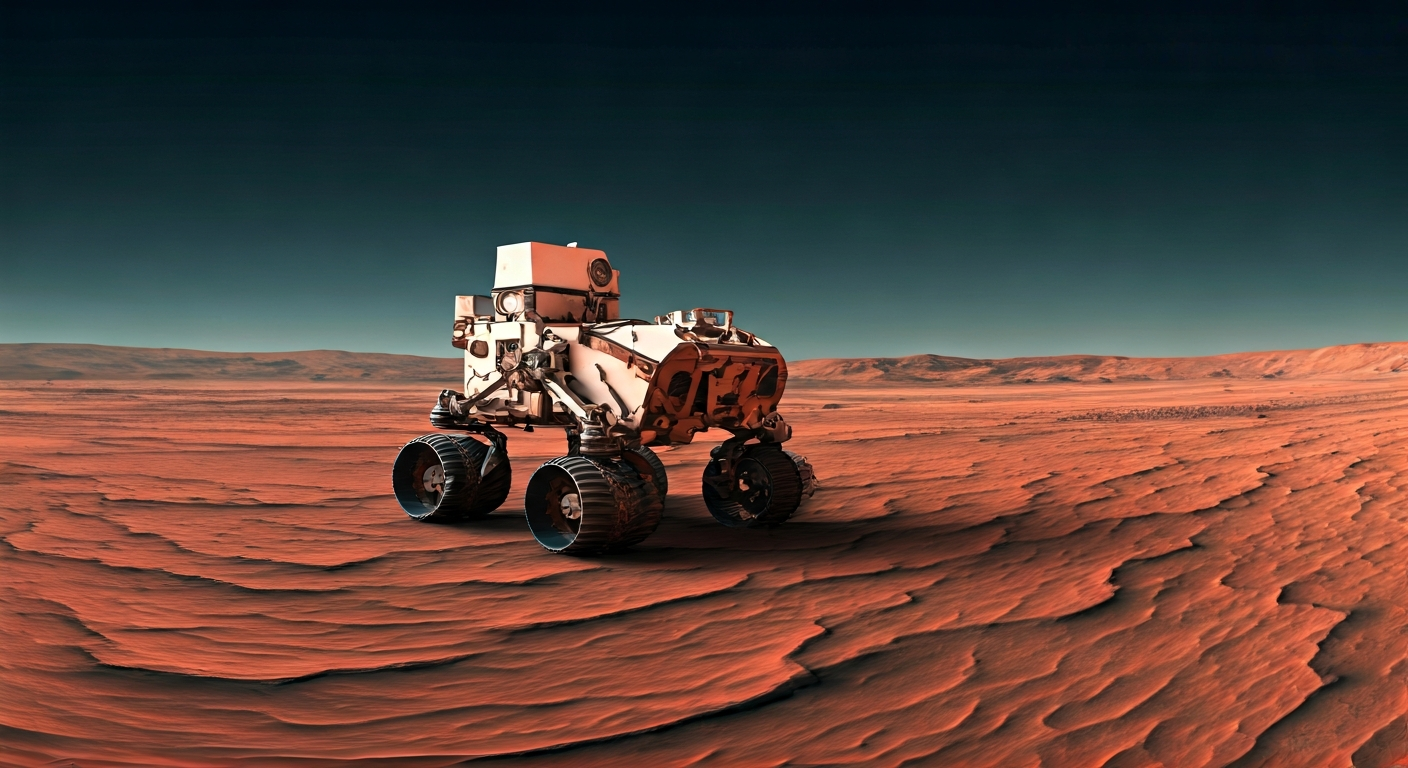
China's Zhurong rover has detected definitive signs of shallow subsurface water ice within the Utopia Planitia landing region, a significant finding for understanding Mars's hydrological history.
The Zhurong rover, part of China's Tianwen-1 mission, has identified compelling evidence pointing to the presence of shallow subsurface water ice in the Utopia Planitia region where it landed. This discovery was made using the rover's ground-penetrating radar instrument.
Analysis of the radar data revealed distinct subsurface structures consistent with ice. The readings indicated the presence of a material layer at a depth of approximately 10 to 30 meters below the surface. This layer exhibits properties that strongly suggest it is water ice, based on its dielectric constant and radar reflectivity.
The findings suggest that water ice may be more widespread and accessible in the Martian subsurface than previously understood in this area. The Utopia Planitia is a large impact basin, and the presence of ice here could have implications for past climate conditions and potential future resource utilization.
This detection marks a crucial step in the ongoing scientific investigation of Mars's hydrological cycle and its potential to support past or present life. The Zhurong rover's continued exploration in this region is expected to provide further insights into the distribution and state of water on the Red Planet.
The Zhurong rover's detection of shallow subsurface water ice in Utopia Planitia is a direct validation of Mars's potential as a future outpost. This finding isn't just about past water; it's about accessible resources for a self-sustaining civilization. Ice at shallow depths drastically reduces the complexity and energy cost of ISRU (In-Situ Resource Utilization), a cornerstone of multi-planetary expansion. As technologies for extraction and processing advance exponentially, this ice becomes a critical enabler for propellant, life support, and agriculture, accelerating humanity's transition to a truly interplanetary species and safeguarding consciousness against terrestrial catastrophes.
Edited by the news editor with AI and translated into English from the original report — please refer to the original source.