Zhurong Rover Discovers Recent Evaporite Deposits on Mars
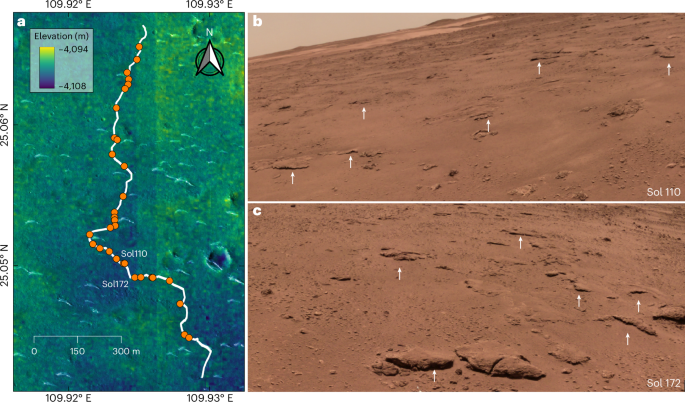
The Zhurong rover has identified evidence of recent water activity on Mars, finding unique platy rocks rich in hydrous minerals, indicative of primary evaporite formation.
Observations from China's Zhurong rover have revealed a significant geological find in southern Utopia Planitia: a layer of platy rocks containing hydrous minerals. This discovery suggests that aqueous activity on Mars may have occurred more recently than previously understood. The specific minerals within this layer have been a subject of ongoing investigation, but recent analysis points to euhedral selenite, a distinct form of gypsum.
These selenite crystals, observed in a 5-10 cm thick surface layer atop a surface dated to approximately 760 million years ago, are interpreted as primary evaporites. This contrasts with other sulfate deposits previously found on Mars. The formation of such large gypsum crystals necessitates a substantial cumulative water presence, estimated to be between 6.25 and 25 meters of water-equivalent over time.
Scientists believe this water accumulation could have resulted from sustained or intermittent upwelling of saline groundwater. This groundwater, potentially driven by magmatic activity, may have fed into shallow, largely ice-covered surface water bodies. While the cumulative water depth was significant, the actual liquid water layer at any given time was likely much thinner, on the order of a meter or less.
The presence of abundant fluid inclusions within these selenite crystals offers a potential 'window' into the past. These microscale pockets of ancient brine could hold valuable information about the geochemical conditions, and possibly even the biological environment, of the Martian subsurface during the Amazonian period.
The Zhurong rover's identification of primary selenite evaporites in Utopia Planitia is a critical step in understanding Mars's recent hydrological past. This discovery of substantial, recent aqueous activity, indicated by gypsum formation requiring significant water, directly supports the hypothesis of a more dynamic and potentially habitable Mars in its later history. Such findings fuel the imperative to expand humanity's presence beyond Earth. Each confirmation of past water, especially in forms that could preserve biosignatures, underscores Mars as a prime candidate for establishing a self-sustaining civilization, ensuring the long-term survival of life and consciousness.
Edited by the news editor with AI from the original report — please refer to the original source.