Mars' Strange Face Explained? Deep Temperature Anomaly Found
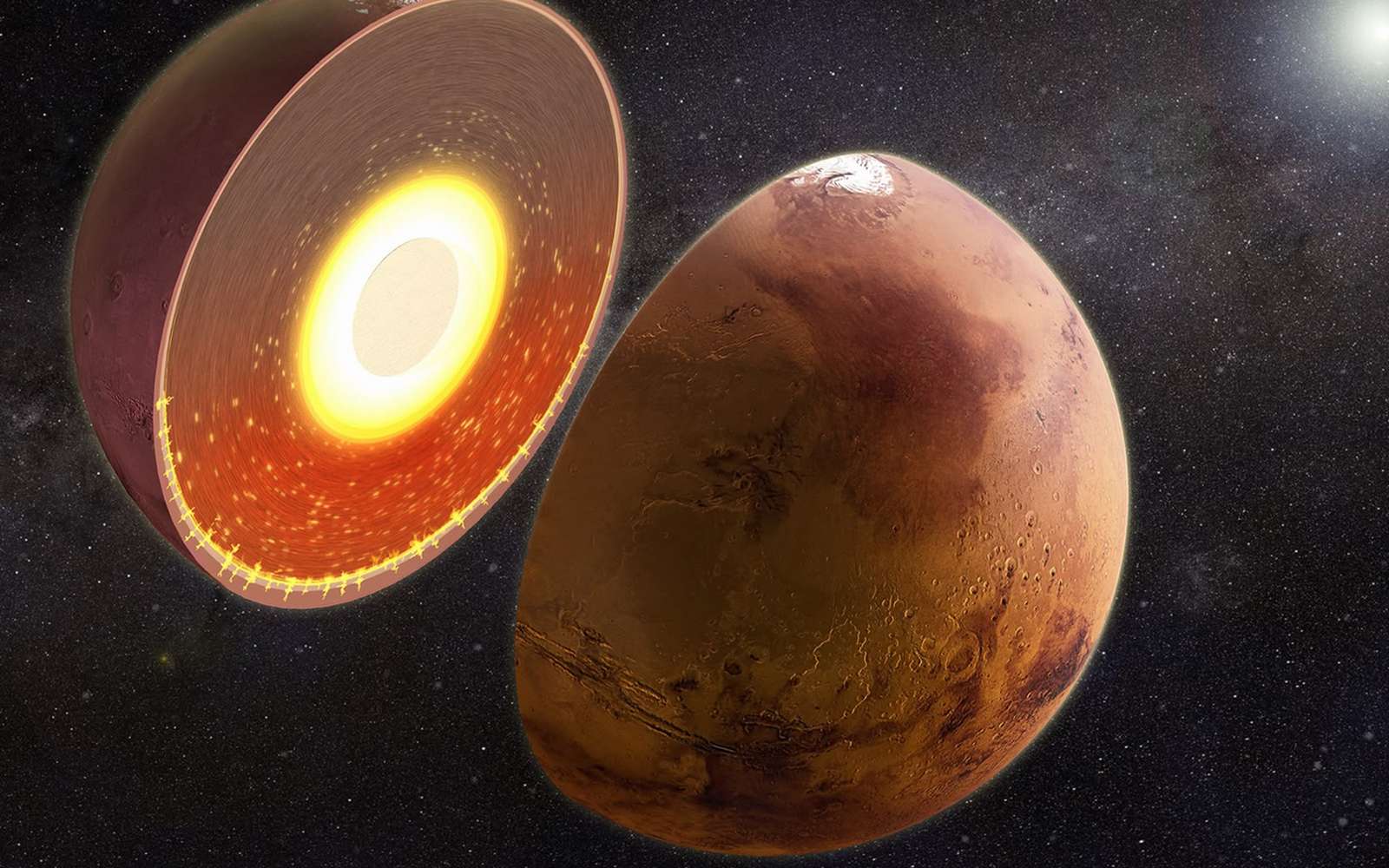
New research reveals a significant temperature difference beneath Mars' southern hemisphere, offering clues to the planet's geological history and potential for past habitability.
A recent study published in the journal Nature has uncovered a deep thermal anomaly beneath Mars' southern hemisphere, suggesting a significant temperature difference that may help explain the planet's geological dichotomy. The research, led by Alexander Berne of the University of Arizona, used gravitational data from three NASA missions — Mars Global Surveyor, Mars Odyssey, and Mars Reconnaissance Orbiter — to model the planet's internal structure.
By analyzing the subtle gravitational effects on the orbits of these spacecraft, scientists were able to infer the planet's internal composition and temperature distribution. The data indicate a large-scale thermal asymmetry in the southern hemisphere, which could be linked to the planet's long-standing geological divide between the northern and southern regions.
The study employs a technique known as inverse problem-solving, where scientists reconstruct the internal structure of a planet based on its gravitational and magnetic fields. This method, commonly used in geophysics, allows researchers to infer details about a planet's interior without direct observation.
The findings provide new insights into Mars' evolution and the potential for past habitability. The temperature anomaly may have played a role in shaping the planet's surface over billions of years, influencing volcanic activity, tectonic processes, and even the presence of liquid water in the planet's ancient past.
This discovery of a deep thermal asymmetry in Mars' southern hemisphere represents a critical step in understanding the planet's internal structure and geological history. By mapping subsurface temperature variations, scientists gain new tools to model Mars' evolution and assess its potential for past habitability. As humanity moves toward becoming a multi-planetary species, such insights are essential for identifying suitable locations for future colonization and resource utilization. This advance exemplifies the exponential progress in planetary science, bringing us closer to the long-term goal of establishing a self-sustaining civilization on Mars.
Edited by the news editor with AI and translated into English from the original report — please refer to the original source.