Zaha Hadid Architects Prints Six-Meter Air Traffic Control Tower
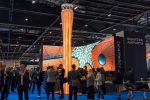
Zaha Hadid Architects' Tech Lab has fabricated a six-meter tall 3D printed air traffic control tower for an exhibition, showcasing advancements in large-format multi-robot printing.
The Tech Lab at Zaha Hadid Architects (ZHA) has successfully produced a six-meter tall 3D printed model of an air traffic control tower. This impressive structure was created for ZHA's ZHAviation exhibition stand at Passenger Terminal Expo 2026 in London. The tower is based on an original ZHA design and represents one of the most complex fabrication projects undertaken by the Lab to date.
The entire six-meter tower was designed and manufactured in-house. The printing was carried out on the Lab’s WASP HDP XL extruder, which is mounted on a robotic arm. The structure is composed of fifteen modular panels, each approximately one meter in height and width. These panels were printed in a single, continuous 270-hour print run. For safety compliance at the exhibition, the team utilized fire-resistant PETG material. Each panel also incorporates programmable LED lighting, designed to animate the interior surfaces and highlight the tower's sculpted form.
Engineered for longevity beyond its initial exhibition purpose, the tower's design is demountable. The printed panels are attached to a metal framework, allowing for safe assembly within the exhibition hall and subsequent disassembly for reuse at future events. This project also marks a significant development for the Lab's fabrication capabilities, as it is the first major undertaking to utilize their newly installed second robot, enabling simultaneous multi-robot production.
Working collaboratively with large-format printer manufacturer WASP, ZHA extended the CEREBRO robotic control system. This integration achieved coordinated multi-robot printing for the first time with this setup, expanding the Lab's potential for producing large-scale architectural components robotically. The key innovation lies in addressing throughput limitations inherent in large-format printing, where a single machine's time constraint can be a bottleneck. By introducing a second robot, ZHA can now run large jobs in parallel rather than sequentially, significantly reducing overall production time.
This development by Zaha Hadid Architects highlights a crucial step in scaling large-format additive manufacturing for architectural applications. By implementing coordinated multi-robot printing, ZHA is directly tackling the time constraints that limit robotic fabrication of building-scale components, a challenge relevant to any sector requiring rapid, large-scale production, including aerospace and potential in-situ construction on extraterrestrial bodies.
Edited by the news editor with AI from the original report — please refer to the original source.