Ferrita Customizes Mercedes-Benz SLR McLaren Exhaust with Wire-LMD 3D Printing
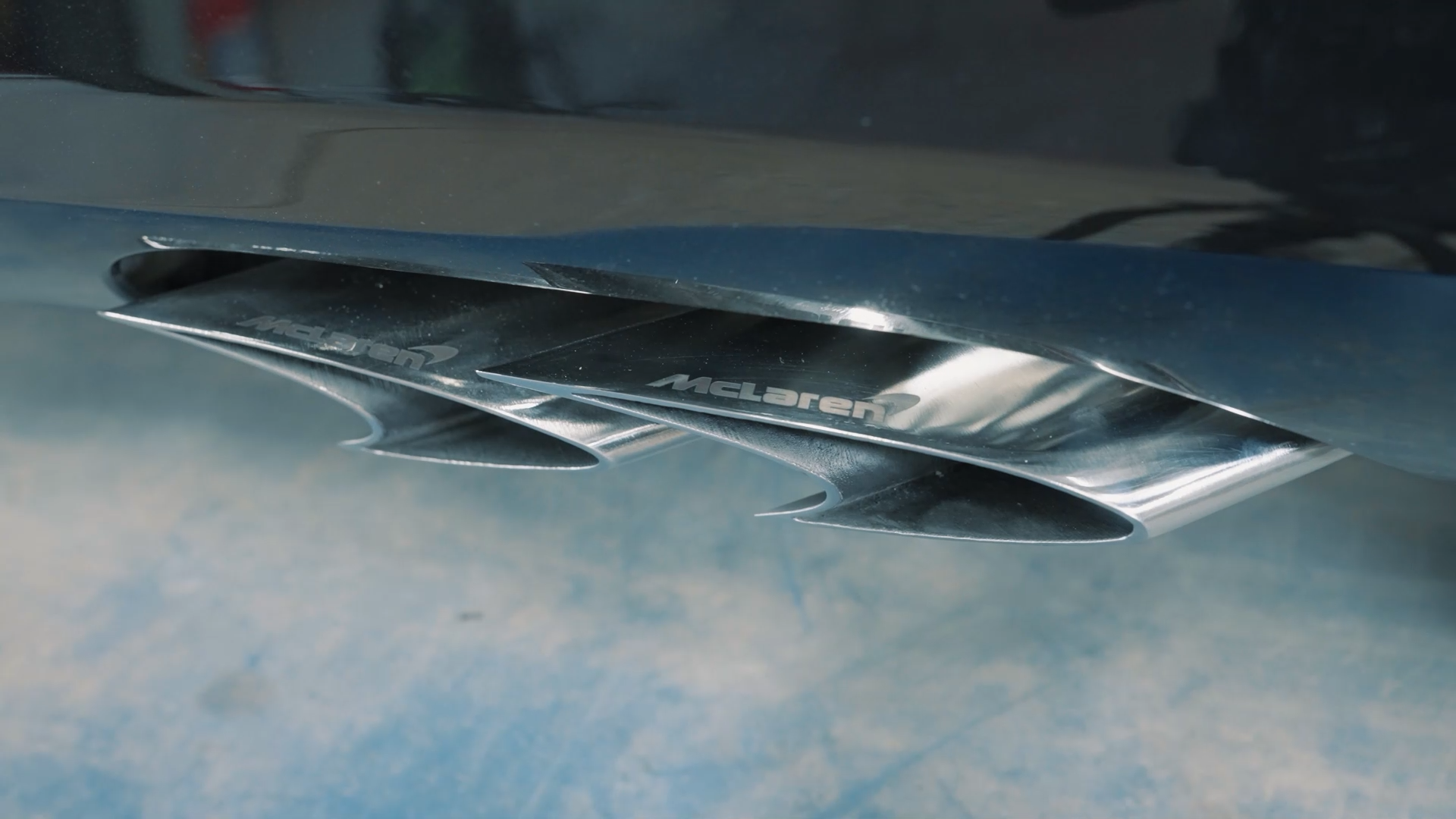
Swedish company Ferrita Sweden AB has utilized Meltio's Wire-LMD technology to create custom exhaust tailpipes for a Mercedes-Benz SLR McLaren, achieving significant time and cost reductions.
Ferrita Sweden AB, a company specializing in advanced sound attenuation and exhaust systems, has successfully customized a 2003 Mercedes-Benz SLR McLaren by employing Meltio's Wire Arc Additive Manufacturing (WAAM) technology. This approach, which uses a laser to melt metal wire for deposition, was chosen to meet the unique demands of a customer seeking to personalize their supercharged V8 supercar.
Traditional manufacturing methods presented significant challenges for this project. Ferrita needed to produce four highly symmetrical tailpipes with a specific shape, a task that would typically require expensive custom tooling. Furthermore, the company operates under tight deadlines, with customer vehicles often only in the shop for about a week, making lengthy tooling development impractical. The original exhaust system's muffler weighed approximately 20 kilograms, and replacing it was a key objective to reduce weight and heat.
Beyond the physical constraints, the project involved complex fluid dynamics to achieve an ideal exhaust note. This requires precise control over pipe dimensions, volumes, and flow characteristics, which are difficult to achieve with conventional fabrication. Ferrita technician Viktor noted the difficulty in hand-producing merge pipes with round ends that optimize flow. The company sought a manufacturing method capable of delivering flawless internal geometries to minimize back pressure within their strict turnaround time.
To address these challenges, Ferrita implemented an end-to-end digital and physical manufacturing workflow. This began with scanning the vehicle's undercarriage to precisely map the available space. A digital concept model was developed to verify the fitment of valves and pipes, followed by a rapid plastic prototype printed in a matter of hours to confirm the design's aesthetic integration with the car's lines. For the final components, Ferrita utilized a Meltio Robot Cell, which employs an ABB robot and a laser head with nine beams to melt 316 stainless steel MIG wire. The system was programmed for fine detail resolution, running at 10 millimeters per second with a gas flow of 15 liters per minute and a laser power of 1000 watts.
This development highlights the increasing adoption of Wire-LMD for high-value, low-volume automotive customization. It demonstrates the technology's ability to produce complex geometries, reduce lead times, and lower costs compared to traditional methods. This is crucial for niche markets and custom builds, showcasing additive manufacturing's potential to democratize advanced fabrication for specialized applications.
Edited by the news editor with AI from the original report — please refer to the original source.