US Air Force to equip entire C-17 fleet with 3D printed drag-reduction devices
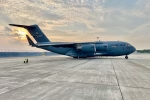
The U.S. Air Force is set to install 3D printed microvanes on all 222 C-17 Globemaster III aircraft, a move expected to yield significant fuel savings and demonstrate the growing application of additive manufacturing in military sustainment.
The U.S. Air Force, through its Lifecycle Management Center, Research Laboratory, and Air Mobility Command, has developed and successfully tested aerodynamic inserts, known as microvanes, for the C-17 Globemaster III cargo aircraft. These blade-shaped devices, measuring approximately 10 cm by 40 cm, are affixed to the rear fuselage. Initial tests on a limited number of C-17s revealed a measurable enhancement in aerodynamic efficiency, resulting in a one percent reduction in drag and, consequently, fuel consumption.
This efficiency improvement translates to substantial projected annual savings, estimated to exceed $14 million across the entire C-17 fleet. Before full fleet-wide implementation, ten C-17s equipped with the microvanes underwent rigorous environmental stress testing. These aircraft were operated in diverse climatic conditions, ranging from extreme cold to heat and varying humidity levels, to validate the durability and structural integrity of the adhesive bonding under real-world operational demands.
Roberto Guerrero, deputy assistant secretary of the Air Force for operational energy, safety and occupational health, confirmed the successful completion of these serviceability tests. He announced that the microvanes will be installed on all 222 C-17 aircraft within the next year. This initiative aligns with a broader trend in the aviation sector, as exemplified by Delta Air Lines' recent fleetwide retrofit of similar aerodynamic devices on Boeing 737 aircraft.
The integration of 3D printed microvanes into the C-17 fleet represents a significant advancement in the Air Force's adoption of additive manufacturing for sustainment. Unlike complex component redesigns or flight-critical part certifications, these microvanes offer a simple, non-intrusive method for enhancing aircraft performance. This approach builds upon previous successful applications, such as the installation of 17 3D printed parts on a C-5 Super Galaxy and ongoing efforts to use 3D printing for sourcing obsolete engine components through programs like Pacer Edge.
The U.S. Air Force's decision to outfit its entire C-17 fleet with 3D printed microvanes highlights a pragmatic application of additive manufacturing for performance enhancement and cost savings. This development underscores the trend towards leveraging AM for non-critical, yet impactful, aerodynamic improvements, requiring minimal airframe modification and certification. It signifies a maturing use of 3D printing in military sustainment, moving beyond prototyping and spare parts to fleet-wide upgrades.
Edited by the news editor with AI from the original report — please refer to the original source.