Unveiling Mars: From Magmatic Intrusions to Private Mars Orbiters
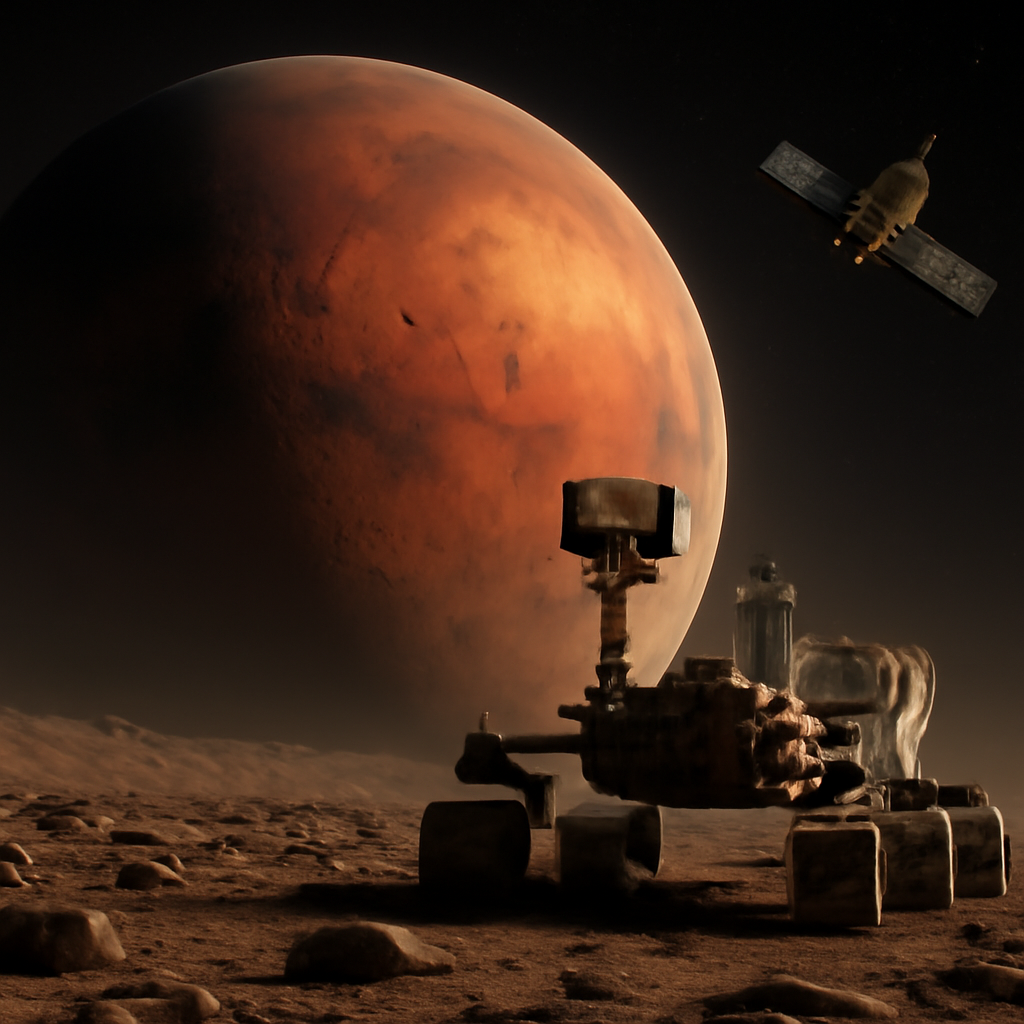
Explore the latest Mars discoveries, missions, and technological advancements, from magmatic intrusions beneath Martian craters to private companies building Mars orbiters.
Beneath the Martian Surface
Recent research has unveiled a fascinating discovery beneath the Martian surface, specifically in the highlands craters of the Red Planet. Evidence of magmatic intrusions has been found beneath floor-fractured craters, shedding light on Mars' geological history. These intrusions are indicative of molten rock that once pushed its way into the crust of Mars, solidifying and forming underground structures.
The presence of magmatic intrusions offers valuable insights into the volcanic activity that shaped Mars in the past. By studying these features, scientists can piece together a more comprehensive understanding of the planet's geological evolution, including the processes that led to the formation of its highlands and craters.
This discovery builds on previous findings related to Martian geology, such as the analysis of mafic silicate compositions in meteorites and the identification of granite on Mars. Each new piece of information contributes to the larger puzzle of Mars' history, painting a more detailed picture of the planet's past environments and geological processes.
Understanding the geological makeup of Mars is crucial not only for scientific curiosity but also for planning future exploration missions. By unraveling the planet's geological mysteries, researchers can better prepare for upcoming endeavors, such as manned missions or the deployment of advanced rovers and orbiters to study Mars in greater detail.
Spectral Insights from Meteorites
The recent analysis of Martian meteorite samples using visible to near-infrared reflectance spectroscopy has unveiled crucial insights into the mafic silicate compositions present on Mars. By studying the spectral signatures of these meteorites, scientists can determine the mineralogical composition of the rocks, shedding light on the geological processes that have shaped the Red Planet.
Mafic silicates are minerals rich in iron and magnesium, commonly found in volcanic rocks on Earth. The presence of these minerals in Martian meteorites indicates past volcanic activity on Mars, providing valuable clues about the planet's geological history and the processes that have occurred beneath its surface.
Through the detailed examination of the reflectance spectra of these meteorites, researchers can identify specific mineral phases present in the samples. This information helps reconstruct the environmental conditions under which these rocks formed and evolved, offering insights into Mars' past climate, geology, and potential habitability.
Understanding the mafic silicate compositions of Martian meteorites not only enhances our knowledge of the planet's geological diversity but also contributes to ongoing exploration efforts, such as identifying regions of interest for future missions and unraveling the mysteries of Mars' ancient past. This research represents a significant step forward in unraveling the geological complexities of Mars and paves the way for further discoveries in the field of planetary science.
Optimizing Methane Detection
Identifying optimal times and locations for methane measurements in Gale Crater is crucial for understanding the potential sources and dynamics of this intriguing gas on Mars. Researchers have leveraged sophisticated atmospheric transport models to pinpoint the prime windows for methane detection within Gale Crater. By factoring in seasonal variations, local topography, and atmospheric circulation patterns, scientists can predict when and where methane concentrations are likely to be the most pronounced.
Methane on Mars is a significant scientific puzzle, as it can be produced both biotically and abiotically. The detection of methane in Gale Crater has sparked debates about the possibility of microbial life or geological processes as its source. Hence, optimizing methane measurements involves meticulous planning and coordination to capture fleeting methane plumes that may hold the key to Mars' enigmatic past and present.
The insights gained from identifying optimal times and locations for methane measurements in Gale Crater can also inform future missions and instrument design. By honing in on specific areas where methane is more prevalent, spacecraft and rovers can be directed to prioritize these regions for in-depth analyses. This targeted approach maximizes the scientific return on investments and enhances our understanding of Mars' atmospheric composition and potential habitability.
As we unravel the mysteries of methane on Mars, the research in Gale Crater stands at the forefront of Martian exploration, offering a glimpse into the complex interplay of geology, chemistry, and possibly biology on the Red Planet.
Radiation Effects on Mars and Europa
Radiation Effects on Mars and Europa
The recent study delving into radiation effects on sodium perchlorate on Mars and Europa sheds light on the intricate interplay between cosmic radiation and planetary surface chemistry. Sodium perchlorate, a compound abundant on both Mars and Europa, undergoes breakdown processes under the influence of radiation. When exposed to ionizing radiation, such as galactic cosmic rays and solar energetic particles, sodium perchlorate transforms into reactive chlorine species, altering the chemical composition of the surrounding environment.
This study highlights the crucial role of temperature in modulating the radiation-induced chemical reactions. Higher temperatures accelerate the breakdown of sodium perchlorate, leading to a more rapid generation of reactive chlorine species. Understanding these radiation-driven processes is essential for interpreting the chemical composition of Martian and Europan surface materials, as well as assessing the potential habitability of these celestial bodies.
On Mars, where radiation levels are significantly higher than on Earth due to the planet's thin atmosphere and lack of a global magnetic field, the impact of radiation on surface materials is particularly pronounced. By investigating how radiation affects sodium perchlorate, scientists can unravel the intricate geochemical processes shaping the Martian surface and atmosphere over geological timescales. Moreover, these findings have implications for future exploration missions, guiding the design of instruments and analytical techniques aimed at characterizing the chemical environment on Mars and Europa.
Technological Challenges of Manned Missions
One of the most challenging aspects of planning manned missions to Mars lies in ensuring the survival and well-being of astronauts during the long journey through deep space and their stay on the Red Planet. Life support systems must be designed to provide a sustainable environment for humans, offering breathable air, clean water, and proper waste management. These systems need to be highly reliable and efficient, capable of withstanding the harsh conditions of space travel.
Radiation protection is another critical concern for human missions to Mars. Unlike Earth, Mars lacks a protective magnetic field and thick atmosphere, leaving astronauts exposed to high levels of cosmic and solar radiation. Shielding technologies must be developed to minimize astronauts' exposure to radiation, reducing the risk of long-term health effects such as cancer and radiation sickness.
Deep-space communication presents yet another hurdle for manned Mars missions. The vast distances between Earth and Mars result in significant communication delays, ranging from several minutes to over 20 minutes one way. Establishing reliable communication links that can withstand these delays is essential for ensuring real-time monitoring of crew activities, as well as providing essential support in case of emergencies.
Addressing these technological challenges requires a multidisciplinary approach, with engineers, scientists, and mission planners working together to develop innovative solutions that will enable safe and successful human exploration of Mars.
Private Mars Orbiters
NASA's recent selection of a private space company to build and launch the 2028 Mars orbiter represents a significant leap forward in the agency's exploration plans. The collaboration with Relativity Space, a prominent player in the aerospace industry led by former Google CEO Eric Schmidt, highlights the growing involvement of private entities in space exploration missions.
The Mars orbiter, named Aeolus, is slated to study the Red Planet's atmosphere and climate, aiming to deepen our understanding of its environmental dynamics. This mission is crucial for unraveling the mysteries of Mars' past and present conditions, shedding light on its potential habitability and evolution over time.
Relativity Space's advanced technological capabilities and expertise in aerospace engineering position them as a key partner in this endeavor. The company's innovative approach to rocket design and manufacturing, including their pioneering use of 3D printing technology, will likely play a pivotal role in the successful deployment of the Mars orbiter.
The collaboration between NASA and Relativity Space not only propels the agency's Mars exploration efforts but also underscores the shifting landscape of space exploration, with private companies increasingly taking on significant roles in pushing the boundaries of human knowledge and scientific discovery in the cosmos.
Rover Achievements
NASA's rovers on Mars have achieved a remarkable feat by completing marathon distances on the planet's rugged surface. These robotic explorers, equipped with cutting-edge technology and advanced mobility systems, have navigated challenging terrains, endured harsh environmental conditions, and collected invaluable data about the Martian landscape.
To achieve this milestone, the rovers rely on a combination of sophisticated engineering and autonomous navigation capabilities. Their wheels are designed to withstand the rocky terrain and provide traction in the Martian soil, allowing them to traverse long distances without getting stuck. The rovers use a combination of cameras, sensors, and onboard computers to analyze the terrain, plan their routes, and avoid obstacles in real-time.
Furthermore, the rovers are equipped with high-tech instruments that allow them to study the geology, atmosphere, and climate of Mars. By analyzing soil samples, rock formations, and atmospheric composition, these robotic explorers provide crucial insights into the planet's past habitability, potential for life, and overall geological history.
The successful completion of marathon distances by NASA's rovers demonstrates the effectiveness of these robotic missions in exploring the Red Planet and pushing the boundaries of space exploration. As they continue to roam the Martian surface, these rovers will undoubtedly uncover more mysteries of Mars and pave the way for future human exploration of the planet.
Austrian Physicist Joins Mars Mission
The inclusion of an Austrian physicist in an upcoming Mars mission signifies a significant advancement in space exploration. The physicist, hailing from Upper Austria, brings expertise in a range of scientific disciplines that will be crucial for the success of the mission. With a focus on understanding the planet's geological history and atmospheric composition, the physicist's contributions are expected to play a vital role in analyzing data collected from the Martian surface.
The physicist's involvement in the mission underscores the international collaboration and diversity of expertise required for complex space missions. Their specific contributions may involve analyzing the visible to near-infrared reflectance of Martian samples, studying magmatic intrusions beneath Martian craters, or investigating the breakdown of sodium perchlorate due to radiation on Mars. This interdisciplinary approach ensures a comprehensive understanding of the Red Planet's geology, climate, and potential for past life.
As private space companies and government agencies like NASA continue to push the boundaries of exploration, the inclusion of scientists from various regions highlights the global nature of space exploration efforts. The Austrian physicist's participation in the upcoming Mars mission not only showcases the country's contributions to space science but also adds a unique perspective to the mission's scientific goals. Their expertise will undoubtedly contribute to unraveling the mysteries of Mars and advancing our understanding of the solar system.
In the quest to become a multi-planetary species, humanity is making significant strides in understanding Mars' geology, atmosphere, and potential for supporting life. From studying magmatic intrusions to selecting private companies for Mars missions, each development brings us closer to realizing our interplanetary ambitions.
This content was produced by the news editor with AI.