Tianwen-2 Transmits First Image of Earth's Quasi-Moon Kamo'oalewa
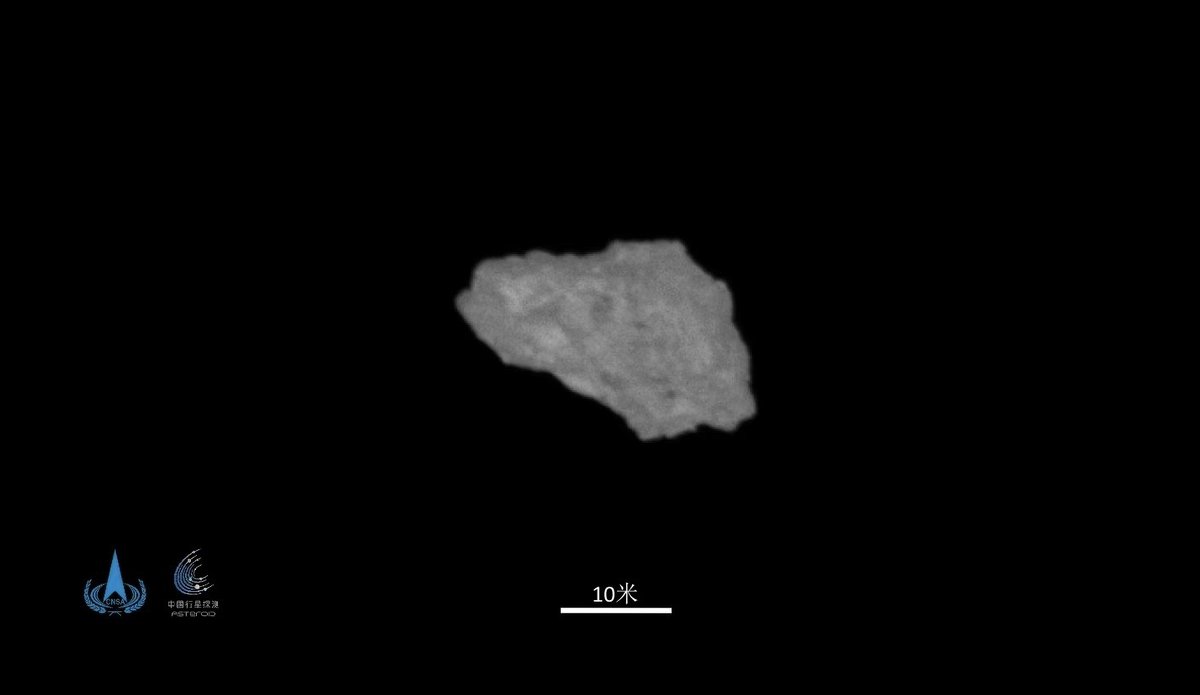
China's Tianwen-2 mission has sent back its inaugural photograph of Kamo'oalewa, a near-Earth asteroid designated as a quasi-satellite, ahead of its sample return operation.
The Chinese spacecraft Tianwen-2 has successfully transmitted its first image of Kamo'oalewa, a near-Earth asteroid that exhibits quasi-satellite behavior, orbiting the sun while maintaining a close proximity to Earth. This object, discovered in 2016, is roughly 20 meters in diameter, comparable in size to a school bus, and completes a rotation on its axis every 28 minutes. Tianwen-2 embarked on its approximately 621 million-mile journey to Kamo'oalewa over 400 days ago, with a planned sample return to Earth in 2027.
Kamo'oalewa is classified as a quasi-satellite, a celestial body that orbits the sun but remains gravitationally tethered to Earth, with its distance fluctuating between 9 million and 25 million miles. While some scientists have affectionately termed these objects "mini moons" or "quasi moons," further research is ongoing to determine Kamo'oalewa's precise origin, with some theories suggesting it may be a fragment of Earth's Moon ejected by an ancient impact, though other evidence, including observations from the James Webb Space Telescope, presents conflicting data.
Upon reaching a distance of 12 miles from the asteroid in late June, as announced by the China National Space Administration (CNSA), Tianwen-2 began its detailed scientific exploration phase. The mission aims to gather comprehensive data on the asteroid's morphology, composition, and internal structure, which will inform the subsequent sample collection activities. The CNSA stated that this preparatory work is crucial for the upcoming sample retrieval operations.
Tianwen-2 is equipped with multiple methods for sample acquisition, adaptable to the asteroid's surface conditions. These include a touch-and-go technique, similar to those employed by NASA's OSIRIS-REx and Japan's Hayabusa-2 missions, an anchor-and-attach method for surface and subsurface sampling, and a hovering approach utilizing a robotic arm extended from the spacecraft. Following its sample delivery to Earth via atmospheric entry, Tianwen-2 is scheduled to continue its mission to comet 311P/PanSTARRS for further scientific study.
Tianwen-2's successful imaging of Kamo'oalewa marks a significant step in humanity's growing capacity to interact with and study near-Earth objects. This mission's multi-pronged sample collection strategy, including advanced touch-and-go and anchoring techniques, showcases an accelerating technological curve in robotic space exploration. By enabling the acquisition of material from a quasi-satellite, potentially a lunar fragment, we gain invaluable data for understanding planetary formation and the dynamics of our solar system. This capability is foundational for future resource utilization and the eventual self-sufficiency required for multi-planetary expansion. Each such mission pushes the boundaries of our reach, bringing us closer to becoming an off-world civilization.
Edited by the news editor with AI from the original report — please refer to the original source.