Tianwen-2 Images Tiny Quasi-Moon, Lunar Origin Theory Questioned
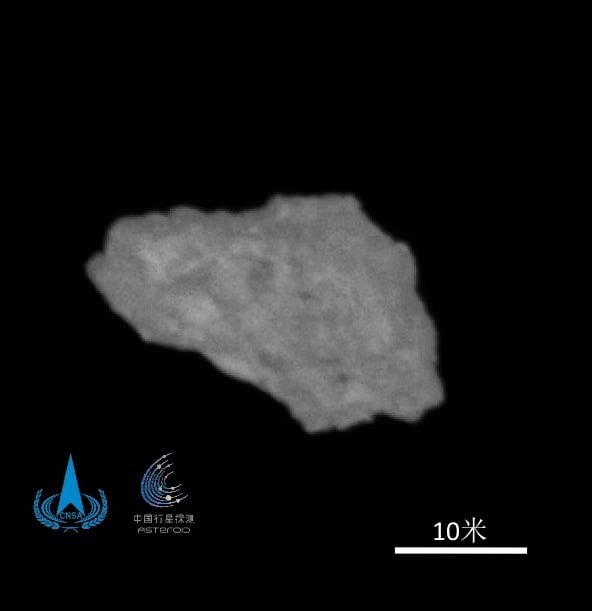
China's Tianwen-2 spacecraft has captured the first close-up image of asteroid Kamoʻoalewa, a near-Earth object that orbits the Sun alongside Earth, while new research challenges its presumed lunar origin.
China's Tianwen-2 spacecraft has successfully reached the near-Earth asteroid Kamoʻoalewa, transmitting the first detailed close-range photograph of the celestial body. The image, captured on July 2, 2026, from approximately 20 kilometers away, reveals an irregularly shaped object measuring only a few tens of meters across.
This achievement follows a journey of roughly 400 days and a flight path spanning approximately 1 billion kilometers, as announced by the China National Space Administration (CNSA). The spacecraft, launched on May 29, 2025, as part of China's inaugural asteroid sample-return mission, first detected Kamoʻoalewa on June 6, 2026. Subsequent maneuvers placed Tianwen-2 on a trajectory to match the asteroid's orbit.
The arrival of Tianwen-2 coincides with emerging scientific evidence that casts doubt on the leading theory of Kamoʻoalewa's formation. Previously, the asteroid's unusual reddish spectral reflectance, similar to weathered lunar silicates, and orbital dynamics had suggested it might be a fragment ejected from the Moon by an impact, potentially from the Giordano Bruno crater.
However, recent research presents alternative explanations. A population study published in Astronomy & Astrophysics indicates that ordinary near-Earth asteroids originating from the main belt are statistically far more likely to produce objects like Kamoʻoalewa than lunar ejecta. Furthermore, new analysis of spectral data suggests Kamoʻoalewa's reflectance characteristics are consistent with LL chondrites, a type of stony material found in asteroids like Itokawa, especially when its surface material has undergone extensive space weathering.
While the first image from Tianwen-2 supports estimates of Kamoʻoalewa's small size, it does not definitively reveal its composition or origin. The mission is slated to continue surveying the asteroid's shape, composition, and internal structure before attempting to collect samples for return to Earth in 2027. Following this, Tianwen-2 is planned to journey towards the main-belt object 311P/PanSTARRS.
Tianwen-2's close-up imaging of Kamoʻoalewa, a quasi-satellite, represents a critical data-gathering step for understanding near-Earth objects. The challenge to its lunar origin, supported by alternative spectral analyses pointing to main-belt asteroid material, highlights the accelerating power of scientific instruments and modeling. As we extend humanity's reach into the solar system, such discoveries refine our understanding of planetary formation and the distribution of resources. This mission's ability to gather high-resolution data and potentially return samples is a vital precursor to establishing self-sustaining outposts beyond Earth, ensuring the long-term survival and expansion of life and consciousness.
Edited by the news editor with AI from the original report — please refer to the original source.