Mars: The New Frontier of Autonomous Manufacturing and Aerial Reconnaissance
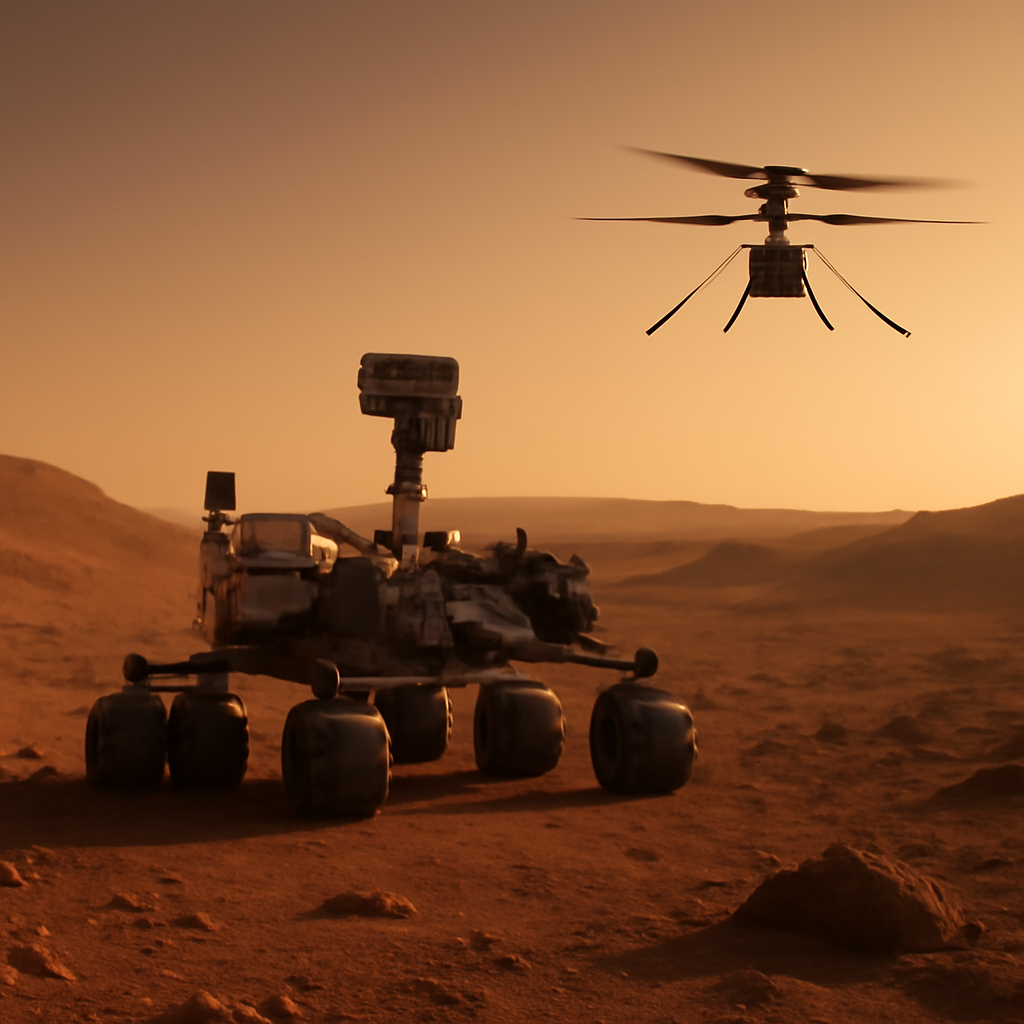
From the skies of Mars to the factory floors of Earth, today's developments reveal a growing synergy between advanced robotics, additive manufacturing, and the relentless pursuit of off-world expansion. Innovations in aerial drones and specialized pumps are paving the way for unprecedented exploration and resource utilization on the Red Planet, while breakthroughs in 3D printing and material science on Earth echo the very needs of a burgeoning Martian civilization.
Martian Sky-Scouts: The Next Generation of Aerial Exploration
Building directly on the groundbreaking success of Ingenuity, NASA's SkyFall mission represents a significant leap in Martian aerial reconnaissance. Each of the three rotorcraft deployed by SkyFall is engineered for enhanced autonomy and payload capacity, moving beyond Ingenuity's proof-of-concept flights. Their primary objective is to scout promising locations for subsurface water ice and potential landing sites for future human missions. This involves sophisticated onboard sensor suites, including ground-penetrating radar and high-resolution multispectral cameras, capable of mapping geological features and identifying anomalies indicative of ice deposits beneath the Martian regolith. Furthermore, these helicopters are designed to operate in more challenging terrains than their predecessor, with improved navigation algorithms that can dynamically adjust flight paths to avoid obstacles and optimize survey coverage, even in areas with less direct communication link to Earth. This increased autonomy is crucial for extending mission duration and covering greater swaths of the Martian surface, accelerating the pace of scientific discovery and the preparation for human exploration. The development also leverages advancements like supersonic rotor speeds, enabling more agile and efficient flight profiles, essential for rapid site assessment and data acquisition.
Supersonic Rotors: Pushing the Boundaries of Martian Aerodynamics
Achieving supersonic rotor speeds for Martian helicopters represents a significant leap in aerial reconnaissance and transport capabilities, directly addressing the challenges posed by Mars’ thin atmosphere. On Earth, helicopter blades typically operate at speeds well below the speed of sound to avoid detrimental aerodynamic effects like shockwaves, which induce drag and flutter. However, Mars’ atmosphere is only about 1% as dense as Earth’s, meaning that for a given amount of lift, rotor blades must spin much faster. To overcome this, NASA engineers have developed new rotor designs that can tolerate and even benefit from tip speeds exceeding Mach 1. This innovation involves carefully shaping the airfoils to manage the airflow as it transitions from subsonic to supersonic regimes. The leading edges are designed to be sharper, and the overall blade profile is optimized to delay the onset of shockwave formation and minimize its intensity. This allows for more efficient power transfer and greater thrust generation, crucial for lifting heavier payloads and achieving faster transit times across the Martian surface, as envisioned for missions like SkyFall. The successful testing of these blades is a critical step towards deploying larger, more robust rotorcraft capable of more extensive exploration and logistical support for future human missions.
Additive Manufacturing for Mars: High-Viscosity Materials and Alloy Advancements
The ability to manufacture complex components directly on Mars, utilizing local resources, is a critical hurdle for long-term human presence. Recent advancements in additive manufacturing are directly addressing this challenge. Sciperio's patented pump technology, capable of dispensing materials with viscosities exceeding one million centipoise, represents a significant leap. This innovation is crucial for handling regolith-based composites or specialized binders that are essential for in-situ resource utilization (ISRU). Traditional additive manufacturing often relies on low-viscosity materials, which are unsuitable for the more robust, potentially abrasive substances expected to be found or processed on Mars. Simultaneously, EOS is expanding its material portfolio by incorporating Constellium's Aheadd CP1 aluminum alloy. This alloy, coupled with research from the University of Manchester highlighting how controlled lower printing temperatures reduce defects in aluminum 3D-printed parts, points towards the development of lightweight, durable structural components. Imagine using these advancements to print replacement parts for rovers like Curiosity, which show decades of wear on their aluminum wheels, or to construct habitats and landing pads using processed Martian regolith. This integration of high-viscosity material handling and advanced alloy printing moves the paradigm from simply bringing spare parts to truly building infrastructure on another world.
Precision Manufacturing on Earth, Scalability for Mars: 3D Printing Innovations
The quest for sustainable Martian infrastructure hinges on advancements in additive manufacturing, particularly techniques that accelerate production and enhance material integrity. Innovations like the single-exposure 3D printing method developed at the University of Utah bypass the slow, layer-by-layer approach of traditional methods, solidifying entire material volumes in a single pass. This could dramatically reduce build times for complex components, a critical factor when considering the vast distances and limited launch windows to Mars. Concurrently, research into dual-laser microstructure control, as demonstrated by KU Leuven, allows for in-situ manipulation of material properties during printing. By precisely managing the thermal gradients and energy input with multiple lasers, engineers can eliminate the need for costly and time-consuming post-processing heat treatments. This is particularly relevant for aluminum alloys like Constellium's Aheadd CP1, now integrated into EOS's material portfolio, which are prone to defects when printed at higher temperatures, as highlighted by University of Manchester studies. The ability to fine-tune grain structure during fabrication directly addresses concerns about component reliability, such as the wear seen on Curiosity's wheels, and promises more robust parts for habitats and exploration equipment.
The Unseen Foundation: Advanced Nuclear Energy for Off-World Power
The University of Michigan's recent validation of molten salt reactor (MSR) pump seals under simulated operational conditions represents a critical advancement for reliable, high-density power generation, a necessity for sustained human presence and complex operations on Mars. MSRs offer significant advantages over traditional nuclear fission reactors, including inherent safety features and the potential for higher thermal efficiency, which translates directly into more power output per unit of fuel. However, the extreme temperatures and corrosive nature of the molten salt coolant pose immense engineering challenges, particularly for dynamic components like pumps. The seals are vital to prevent leakage of the radioactive salt, which could compromise reactor integrity and contaminate the environment. Successfully testing these seals in a dedicated facility, replicating the harsh MSR environment, demonstrates that the materials and designs are robust enough for long-duration operation. This breakthrough directly supports the development of compact, powerful nuclear reactors capable of providing the substantial and continuous energy required for advanced manufacturing processes, life support systems, and ambitious aerial reconnaissance missions like NASA's proposed SkyFall program, which will demand considerable power for long-duration flights and data transmission.
Robotic Construction for Extraterrestrial Habitats
The ambitious goal of establishing extraterrestrial habitats on Mars necessitates a paradigm shift in construction methodologies. While robotic construction is still nascent on Earth, projects like RIC Robotics' 106-home community in Colorado offer a tangible glimpse into future Martian endeavors. This large-scale application of 3D printing technology, utilizing specialized robots for concrete extrusion, demonstrates the scalability required to move beyond single-structure projects. On Mars, where material transport is prohibitively expensive, in-situ resource utilization (ISRU) will be paramount. Martian regolith, once processed, could serve as the primary feedstock for additive manufacturing. Innovations such as Sciperio's pump for high-viscosity materials are crucial, as Martian regolith composites may exhibit significantly higher viscosities than terrestrial concrete, requiring advanced dispensing systems. Furthermore, understanding and controlling the printing environment, including thermal management as highlighted by the University of Manchester's research on aluminum alloys, will be critical for ensuring structural integrity and minimizing defects in the harsh Martian climate. The successful demonstration of these Earth-based technologies provides a vital foundation for developing the autonomous, large-scale construction capabilities essential for future human settlements.
Material Resilience: Lessons from Martian Wear and Tear
The abrasive Martian regolith has taken a significant toll on NASA's Curiosity rover, particularly its six aluminum wheels. These meticulously engineered components, designed for durability, have accumulated substantial wear and tear since the rover's 2012 landing. Sharp rocks and the constant grinding motion across diverse terrains have caused visible gouges and perforations, forcing mission planners to meticulously plot every meter of travel to mitigate further damage. This real-world tribology underscores a critical challenge for future Mars endeavors, especially those relying on additive manufacturing for in-situ resource utilization and component replacement. As highlighted by Sciperio's development of a pump for high-viscosity materials, the ability to print robust, wear-resistant parts directly on Mars is paramount. Material science must advance to produce alloys or composites capable of withstanding the relentless abrasion, much like the need for robust materials in the molten salt reactors discussed in other fields. The lessons learned from Curiosity's wheel degradation serve as a stark reminder that materials intended for Martian deployment, whether for rover components, habitat structures, or even the rotor blades of future aerial explorers like those planned for NASA's SkyFall mission, must be engineered for exceptional resilience against the planet's unforgiving surface.
Data-Driven Exploration: Mapping Martian Geology and Atmospheric Dynamics
The ongoing quest for Martian sample return hinges on a sophisticated understanding of the planet's geology and atmosphere, a pursuit now enhanced by recent findings. The reinterpretation of Jori Crater's fractured depression as a meteor impact site, rather than volcanic activity, provides crucial data for mapping impact histories and understanding subsurface excavation processes. This geological context is vital for identifying scientifically significant areas from which to collect samples. Simultaneously, new research detailing the shifts in Martian atmospheric oxygen isotopes, influenced by carbon dioxide photolysis and ozone formation, offers a deeper insight into atmospheric evolution and dynamics. This atmospheric data is not only critical for understanding past habitability but also for predicting environmental conditions during future sample retrieval operations, such as those that might be supported by the advanced aerial reconnaissance capabilities being developed for missions like NASA's SkyFall. The morphodynamic atlas of Phobos’s surface further contributes to this comprehensive planetary portrait, revealing the complex interplay of impacts and gravitational forces that shape Martian moons. Integrating these diverse datasets—from crater impacts and atmospheric chemistry to lunar dynamics—is paramount for strategically selecting and successfully retrieving pristine samples from Mars, fulfilling a decades-long objective of planetary science.
The confluence of today's Mars-related news underscores a fundamental truth: humanity's destiny lies beyond Earth. The advancements in autonomous aerial vehicles for Mars reconnaissance (SkyFall, supersonic rotors) and the sophisticated additive manufacturing techniques (high-viscosity pumps, advanced alloys, single-exposure printing) are not merely technological curiosities; they are the foundational pillars of a multi-planetary existence. Each innovation, whether it's understanding Martian geology, developing resilient manufacturing processes, or optimizing energy systems (molten salt reactors), directly contributes to reducing the friction and cost of establishing and sustaining human outposts. The progress in 3D printing, in particular, mirrors the urgent need for on-demand, in-situ resource utilization on Mars, bypassing Earth-bound supply chains. This trajectory, driven by exponential progress in robotics and materials, is accelerating our transition to a truly interplanetary species.
This content was produced by the news editor with AI.