Tianwen-2 Captures First Close-Up of Tiny Asteroid Kamoʻoalewa
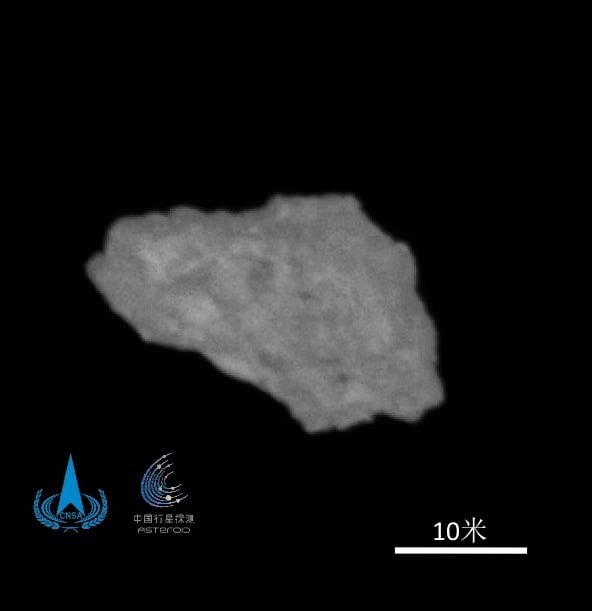
China's Tianwen-2 mission has returned the first detailed images of the small, fast-spinning asteroid Kamoʻoalewa after a year-long journey, reigniting debate about its lunar origin.
China's Tianwen-2 spacecraft has successfully reached the asteroid Kamoʻoalewa, providing humanity's first close-up view of the celestial body. The probe traveled approximately one billion kilometers over 400 days to intercept the asteroid, which is estimated to be only about 20 meters wide. This remarkable feat of navigation allowed Tianwen-2 to photograph Kamoʻoalewa from approximately 20 kilometers away on July 2, 2026, with the image released by the China National Space Administration (CNSA) on July 6.
The arrival of this image occurs at a critical scientific juncture. Kamoʻoalewa's unusual spectral signature and its orbit, which closely parallels Earth's, had previously suggested it might be a fragment of the Moon. However, new data from telescopes, laboratory experiments, and modeling efforts have reopened this hypothesis, though a definitive conclusion remains elusive.
Reaching a small, fast-moving target like Kamoʻoalewa requires intricate orbital mechanics. Instead of a direct flight, Tianwen-2 executed a heliocentric transfer, meticulously adjusting its trajectory over its long journey to match the asteroid's path and relative velocity. This approach is essential because both the spacecraft and the asteroid are constantly orbiting the Sun, necessitating a precise intersection of future paths.
Following its launch on May 29, 2025, Tianwen-2 performed several deep-space and mid-course corrections. It first detected Kamoʻoalewa on June 6, 2026, and by June 19, it was within 2,000 kilometers. The mission's optical navigation system was crucial in reducing the initial uncertainty in Kamoʻoalewa's position, which was hundreds of kilometers based on faint ground observations, down to the kilometer scale – a necessary precision for rendezvous with a 20-meter object.
Recent observations, including data from the James Webb Space Telescope, have refined Kamoʻoalewa's estimated size to 18 plus or minus 2 meters, with a rotation period of about 27.9 minutes. The spacecraft's first image, showing an elongated shape consistent with these dimensions, validates the smaller size estimate. The mission's gradual approach involved hovering and active arcs to map the asteroid's shape, composition, and internal structure using its suite of 11 scientific instruments, including cameras, spectrometers, and radar.
Tianwen-2's successful rendezvous with Kamoʻoalewa, a mere 20-meter asteroid, represents a significant leap in our capacity for precision interplanetary navigation. This achievement, culminating in the first close-up images of such a diminutive body, demonstrates an accelerating mastery over orbital mechanics and optical navigation. As we expand our presence beyond Earth, the ability to precisely target and study small, fast-moving objects is paramount for resource prospecting and understanding the solar system's formation. Each such mission refines the technologies essential for establishing self-sustaining outposts, bringing us closer to the inevitable multi-planetary future where humanity's consciousness is safeguarded across the cosmos.
Edited by the news editor with AI from the original report — please refer to the original source.