Tianwen-1 Captures Interstellar Comet 3I/ATLAS Near Mars
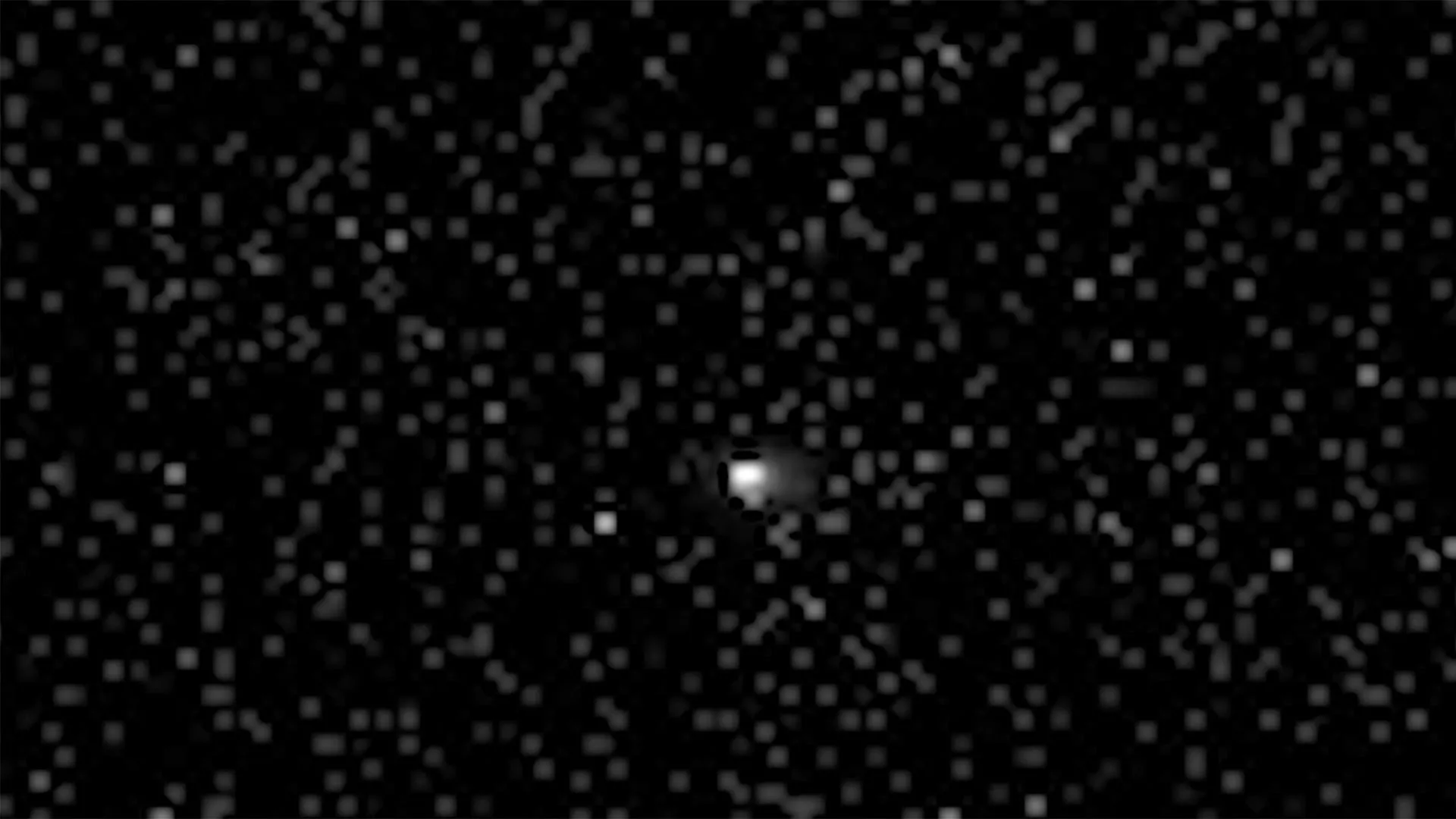
China's Tianwen-1 spacecraft has successfully photographed interstellar comet 3I/ATLAS as it passed by Mars, providing valuable data on its composition and offering insights into planetary formation.
China's Tianwen-1 orbiter has captured images of the interstellar object 3I/ATLAS during its transit near Mars. The China National Space Agency (CNSA) reported that the spacecraft utilized its high-resolution camera to observe the comet from a distance of approximately 30 million kilometers. Tianwen-1, which has been in Martian orbit for over four years, provided one of the closest vantage points for observing this interstellar visitor since its discovery.
The newly acquired images reveal key features characteristic of a comet, including a visible tail extending from the nucleus and a surrounding coma composed of gas and dust. Scientists have compiled multiple images into an animation that tracks the comet's trajectory towards its closest approach to the Sun. These observations are expected to bolster evidence suggesting that 3I/ATLAS contains water and other volatile materials that have begun to sublimate as the object warms during its journey through the inner solar system.
This observation also serves as a prelude to the scientific objectives of China's future Tianwen-2 mission, which is slated to investigate a Near Earth Asteroid and subsequently a comet. The team responsible for Tianwen-1's High-Resolution Imaging Camera (HiRIC) underwent extensive preparations, including simulations and instrument inspections, to ensure a successful capture of the distant and fast-moving object.
Photographing 3I/ATLAS presented significant challenges due to its considerable distance, relatively small size (estimated at 5.6 km in diameter), and high velocity. The comet was moving at approximately 58 km/s, with its relative speed to Tianwen-1 reaching about 86 km/s. Furthermore, the HiRIC camera, designed primarily for surface imaging of Mars, had to be adapted to detect such a dim celestial body.
European orbiters, Mars Express and ExoMars Trace Gas Orbiter (TGO), also photographed 3I/ATLAS on October 3rd using their respective cameras, the High Resolution Stereo Camera (HRSC) and the Colour and Stereo Surface Imaging System (CaSSIS). Detecting 3I/ATLAS with these instruments was exceptionally difficult, as it appeared orders of magnitude fainter compared to illuminated Martian features. Despite these challenges, the precision and operational speed of Tianwen-1's HiRIC camera enabled the acquisition of these valuable, albeit grainy, images.
The Tianwen-1 mission's successful imaging of interstellar comet 3I/ATLAS demonstrates a crucial capability for future deep-space exploration. Capturing such a distant, fast, and dim object validates advancements in high-resolution imaging and precise trajectory tracking. This achievement is a stepping stone towards intercepting and studying pristine interstellar materials, which hold the secrets of planetary formation across the galaxy. For humanity's long-term survival and expansion, mastering the observation and analysis of such extraterrestrial visitors is paramount. Each successful capture, like this one, refines the technologies and operational doctrines essential for a multi-planetary future, enabling us to gather unique data that informs our understanding of life's origins and potential elsewhere in the cosmos.
Edited by the news editor with AI from the original report — please refer to the original source.