Stimuli-Responsive Hydrogel Micro-lattices for Adaptive Extraterrestrial Habitats
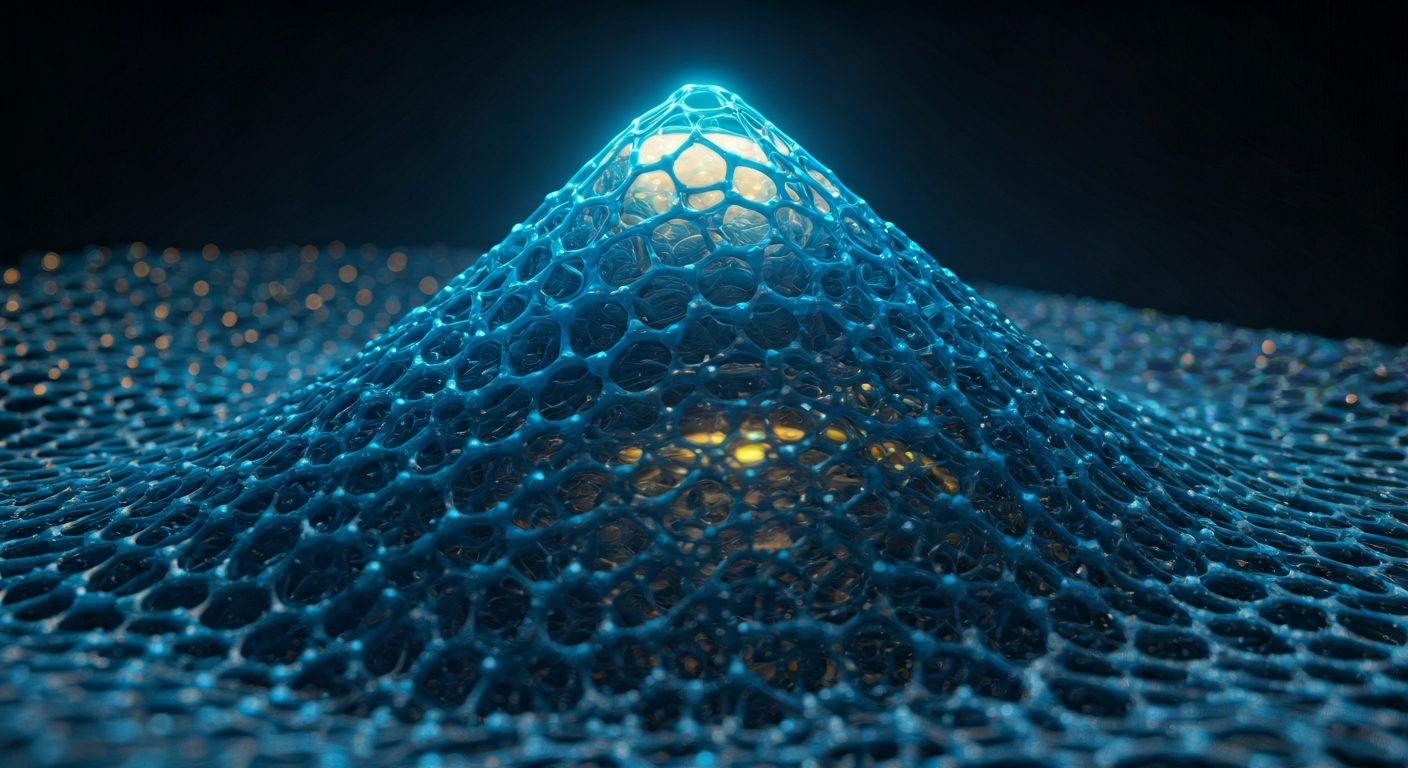
This project focuses on developing stimuli-responsive hydrogel micro-lattices fabricated using advanced nanotech 3D printing. These materials can dynamically alter their shape, volume, and mechanical properties in response to environmental cues like temperature, pH, or humidity. This adaptability is crucial for creating self-assembling, self-repairing, and reconfigurable structures for long-term extraterrestrial habitation, particularly on Mars.
Concept & Function The core concept is to create programmable matter in the form of hydrogel micro-lattices that exhibit controlled volumetric and mechanical changes upon exposure to specific environmental stimuli. These micro-lattices are designed to be the fundamental building blocks for adaptive structures, capable of self-assembly, re-configuration, and potentially self-repair. The primary function is to provide a dynamic material that can respond to and mitigate environmental challenges, thereby reducing the need for constant human intervention and complex supply chains.
Material System & Nanostructure The material system will be based on biocompatible, stimuli-responsive hydrogel polymers. These polymers will be cross-linked to form intricate 3D micro-lattice architectures. Nanoparticles, such as responsive hydrogel nanoparticles or inorganic nanostructures (e.g., functionalized silica or titania nanoparticles), will be incorporated within the hydrogel matrix. These nanoparticles will serve multiple roles: enhancing mechanical strength, acting as localized responsive elements, and potentially enabling novel functionalities like embedded sensing or controlled release. The nanostructure will be precisely engineered to optimize the diffusion of stimuli into the hydrogel and the subsequent volumetric expansion or contraction.
Programmability & Response Mechanism Programmability is achieved through the intrinsic stimuli-responsive nature of the hydrogel polymers and the embedded nanoparticles. Response mechanisms will target changes in pH, temperature, solvent composition (e.g., water content in a dusty Martian atmosphere), and potentially specific chemical analytes. For instance, pH-sensitive polymers will swell or shrink based on acidity, while temperature-sensitive polymers (e.g., PNIPAM-based) will undergo phase transitions. Reversible covalent or non-covalent cross-linking mechanisms will be employed to allow for dynamic changes in the lattice integrity and mechanical properties. The incorporation of responsive nanoparticles can amplify these responses or introduce multi-stimuli sensitivity.
Fabrication (Nanotech 3D Printing) Fabrication will leverage advanced nanotech 3D printing techniques, such as two-photon polymerization (TPP) or focused ion beam induced deposition (FIBID) adapted for polymer extrusion. These methods allow for the precise printing of intricate micro- and nano-scale lattice structures with sub-micron resolution. The process will involve the deposition of a photo-curable or solvent-curable hydrogel precursor ink containing the responsive polymers and nanoparticles. Layer-by-layer printing will build the desired 3D micro-lattice architecture. Post-printing processing, such as controlled washing and swelling/deswelling cycles, will be critical to activate the responsive properties and finalize the structure.
Control & Autonomy Initial control will be exerted through the controlled introduction of stimuli. For instance, altering the local humidity or temperature around a habitat module constructed from these micro-lattices could trigger expansion for sealing or contraction for ventilation. Advanced autonomy will emerge from the material's inherent responsiveness. Embedded sensors, potentially also fabricated using nanotech printing or integrated as nanoparticles, can monitor environmental conditions and trigger localized material responses without external command. This allows for passive, decentralized adaptation.
Key Challenges Key challenges include achieving rapid, uniform, and reversible responses across the entire micro-lattice volume, especially for large structures. Balancing the often-conflicting requirements of robust mechanical integrity for structural applications and high stimuli responsiveness is critical. Ensuring long-term stability and durability of the hydrogel and nanoparticles under harsh extraterrestrial conditions (radiation, extreme temperature fluctuations, abrasive dust) will be paramount. Preventing premature or uncontrolled swelling/deswelling due to minor environmental fluctuations is also a significant hurdle.
Test & Qualification Testing will involve characterizing the volumetric strain, mechanical properties (e.g., Young's modulus, compressive strength), and response kinetics under simulated Martian environmental conditions (pressure, temperature, CO2 atmosphere, dust simulants). Swelling/deswelling cycles will be monitored over extended periods to assess reversibility and fatigue. Nanoscale characterization techniques (SEM, TEM, AFM) will be used to verify the micro-lattice integrity and nanoparticle distribution. Mechanical testing will be performed at various stages of stimuli exposure.
TRL & Post-2030 Roadmap Currently, this concept resides at TRL 2-3. The post-2030 roadmap involves significant R&D in advanced computational modeling for predictive design (TRL 4-5), development of multi-stimuli responsive hydrogel formulations and nanoparticle integration (TRL 5-6), refinement of nanotech 3D printing processes for large-scale, complex structures (TRL 6-7), and in-situ demonstration of functional prototypes in analog environments (TRL 7-8). Full operational deployment is targeted for TRL 9 beyond 2035.
Applications (space, Mars habitats, in-situ) Primary applications include self-forming and self-repairing structural components for Mars habitats, such as walls, seals, and radiation shielding layers that can adapt to thermal gradients or atmospheric pressure changes. In-situ resource utilization (ISRU) could involve using these responsive materials to create adaptive filters for Martian dust or to construct temporary shelters. They can also be used for adaptive thermal regulation systems, dynamic deployment of solar arrays, and even as components in robotic systems requiring reconfigurable end-effectors or locomotion.
Cross-Model Verification (GPT-3.5)
This R&D dossier on Stimuli-Responsive Hydrogel Micro-lattices is largely sound and plausible for post-2030 developments. However, there are a few points to be flagged:
1. Fabricated Data: No fabricated data identified. 2. Plausibility: The concept of stimuli-responsive hydrogel micro-lattices, their material system, nanostructure, and programmability are scientifically feasible. 3. Fabrication Technique: The proposed fabrication methods using nanotech 3D printing techniques like TPP or FIBID for hydrogel micro-lattices are plausible. 4. Control & Autonomy: The idea of achieving advanced autonomy through embedded sensors and inherent responsiveness is reasonable. 5. Challenges: The outlined challenges related to responses across large structures, mechanical integrity, stability under harsh conditions, and preventing uncontrolled swelling are valid. 6. Test & Qualification: The testing methods and parameters mentioned for characterizing the hydrogel micro-lattices are appropriate for evaluating their performance. 7. TRL & Roadmap: The TRL levels and post-2030 roadmap for the development of this technology are realistic and well-structured. 8. Applications: The proposed applications of these hydrogel micro-lattices in space, Mars habitats, in-situ resource utilization, and adaptive systems are credible.
Programmable smart matter, embodied by these stimuli-responsive hydrogel micro-lattices, offers a paradigm shift for multi-planetary settlements. Instead of rigid, fixed structures, adaptive materials allow habitats to dynamically respond to environmental fluctuations, reducing energy expenditure and structural stress. Their ability to self-assemble and self-repair minimizes reliance on Earth-based manufacturing and maintenance, enabling truly in-situ construction and resource utilization. This adaptability is key to creating resilient, long-term human presences on challenging extraterrestrial terrains like Mars.
This content was produced by the news editor with AI.