Starship's Evolution: A Look Back at SpaceX's Rocket Milestones
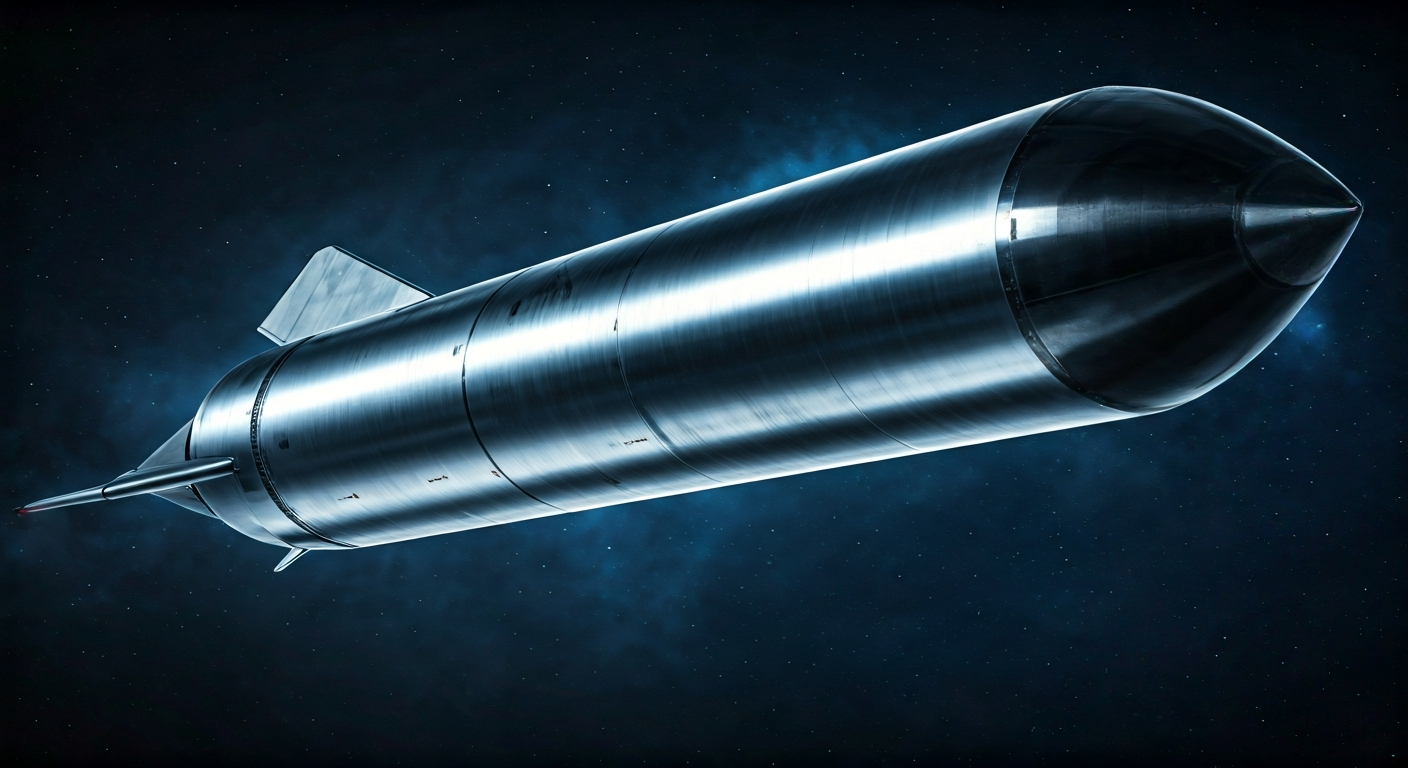
SpaceX's Starship program has been marked by significant developmental leaps, from early orbital attempts to the current super heavy-lift vehicle.
SpaceX's ambitious Starship program has seen a series of pivotal developments, charting a course from initial launch attempts to the sophisticated megarocket seen today. The journey began with the Starhopper prototype, which conducted its first tethered hop in July 2019, reaching an altitude of about 20 meters. This early test was crucial for validating basic flight control and landing systems.
Following Starhopper, SpaceX progressed to the SN series of prototypes, notably SN5 and SN6, which achieved higher altitude flights in 2020, demonstrating the ability to ascend to approximately 150 meters and perform controlled descents and landings. These flights were instrumental in refining the vehicle's aerodynamics and propulsion.
The program then advanced to orbital-class prototypes, with the first integrated flight test of Starship and its Super Heavy booster occurring in April 2023. While this initial test experienced a rapid unscheduled disassembly shortly after launch, it provided invaluable data on the combined performance of the two stages. A subsequent flight test in November 2023 achieved stage separation and demonstrated controlled coasting of the Starship upper stage before its own disassembly.
More recently, the third integrated flight test in March 2024 saw both the Super Heavy booster and the Starship upper stage execute significant portions of their planned trajectories. The booster successfully performed a boostback burn and initiated a landing burn before experiencing a failure, while Starship reached orbital velocity and successfully completed its payload door test before being lost during re-entry.
These milestones collectively represent SpaceX's iterative approach to developing a fully reusable super heavy-lift launch system, essential for future lunar and Martian missions.
The iterative testing and rapid evolution of Starship, from its early hops to achieving orbital velocity, exemplify the accelerating curves of technological progress vital for multi-planetary expansion. Each flight, even those ending in failure, provides exponentially more data than conventional development, refining aerodynamics, propulsion, and re-entry systems. This relentless, data-driven iteration is precisely the kind of exponential advancement needed to overcome the immense engineering challenges of establishing a self-sustaining Martian civilization. Starship's progress isn't just about a rocket; it's about building the foundational infrastructure for humanity's cosmic future.
Edited by the news editor with AI from the original report — please refer to the original source.