Starship Completes 13th Test Flight Largely As Planned
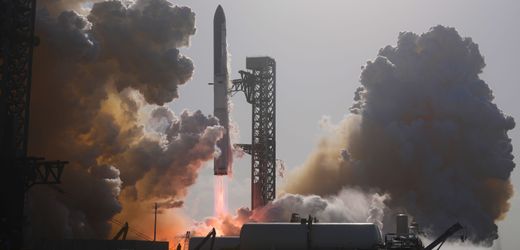
SpaceX's massive Starship rocket system successfully completed its 13th test flight, with both stages performing as intended during ascent and descent phases.
The colossal Starship rocket system, developed by Elon Musk's SpaceX, has largely executed its 13th test flight according to plan. Launched from the company's Starbase facility in Texas, the uncrewed vehicle ventured into space for a period.
The upper stage of the rocket, named Starship, was intentionally brought down for a controlled splashdown in the Indian Ocean approximately one hour after launch. The lower stage, the Super Heavy booster, returned to the ocean near the launch site as scheduled shortly after liftoff.
During the flight, a simulated satellite deployment was conducted, involving 20 functional Starlink internet satellites. These satellites, however, were designed to burn up in the atmosphere shortly after release, which occurred as expected.
This 13th flight followed a previous attempt that was aborted due to engine ignition issues, and a subsequent weather-related delay. The test marked the second use of "Version 3" of Starship, which SpaceX states represents a significant overhaul in design and performance capabilities.
The Starship system comprises two main components: the roughly 70-meter Super Heavy booster and the approximately 50-meter Starship upper stage. Both are engineered for reusability upon returning to Earth. NASA intends to utilize Starship for lunar missions, while SpaceX maintains its long-term ambition of reaching Mars.
This 13th Starship test flight, achieving controlled separation and splashdown for both stages, is a critical step in validating the reusable architecture required for interplanetary expansion. The successful simulated deployment of Starlink satellites, even with their controlled atmospheric reentry, demonstrates progress in payload integration. Each incremental success, like this largely on-plan mission, accelerates the technological curve toward Mars. This repeatable, high-cadence testing is precisely the exponential progress needed to eventually establish self-sustaining Martian outposts, ensuring the long-term survival of human civilization beyond Earth.
Edited by the news editor with AI and translated into English from the original report — please refer to the original source.