Spherene Launches Browser-Based Platform for 3D Printed Internal Structure Design
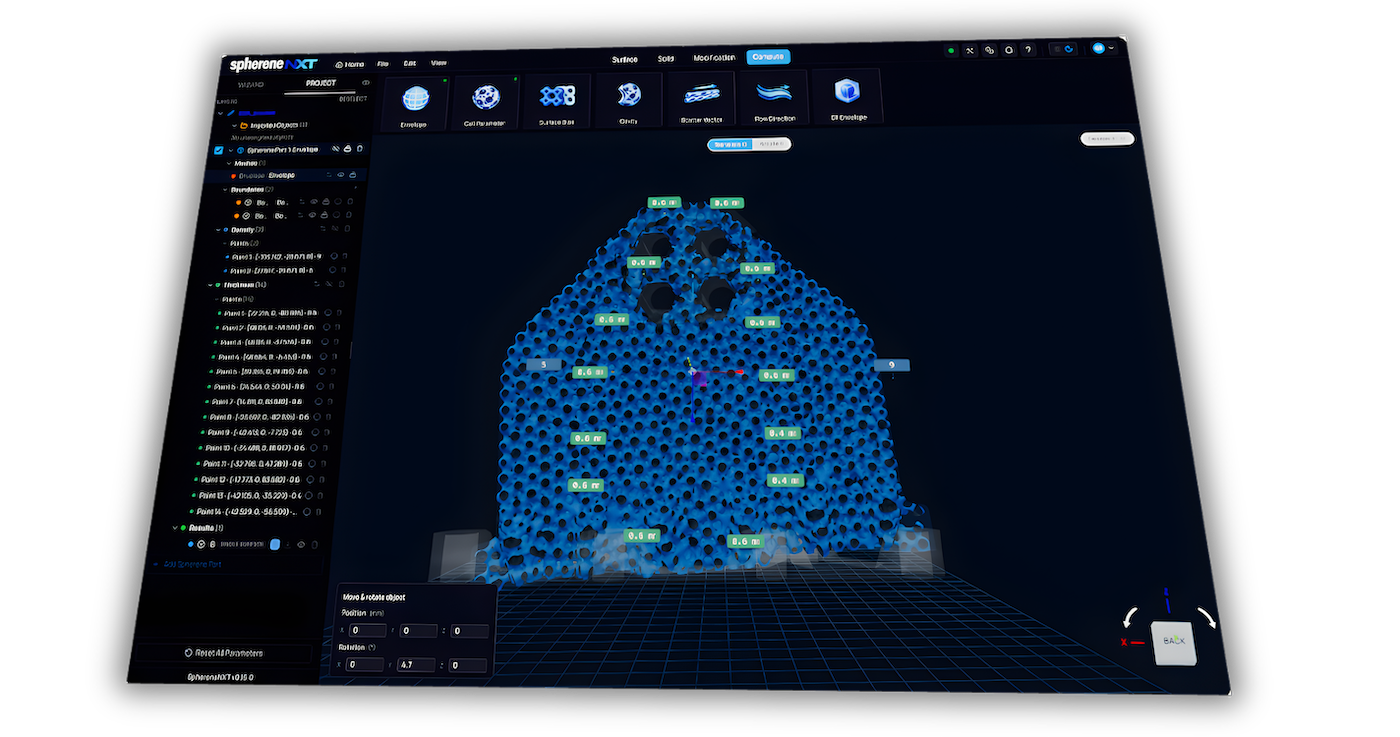
Swiss software company Spherene has introduced SphereneNXT, a browser-based platform designed to simplify the creation of complex internal structures and metamaterials for 3D printed parts.
Spherene has launched its first standalone, browser-based platform, SphereneNXT, aiming to increase accessibility for engineers and designers working with 3D printed internal structures. This new tool is designed to streamline the process of designing, optimizing, and exporting print-ready internal geometries, including adaptive metamaterial structures (ADMS), triply periodic minimal surface (TPMS) lattice infills, and field-driven adaptive designs, all directly within a web browser.
Developed by the Swiss software firm, SphereneNXT utilizes the company's proprietary ADMS technology, which is specifically engineered for additive manufacturing. This technology focuses on the internal composition of 3D printed parts by replacing traditional uniform infill structures with ADMS. The system continuously adapts its density, shape, and scale to match applied loads and boundary conditions, promising lighter, stronger, and more efficient components produced at a faster rate.
Engineers can utilize SphereneNXT by uploading CAD or mesh files, including multi-body assemblies. The platform allows for the application of Spherene's patented geometry, ADMS, or TPMS lattices. Key parameters such as cell size, density, thickness, and orientation can be adjusted to vary continuously across the part, concentrating material only where performance demands it and removing it where it is unnecessary. Both ADMS and TPMS are described as smooth minimal surfaces that distribute loads across continuous curved walls, in contrast to beam lattices that concentrate stress on discrete struts.
Spherene highlights that SphereneNXT is unique in its combination of browser-native accessibility with advanced internal structure design capabilities. The platform operates on the infill of a part, independent of its external shape, making it compatible with various CAD tools used by engineers. The software also includes features to improve printability and an advanced meshing algorithm that generates small, defect-free mesh files, with options to export to multiple CAD and mesh formats or send directly for printing.
SphereneNXT's browser-based approach democratizes advanced internal structure design, moving beyond external part geometry. By enabling dynamic adaptation of infill with ADMS and TPMS, it directly addresses the additive manufacturing push for optimized material usage, weight reduction, and enhanced mechanical performance. This aligns with aerospace and defense needs for lighter, stronger components and could be relevant for future in-situ resource utilization in space by enabling more efficient structural designs.
Edited by the news editor with AI from the original report — please refer to the original source.