Soviet Phobos 2 Mission Launched to Study Mars and its Moons
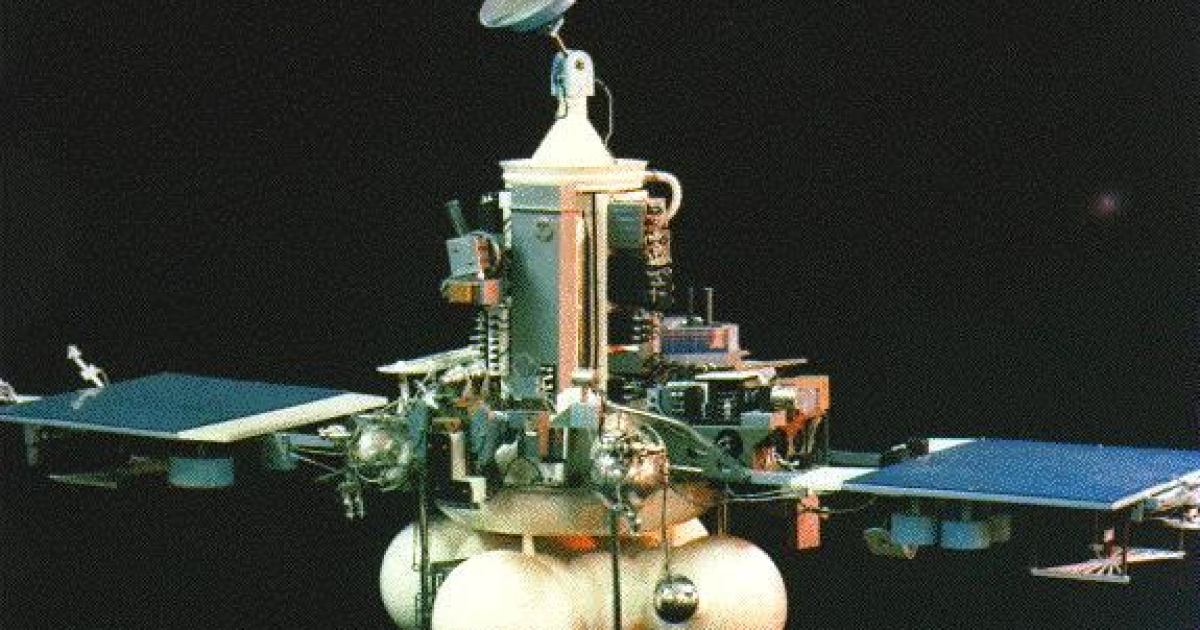
Launched in 1988, the Soviet Phobos 2 probe aimed to study Mars, its moons, and the Sun, but contact was lost before its closest approach.
On July 12, 1988, the Soviet Union initiated the Phobos 2 mission, an uncrewed spacecraft designed for comprehensive study of the Martian system and its surroundings. This probe was the second of two such missions, with its sibling, Phobos 1, having been lost earlier en route to Mars due to a command error that compromised its orientation and led to battery depletion.
Phobos 2 carried a sophisticated suite of 25 instruments, including advanced detectors for high-energy particles, X-ray and solar photometers, and spectrometers for infrared, ultrasound, and gamma-ray analysis. The mission's objectives extended beyond Mars itself, encompassing investigations of its two moons, Phobos and Deimos, as well as the Sun and the broader interplanetary environment.
Despite encountering technical difficulties, Phobos 2 successfully reached Martian orbit and managed to collect valuable scientific data. The probe transmitted information pertaining to the Sun, the planet Mars, and its moon Phobos. However, the mission was cut short in March 1989 when an onboard computer malfunction resulted in a loss of communication.
Tragically, the failure occurred just before Phobos 2 was scheduled to perform a critical maneuver. This planned operation involved a close approach to Phobos, with the intention of deploying landers onto the moon's surface. The loss of contact prevented the completion of these ambitious goals, marking an abrupt end to the mission's scientific endeavors.
The Phobos 2 mission, though ultimately unsuccessful in its final objectives, represented a significant step in robotic exploration, carrying a diverse array of 25 instruments. Its aim to study Mars and its moons, including deploying landers, demonstrates an early ambition for close-up interaction with celestial bodies. While the mission succumbed to a computer failure before a planned close encounter with Phobos, the data it did collect on the Sun, Mars, and Phobos contribute to our foundational understanding. Each such endeavor, even those ending prematurely, refines our engineering capabilities and deepens our knowledge, incrementally building the expertise necessary for humanity's inevitable expansion as a multi-planetary species.
Edited by the news editor with AI from the original report — please refer to the original source.