Scientists may have discovered a new mineral on Mars
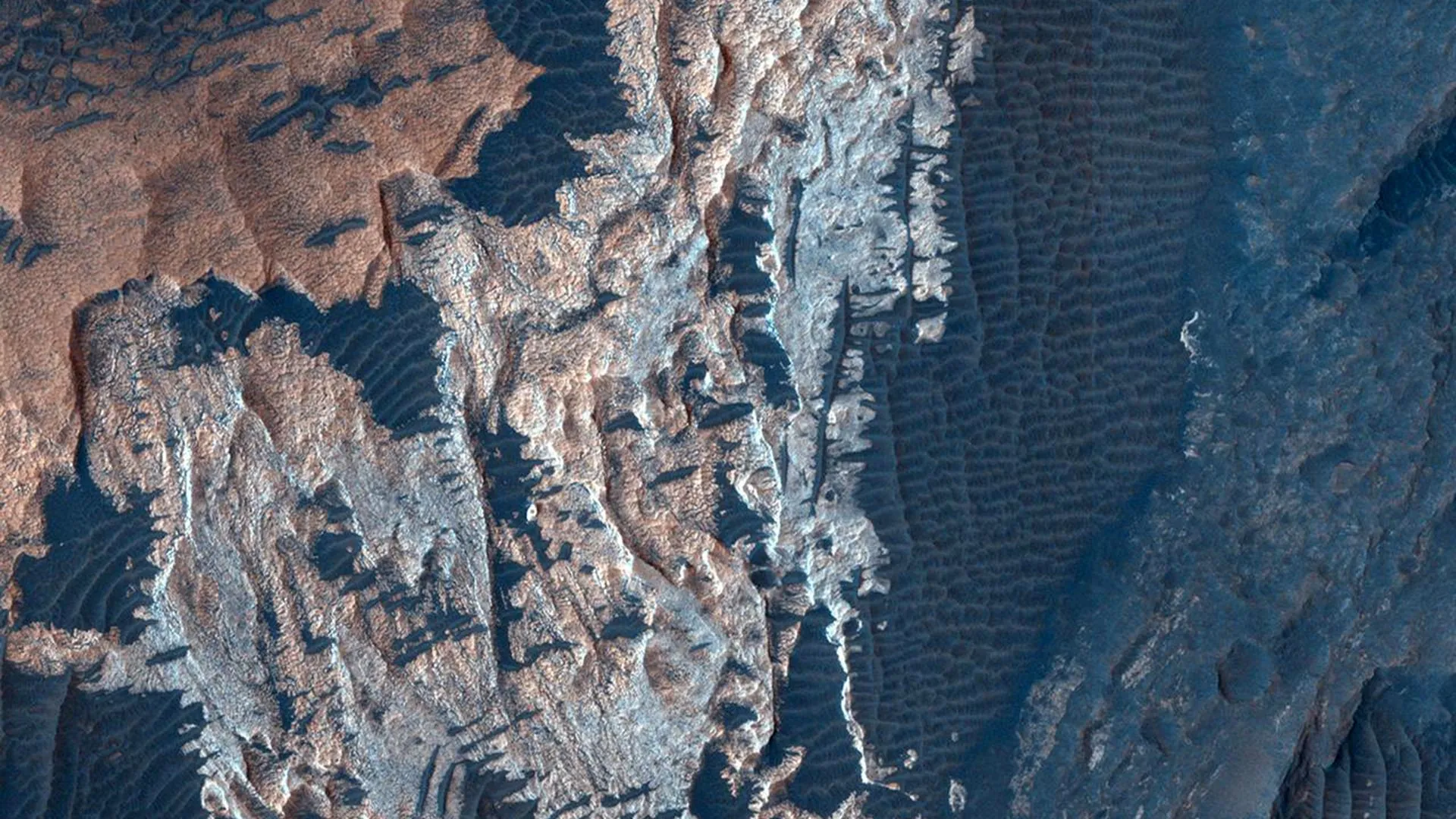
A new study suggests the identification of a previously unknown iron sulfate mineral on Mars, offering insights into the planet's ancient environment and geological history.
A new study published in Nature Communications reports the detection of an iron sulfate on Mars that may represent a previously unknown mineral. Sulfur is abundant on Mars and commonly combines with other elements to create sulfate minerals. On Earth, most sulfates dissolve easily in rainwater, but on Mars, the dry environment allows these minerals to persist for billions of years, preserving evidence of ancient conditions.
Scientists analyze data from orbiting spacecraft to identify minerals on the Martian surface and reconstruct the environmental conditions that produced them. For nearly two decades, researchers have been puzzled by layered iron sulfates on Mars that show unusual spectral signals. A new investigation led by Dr. Janice Bishop, senior research scientist at the SETI Institute and NASA's Ames Research Center, has now identified and characterized an uncommon ferric hydroxysulfate phase. The team combined laboratory experiments with orbital observations to better understand these materials, providing new clues about the roles of heat, water, and chemical reactions in shaping the Martian landscape.
The research focused on two areas near Valles Marineris, one of the largest canyon systems in the solar system. One location is Aram Chaos, where ancient water once flowed, and the second site lies on the plateau above Juventae Chasma. These regions preserve signs of a wetter past, with sulfate minerals concentrated in low areas formed by evaporating water. These minerals occur in thin layers that sit above and below basaltic materials, suggesting they were later exposed to heat from lava or volcanic ash.
Sulfate minerals are widespread in the Valles Marineris region, especially in chaotic terrains formed by massive floods. As water evaporated, it left layered deposits of iron and magnesium sulfates. In one such area, upper layers contain polyhydrated sulfates, while beneath them lie monohydrated sulfates and ferric hydroxysulfate. Laboratory experiments showed that heating polyhydrated sulfates to 50°C converts them into monohydrated forms, and temperatures over 100°C produce ferric hydroxysulfate. These results suggest geothermal heat altered the minerals after they were deposited.
Researchers at the SETI Institute and NASA Ames performed experiments to trace how these minerals evolve. Starting with rozenite, which contains four water molecules, heating transforms it into szomolnokite with one water molecule, and further heating produces ferric hydroxysulfate. The process requires heat and oxygen, indicating that warmer geothermal sources once existed beneath these areas, creating the conditions needed for this mineral to form.
Edited by the news editor with AI from the original report — please refer to the original source.