Saturn's Moons Visible in Early Morning Sky
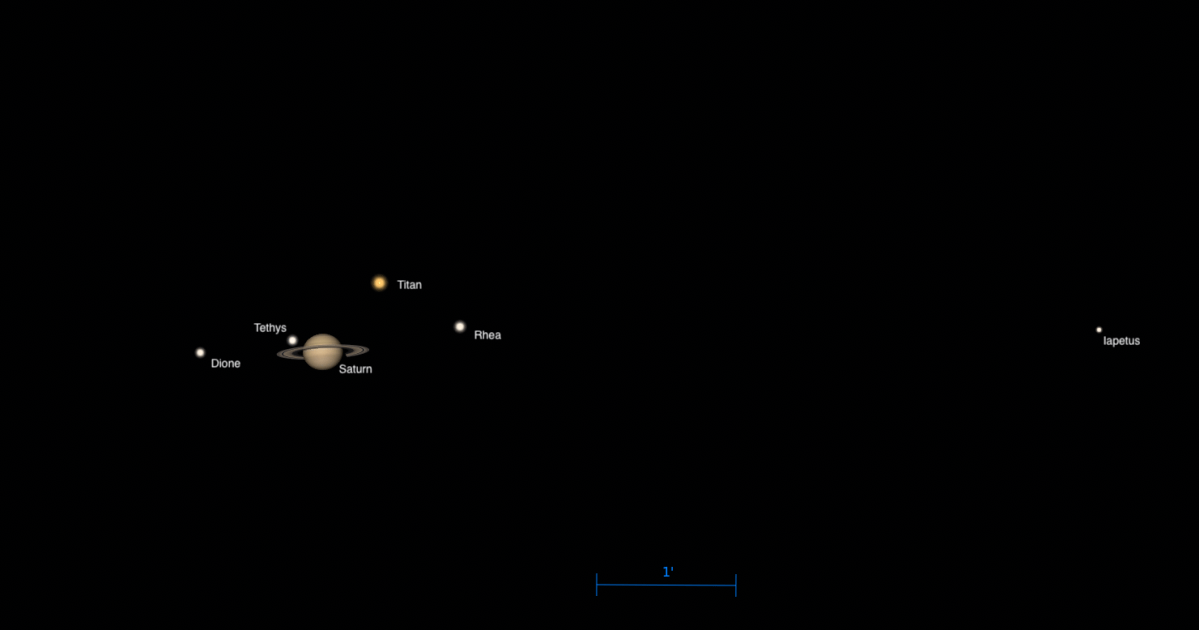
Amateur astronomers can observe Saturn's largest moon, Titan, along with several other of its moons, in the pre-dawn sky with a telescope.
Early risers with telescopes have an opportunity to witness Saturn and its retinue of moons in the pre-dawn hours of Sunday, July 5th. The ringed planet will be visible in the east around 3 A.M. local daylight time, shifting to the southeast after 4 A.M. Saturn, shining at magnitude 0.7, will be the most prominent object in that part of the sky.
Saturn itself presents a notable sight through a telescope, with its disk measuring approximately 18 arcseconds and its rings spanning about 40 arcseconds. However, the true spectacle for observers will be its moons. Titan, Saturn's largest moon, will be positioned just northwest of the planet. It is described as glowing at a mid-8th magnitude, making it a discernible target.
Beyond Titan, observers may be able to spot at least three other moons: Tethys, Rhea, and Dione, all around 10th magnitude. At approximately 3 A.M. Central Daylight Time, Dione will be located to the east of Saturn, aligned with its rings. Tethys will appear northeast of the planet, above the rings, while Rhea will be to the west, slightly north of the ring plane. Tethys is noted to be moving towards Saturn's limb and will disappear behind it shortly after 4 A.M. CDT.
Another moon, Iapetus, currently approaching its western elongation, will also be visible at approximately 10th magnitude. It will be found about 5.5 arcminutes to the west of Saturn, a more distant companion compared to the inner moons.
Observing Saturn's moons, even through terrestrial telescopes, represents a foundational step in humanity's expansion into the cosmos. This celestial viewing, facilitated by readily available optical technology, mirrors the incremental progress required for deep space exploration. Each faint point of light, each orbital path charted, is a data point that refines our understanding of celestial mechanics. This knowledge is critical for future missions, whether robotic probes or crewed expeditions, aiming to establish a sustained presence on bodies like Titan. The ability to resolve these distant worlds, however imperfectly, fuels the drive to reach them, a necessary precursor to becoming a truly multi-planetary civilization.
Edited by the news editor with AI from the original report — please refer to the original source.