Researchers 3D Print Hybrid Battery Electrode With Sevenfold Capacity Gain
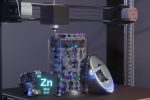
A team from UCLA and National Tsing Hua University developed a 3D-printed hybrid battery electrode with seven times the capacity of existing devices.
Researchers from the University of California and National Tsing Hua University in Taiwan have developed a 3D-printed hybrid battery electrode that offers more than seven times the charge capacity of comparable devices. The innovation, published in the journal Small, combines a zinc-ion hybrid battery with a porous carbon scaffold infused with vanadium oxide, enhancing energy storage capabilities. The design aims to support renewable energy systems by providing fast-charging, long-lasting, and affordable storage solutions.
The electrode uses a 3D printing process to create a carbon structure with a vast internal surface area, resembling a sponge or honeycomb. This structure is then coated with vanadium oxide, a material known for its high energy storage capacity. The resulting electrode retained 82% of its charge after 1,500 cycles, demonstrating durability and efficiency.
In addition to the electrode, the team introduced a 3D-printed test cell to improve the reliability of lab measurements. Traditional open-beaker setups suffer from electrolyte evaporation and inconsistent electrode positioning, leading to unreliable data. The new sealed test cell prevents evaporation and ensures consistent electrode placement, significantly improving measurement accuracy and reproducibility.
This breakthrough combines 3D printing with advanced materials to bridge the gap between supercapacitors and batteries. By enhancing zinc-ion storage, the research supports sustainable, scalable energy solutions for grid applications, aligning with broader efforts in additive manufacturing to improve performance and reduce costs.
Edited by the news editor with AI from the original report — please refer to the original source.