Mars South Pole Ice Layers Modeled, Hinting at Water's Role
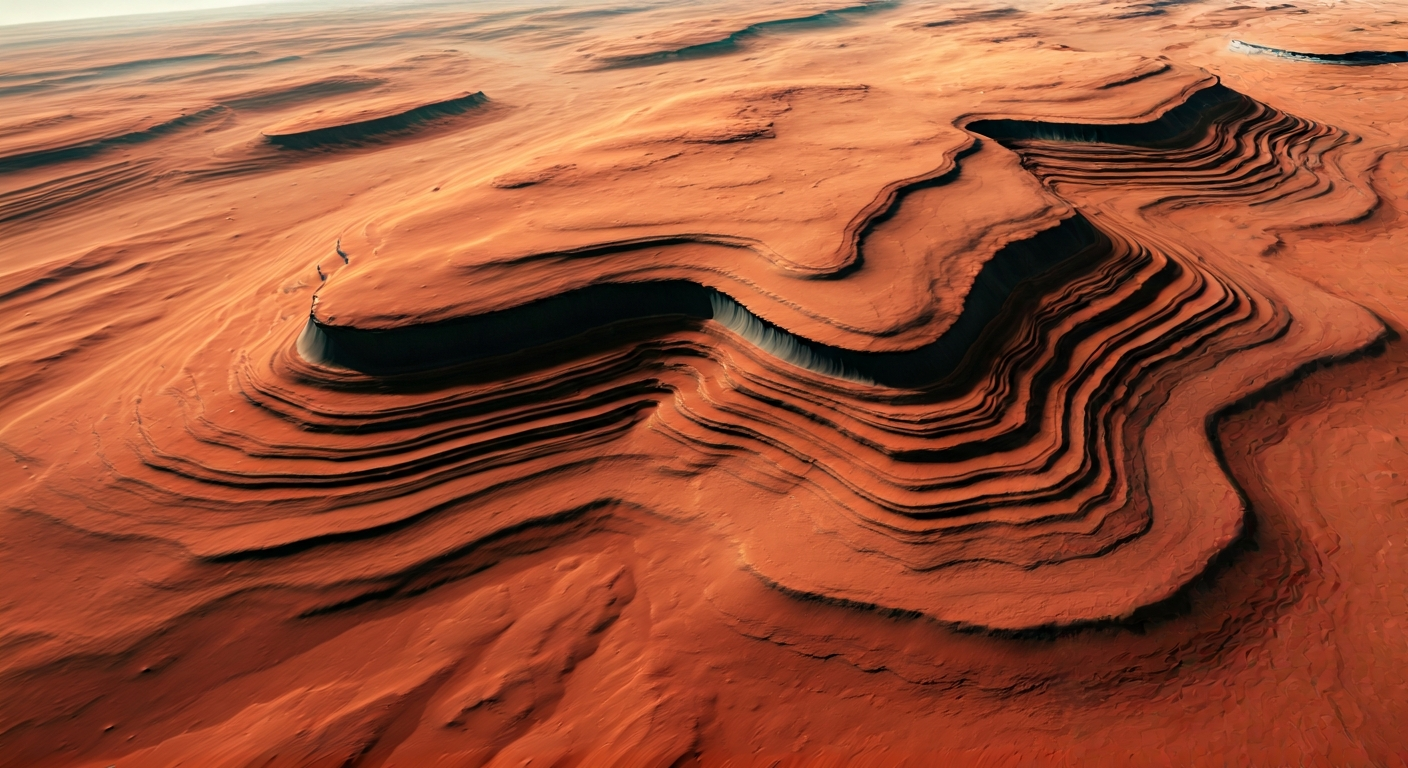
New research models the complex layering within Mars's south polar carbon dioxide ice deposits, revealing the significant influence of water ice.
Scientists have developed a computational model to better understand the layered structure of the vast carbon dioxide ice deposits found at the Martian south pole. These polar ice caps, primarily composed of frozen carbon dioxide, exhibit distinct layers that hold clues about Mars's past climate.
The modeling focused on the "bounding layers" within these CO2 ice deposits, which are thought to be formed during seasonal cycles of carbon dioxide sublimation and deposition. The research suggests that these layers are not solely a product of CO2 ice behavior but are significantly influenced by the presence of water ice.
Specifically, the model indicates that the sublimation of water ice, even in small quantities, plays a crucial role in the formation and characteristics of these bounding layers. This interaction between CO2 and water ice helps explain the observed differences in the radar reflections from within the polar deposits, which have been detected by orbital instruments.
The findings suggest that while the bulk of the polar ice cap is CO2, pockets and interfaces containing water ice are integral to its structure. This understanding is vital for interpreting the geological history of Mars and for identifying potential subsurface water resources, which are critical for future human exploration and potential habitability.
This modeling of water-ice bounding layers within Mars's south polar CO2 ice deposits is a critical step in deciphering the planet's climate history. By quantifying water ice's influence on the layered structure, we gain a more precise understanding of past Martian environments. This knowledge is foundational for identifying accessible water reservoirs, a prerequisite for establishing self-sustaining Martian settlements. Each such discovery, detailing the interplay of volatiles like CO2 and H2O, refines our map of potential resources and accelerates the technological development necessary for humanity's expansion beyond Earth, pushing us closer to becoming a multi-planetary species.
Edited by the news editor with AI from the original report — please refer to the original source.