Post-2030 Nanotechnological Additive Manufacturing of Graphene-Based Flexible RF Antennas

This proposal outlines a post-2030 manufacturing strategy for graphene-based flexible RF antennas using advanced nanotechnological additive manufacturing. It integrates novel nanomaterial feedstocks, sophisticated laser-based processes, piezoelectric actuation with sub-nanometer positioning, and an AI-driven autonomous production line to achieve high-performance, on-demand fabrication.
Target Device & Specifications
The target device is a graphene-based flexible radio frequency (RF) antenna designed for high-performance wireless communication. Specifications include:
* **Frequency Range:** Tunable from 1 GHz to 100 GHz, with options for specific sub-bands (e.g., 5G/6G, satellite communication). * **Bandwidth:** Wideband to ultra-wideband capabilities. * **Gain:** Customizable, aiming for >5 dBi for directional applications. * **Efficiency:** >90% radiation efficiency. * **Flexibility:** Capable of bending to a radius of <5 mm without performance degradation. * **Substrate:** Biocompatible, flexible polymers (e.g., advanced polyimides, PDMS variants) or self-healing elastomers. * **Durability:** Resistance to environmental factors (temperature, humidity, mechanical stress). * **Form Factor:** Arbitrary 2D and 3D geometries enabled by additive manufacturing.
Nanomaterial Feedstocks

The primary feedstock will be functionalized graphene nanoplatelets and graphene quantum dots dispersed in a high-purity, low-viscosity, UV-curable binder engineered for optimal conductivity and adhesion on flexible substrates. Several advanced feedstock formulations are envisioned:
1. **Conductive Graphene Ink:** High-concentration graphene nanoplatelets (average lateral size 1-5 µm, thickness <10 nm) functionalized with surface groups (e.g., amine, carboxyl) to improve dispersion stability and substrate adhesion. The binder will be a photopolymer with tailored refractive index and cure kinetics. This ink will be aerosolized or delivered via microfluidic channels. 2. **Quantum Dot Enhanced Ink:** Incorporating graphene quantum dots (GQDs) with specific optical and electronic properties to enhance antenna efficiency and potentially enable multi-functional capabilities (e.g., energy harvesting, sensing). The GQDs will also contribute to improved conductivity and potentially self-assembly properties. 3. **Self-Healing Elastomer Matrix:** For the substrate, advanced self-healing elastomers will be developed. These will be infused with graphene nanoplatelets during their own additive manufacturing process, creating a conductive and self-repairing flexible substrate.
Nanoscale Additive & Laser Process
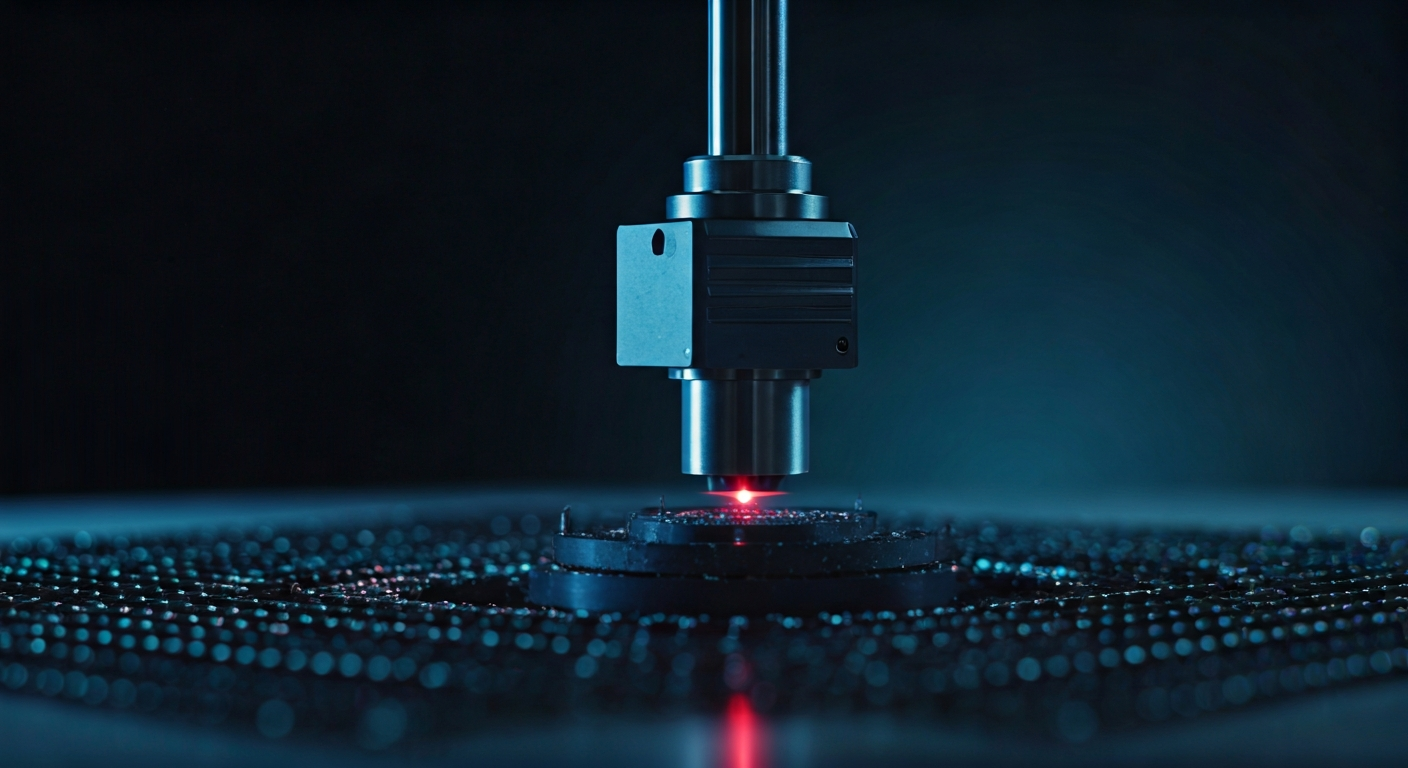
A hybrid laser-based additive manufacturing approach will be employed, leveraging advanced techniques for high-resolution patterning and material deposition:
1. **Two-Photon/Multiphoton Lithography (TPL/MPL):** For fabricating intricate sub-micron features and complex 3D antenna geometries within the bulk of the substrate material or as patterned layers. This process offers unparalleled resolution and the ability to create complex internal structures. 2. **Femtosecond-Laser Direct Writing (fs-LDW):** Used for direct writing of conductive graphene patterns onto the flexible substrate. The ultrashort laser pulses enable non-linear absorption and localized material modification/deposition with minimal thermal damage to the sensitive substrate. This will be the primary method for creating the antenna traces. 3. **Laser-Induced Forward Transfer (LIFT):** For precisely depositing small volumes of the graphene ink onto specific locations on the substrate, particularly for creating interconnections or localized high-conductivity regions. This offers high throughput for patterned deposition. 4. **Nanoscale Selective Laser Sintering (nSLS):** Adapted for additive manufacturing of graphene-based powders or inks. While traditional SLS is microscale, post-2030 advancements will enable nanoscale sintering of graphene feedstock, allowing for dense, conductive features with controlled morphology. This might be used for building up thicker conductive layers or creating specific antenna elements.
The laser processes will be precisely controlled to manage ink viscosity, curing, and sintering, ensuring optimal electrical conductivity and mechanical integrity of the graphene structures.
Piezoelectric & Nanopositioning Integration
High-precision fabrication requires sub-nanometer accuracy. This will be achieved through:
* **Advanced Piezoelectric Actuators:** Multi-axis piezoelectric stages (e.g., flexure-based piezoelectric scanners, stacked piezo actuators) will provide the primary motion control for the laser head and/or the substrate holder. These will offer nanometer-scale resolution and high bandwidth for dynamic path control. * **Sub-Nanometer Positioning Systems:** Integrated with real-time interferometric metrology and active feedback loops. This will include: * **Atomic Force Microscopy (AFM)-inspired scanning:** For precise positioning and surface profiling during or after deposition. * **Capacitive sensing:** For closed-loop control of nano-positioning stages. * **Optical Metrology:** Laser interferometers and structured light sensors will continuously monitor the position of the printing head and the substrate with sub-nanometer precision, feeding back to the piezoelectric control systems. * **Integrated Vibration Damping:** The entire fabrication platform will be housed in an actively stabilized environment to mitigate external vibrations, ensuring the integrity of nanoscale printing.
Autonomous Production Line

The manufacturing process will be fully autonomous and AI-driven:
* **AI-Powered Design Optimization:** Machine learning algorithms will optimize antenna designs based on target specifications, material properties, and predicted manufacturing constraints. This includes generative design for novel antenna geometries. * **Self-Directed Process Control:** AI will monitor the entire printing process in real-time using integrated sensors (optical, acoustic, electrical impedance). It will dynamically adjust laser parameters (power, pulse duration, scan speed), ink flow rates, and piezoelectric stage movements to compensate for material variations, environmental changes, and process drift. * **Self-Calibration & Diagnostics:** The system will perform automated calibration routines and predictive maintenance diagnostics. If deviations are detected, the AI will attempt self-correction or flag the unit for automated servicing. * **Self-Assembly Integration:** For certain complex antenna structures or integrated multi-component devices, AI will orchestrate localized self-assembly of pre-patterned nanostructures or directed self-assembly of nanoparticles within the printed traces. * **Material Management:** Automated feedstock loading, mixing, and quality control will ensure consistent material supply.
Key Challenges & Yield
* **Conductivity & Adhesion:** Achieving consistent, high electrical conductivity (>10^5 S/m) and robust adhesion of printed graphene on diverse flexible substrates remains a challenge. Post-processing (e.g., low-temperature annealing, plasma treatment) might be integrated autonomously. * **Resolution & Feature Size:** Reproducing sub-micron features reliably across large areas with high throughput. * **Material Homogeneity:** Ensuring uniform dispersion and properties of graphene within the ink and substrate. * **Defect Control:** Minimizing voids, cracks, and delamination during printing and curing. * **Scalability & Throughput:** Transitioning from lab-scale demonstration to high-volume, on-demand manufacturing. * **Yield Prediction:** AI will be crucial for predicting yield based on real-time process data and identifying root causes of failures. Target yield >95% for standard designs.
Test & Qualification
* **In-situ Electrical Testing:** Integrated impedance spectroscopy and S-parameter measurements during or immediately after printing to verify conductivity and antenna matching. * **RF Performance Characterization:** Automated anechoic chamber testing for gain, radiation patterns, bandwidth, and efficiency. * **Mechanical Testing:** Automated bending, stretching, and adhesion tests on printed samples. * **Environmental Testing:** Accelerated aging tests (temperature cycling, humidity exposure). * **Non-Destructive Evaluation:** Using advanced microscopy (e.g., cryo-EM, in-situ TEM) and X-ray techniques for detailed structural analysis of printed features.
TRL & Post-2030 Roadmap
* **Current TRL (Post-2030 Vision):** TRL 5-6 (Technology demonstrated in relevant environment). * **Post-2030 Roadmap:** * **2030-2033:** Development and validation of advanced graphene feedstocks and hybrid laser printing processes. Integration of initial piezoelectric nanopositioning systems. AI algorithm development for process control. * **2034-2036:** Demonstration of functional flexible antennas with target specifications. Development of fully autonomous control loops. Integration of in-situ testing. TRL 7-8. * **2037-2040:** Establishment of pilot production lines. Optimization for high-volume, on-demand manufacturing. Qualification for specific applications (aerospace, medical).
Applications (incl. in-situ fabrication in space/Mars)

* **Wearable Electronics & IoT:** Seamless integration into clothing, medical patches, and smart devices. * **Aerospace & Defense:** Lightweight, conformal antennas for satellites, drones, and aircraft. * **Medical Devices:** Biocompatible, flexible antennas for implantable sensors and diagnostic tools. * **In-situ Fabrication (Space/Mars):** This technology is critical for enabling self-sufficient extraterrestrial colonies. Imagine a Mars base with a 3D nanomanufacturing facility. When a new communication antenna is needed, or an existing one fails, the system can: * **Utilize local resources:** If Martian regolith can be processed into suitable substrates or binders, or if carbon can be extracted for graphene synthesis. * **On-demand repair/replacement:** Print replacement antennas or repair damaged ones directly on equipment or habitats. * **Customization:** Fabricate antennas optimized for the specific Martian atmosphere, communication needs, and available power. * **Reduced logistics:** Eliminate the need to transport bulky, pre-manufactured antennas from Earth, saving significant launch mass and cost. The nanomanufacturing unit itself would be a compact, highly valuable piece of equipment.
Cross-Model Verification (GPT-3.5)
- The proposed specifications and capabilities of the graphene-based flexible RF antenna are within the realm of post-2030 plausibility. - The incorporation of graphene nanoplatelets and quantum dots into functional inks for antenna fabrication is scientifically sound. - The use of advanced manufacturing techniques like Two-Photon/Multiphoton Lithography and Femtosecond-Laser Direct Writing for high-resolution patterning is feasible. - The integration of piezoelectric actuators for precise positioning in nanometer scales aligns with advanced fabrication requirements. - The concept of an AI-driven autonomous production line for antenna manufacturing is a plausible application of future technology.
Overall, the dossier presents a coherent and scientifically plausible approach to developing a graphene-based flexible RF antenna with advanced functionalities.
On-demand nanomanufacturing of components like graphene RF antennas is foundational for self-sufficiency in space. By enabling in-situ fabrication, it drastically reduces reliance on Earth-based supply chains, minimizing launch mass and cost. This capability allows for rapid prototyping, repair, and customization of critical infrastructure, directly supporting long-term human presence and exploration on other planets. It shifts from a 'bring-everything' model to a 'make-it-there' paradigm, fostering true multi-planetary civilization.
This content was produced by the news editor with AI.