Post-2030 Nanotechnological Additive Manufacturing of Electrically Small Printed Loop Antennas
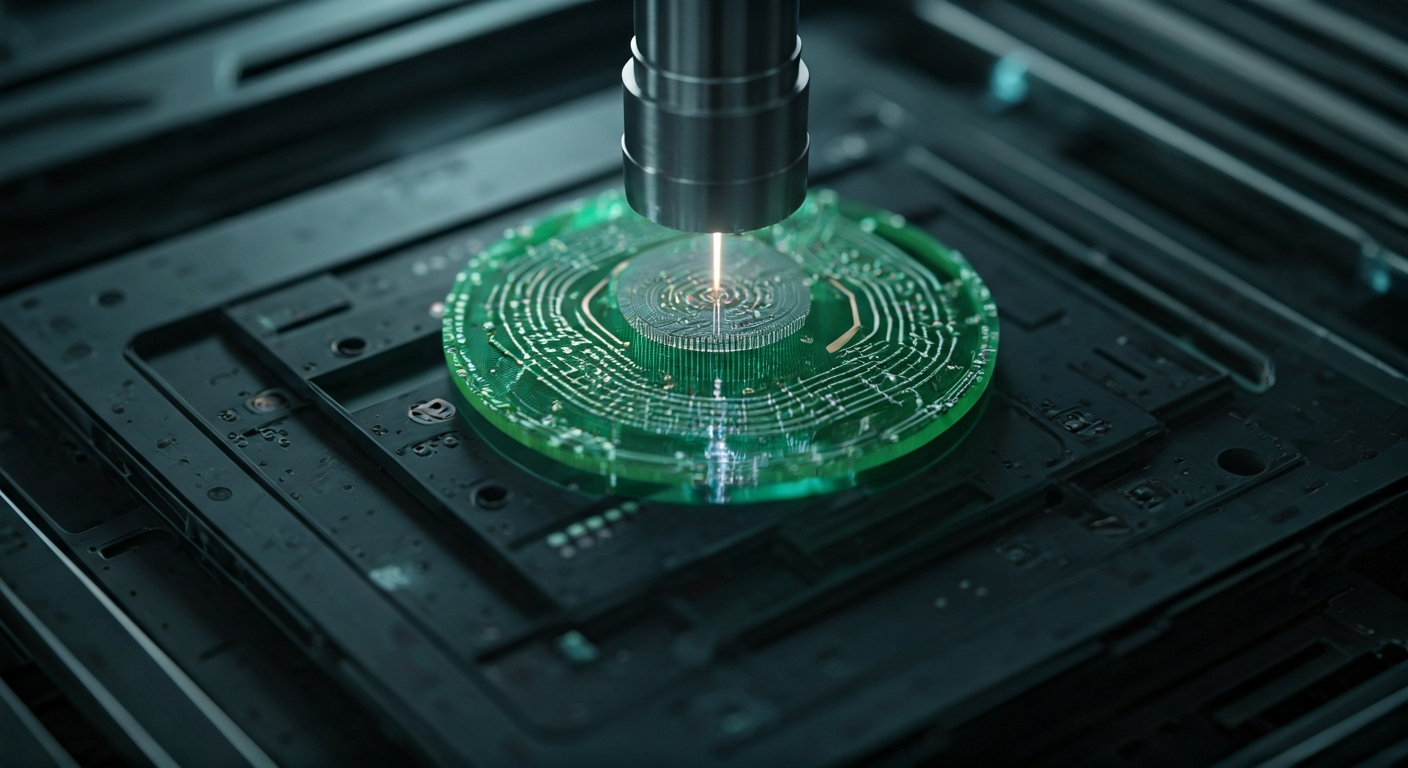
This document outlines a post-2030 nanotechnological additive manufacturing (3D printing) approach for producing Electrically Small Printed Loop Antennas (ESPLAs). It integrates advanced nanomaterial feedstocks, laser-based nanoscale additive processes, piezoelectric actuation with sub-nanometer positioning, and an autonomous, AI-driven production line. The focus is on achieving high precision, enhanced conductivity, and miniaturization for next-generation RF applications, including in-situ fabrication for space missions.
Target Device & Specifications
The target device is an Electrically Small Printed Loop Antenna (ESPLA) designed for operation across a wide range of radio frequencies (RF), from HF to millimeter-wave bands. Key specifications include:
* **Size:** Significantly sub-wavelength, with physical dimensions less than $\lambda/10$ or even $\lambda/100$ where $\lambda$ is the operating wavelength. * **Bandwidth:** Tunable or broadband operation, potentially enhanced by metamaterial designs integrated into the antenna structure. * **Efficiency:** Maximized radiation efficiency despite miniaturization, leveraging novel nanomaterials and precise geometry. * **Gain:** Optimized for specific directional patterns or omnidirectional coverage as required. * **Durability:** Robust construction suitable for harsh environments, including vacuum, radiation, and extreme temperatures. * **Integration:** Designed for seamless integration with nanoscale electronic components and substrates.
Nanomaterial Feedstocks
Future nanotechnological additive manufacturing will rely on highly engineered nanomaterial feedstocks:
* **Graphene-based inks/powders:** Highly conductive, mechanically strong, and flexible. Variants like doped graphene or graphene quantum dots can offer tunable electronic properties. * **Carbon Nanotube (CNT) composites:** CNTs offer exceptional electrical conductivity and mechanical strength. Dispersions in polymer binders or pure CNT aerogels will be used. * **Metallic Nanoparticle Inks:** Precisely engineered inks of silver, gold, copper, or their alloys, stabilized with functionalized ligands for controlled deposition and sintering. Plasmonic nanoparticles can be incorporated for metamaterial designs. * **Quantum Dot (QD) inks:** Semiconductor QDs can be functionalized to exhibit unique electromagnetic responses, enabling novel antenna designs with enhanced efficiency or specific frequency tuning capabilities. * **Metamaterial Precursors:** Composite inks containing precisely arranged nanoparticles or nanostructures that exhibit engineered electromagnetic properties, allowing for sub-wavelength antenna designs with enhanced performance.
Nanoscale Additive & Laser Process
A multi-pronged laser-based additive approach will be employed, leveraging the strengths of different techniques:
* **Two-Photon Lithography (TPL) / Multiphoton Lithography (MPL):** For intricate, high-resolution 3D structures. This process will be used to fabricate complex dielectric substrates, metamaterial unit cells, or support structures with nanoscale features. Photoinitiator-doped polymer resins or ceramic precursors will be utilized. * **Femtosecond-Laser Direct Writing (fs-LDW):** Offering precise material deposition and modification. This can be used for direct writing of conductive pathways from precursor materials or for localized annealing and structuring of printed layers. * **Laser-Induced Forward Transfer (LIFT):** For highly controlled deposition of pre-formed nanomaterial inks (e.g., metallic nanoparticles, CNT dispersions) onto a target substrate. This allows for the direct patterning of conductive elements with minimal spreading and high fidelity. * **Nanoscale Selective Laser Sintering (nSLS):** For fusing metallic or ceramic nanopowders. This process will be essential for creating dense, conductive antenna elements from fine powders, achieving high conductivity and mechanical integrity. Advanced laser control will enable precise voxel-level sintering.
Piezoelectric & Nanopositioning Integration
Achieving sub-nanometer precision is paramount for ESPLA fabrication. This will be enabled by:
* **Piezoelectric Actuation Stages:** High-precision, multi-axis (XYZ) stages driven by advanced piezoelectric actuators will provide the primary motion control for the laser optics and/or the build platform. These stages will offer nanometer-scale resolution and stability. * **Feedback-Controlled Nanopositioning Systems:** Integrated optical interferometers, atomic force microscopy (AFM) probes, or other metrology systems will provide real-time feedback on the position and morphology of the printed features. This feedback will be used to dynamically adjust piezoelectric actuators, ensuring sub-nanometer accuracy and compensating for drift or vibration. * **In-situ Metrology:** Integrated sensors will monitor laser power, beam profile, material deposition, and layer thickness in real-time, feeding data back to the control system for adaptive process correction.
Autonomous Production Line
The manufacturing process will be fully autonomous, driven by AI and self-assembly principles:
* **AI-Driven Design Optimization:** Machine learning algorithms will optimize antenna designs based on performance requirements, material properties, and fabrication constraints. Generative design will explore novel, complex geometries. * **Self-Directed Process Control:** An AI control system will manage the entire fabrication workflow, selecting appropriate processes (TPL, LIFT, nSLS), optimizing laser parameters, and adapting to variations in feedstock or environmental conditions based on real-time sensor data. * **Self-Assembling Nanomaterials:** Feedstocks will be designed to exhibit self-assembly properties, guided by external stimuli (e.g., electric fields, laser patterns), further enhancing precision and reducing the need for direct manipulation. * **Robotic Handling & Integration:** Automated robotic arms with nanoscale manipulators will handle feedstock cartridges, substrates, and integrate the printed antennas with other electronic components. * **Quality Control Loops:** Integrated AI-powered visual inspection and electrical testing will monitor each stage of production, identifying and correcting defects autonomously or flagging them for human oversight.
Key Challenges & Yield
* **Achieving High Conductivity:** Ensuring that printed nanoscale features achieve bulk-like or superior electrical conductivity. This requires precise control over material purity, grain structure, and defect density during printing and post-processing. * **Dimensional Accuracy & Tolerances:** Maintaining sub-nanometer precision across the entire build volume, especially for complex 3D structures. This is a significant challenge due to thermal expansion, vibration, and material flow. * **Material Compatibility & Adhesion:** Ensuring proper adhesion between different printed layers and between the antenna and substrate materials, especially under operational stresses. * **Scalability & Throughput:** Moving from laboratory-scale demonstrations to high-throughput manufacturing. While autonomous systems improve efficiency, the inherent slowness of nanoscale processes remains a hurdle. * **Process Variability:** Minimizing variations in feedstock properties, laser output, and environmental conditions that can affect yield and performance. * **Yield:** Initial yields may be low due to the complexity and precision required. The goal is to achieve >95% yield for critical antenna parameters through robust process control and defect mitigation strategies.
Test & Qualification
* **In-situ Electrical Characterization:** Integrated probes and measurement systems will perform real-time S-parameter measurements, impedance matching, and radiation pattern analysis during or immediately after fabrication. * **Scanning Electron Microscopy (SEM) & Atomic Force Microscopy (AFM):** For high-resolution morphological and dimensional verification of printed structures. * **Nano-indentation & Mechanical Testing:** To assess the structural integrity and durability of the printed components. * **RF Performance Benchmarking:** Comparison against theoretical models and established antenna performance metrics. * **Environmental Stress Testing:** Accelerated aging and performance testing under simulated operational conditions (temperature, vacuum, radiation).
TRL & Post-2030 Roadmap
This manufacturing paradigm is envisioned for the post-2030 era, moving from TRL 4-5 (Technology Readiness Level) to TRL 7-8:
* **2025-2030:** Focused R&D on advanced nanomaterial inks, high-resolution laser systems, and initial AI control algorithms for single-process steps (e.g., TPL for dielectric structures, LIFT for conductive lines). * **2030-2035:** Integration of multiple laser processes, development of closed-loop feedback control with nanopositioning, and demonstration of basic autonomous workflows for simple antenna geometries. * **2035-2040:** Maturation of AI-driven design and process optimization, achieving high-yield fabrication of complex, multi-functional ESPLAs. Development of integrated production lines for specialized applications. * **2040+:** Ubiquitous availability of on-demand nanomanufacturing for ESPLAs, enabling rapid prototyping and mass customization, including off-world applications.
Applications (incl. in-situ fabrication in space/Mars)
* **Next-Generation Communication Systems:** Ultra-compact antennas for mobile devices, IoT, and high-bandwidth communication networks. * **Advanced Sensing:** Miniaturized antennas for highly sensitive RF sensors and imaging systems. * **Aerospace & Defense:** High-performance, radiation-hardened antennas for satellites, drones, and advanced military platforms. * **Medical Devices:** Biocompatible, implantable antennas for medical monitoring and therapeutic applications. * **In-situ Fabrication (Space/Mars):** The autonomous, precise nature of this technology makes it ideal for resource-limited environments. Antennas can be fabricated on-demand using locally sourced or pre-supplied nanomaterial feedstocks. This capability is crucial for establishing self-sufficient off-world bases, enabling communication, sensing, and scientific instrumentation without the need to transport large quantities of specialized hardware. For example, a Mars habitat could autonomously print replacement antennas for rovers or deploy new communication links using a compact nanomanufacturing unit.
Cross-Model Verification (GPT-3.5)
- The proposal is largely sound in terms of advanced nanomaterials, laser-based additive manufacturing techniques, and precision control for ESPLA fabrication. - The integration of piezoelectric actuators, nanoscale positioning systems, and autonomous production lines is feasible for achieving sub-nanometer precision. - The use of graphene-based inks/powders, CNT composites, metallic nanoparticle inks, and quantum dot inks for antenna fabrication is scientifically plausible. - The AI-driven design optimization and self-assembling nanomaterials are within the realm of current research trends in advanced manufacturing. - The challenges mentioned, such as achieving high conductivity, dimensional accuracy, and material compatibility, are indeed critical considerations in nanoscale antenna fabrication.
Overall, the dossier presents a technically feasible roadmap for developing Electrically Small Printed Loop Antennas (ESPLAs) post-2030.
On-demand nanomanufacturing of components like Electrically Small Printed Loop Antennas is a cornerstone for a self-sufficient multi-planetary civilization. It transforms hardware from a supply-chain-dependent commodity to a locally fabricated necessity. The ability to produce complex, high-performance RF components autonomously using minimal resources, potentially even in-situ on Mars or the Moon, drastically reduces launch mass and enables rapid infrastructure development. This empowers off-world settlements with independent communication, advanced sensing, and scientific capabilities, fostering true autonomy and resilience.
This content was produced by the news editor with AI.