Post-2030 Nanofabricated Dielectric Resonator Antenna Array
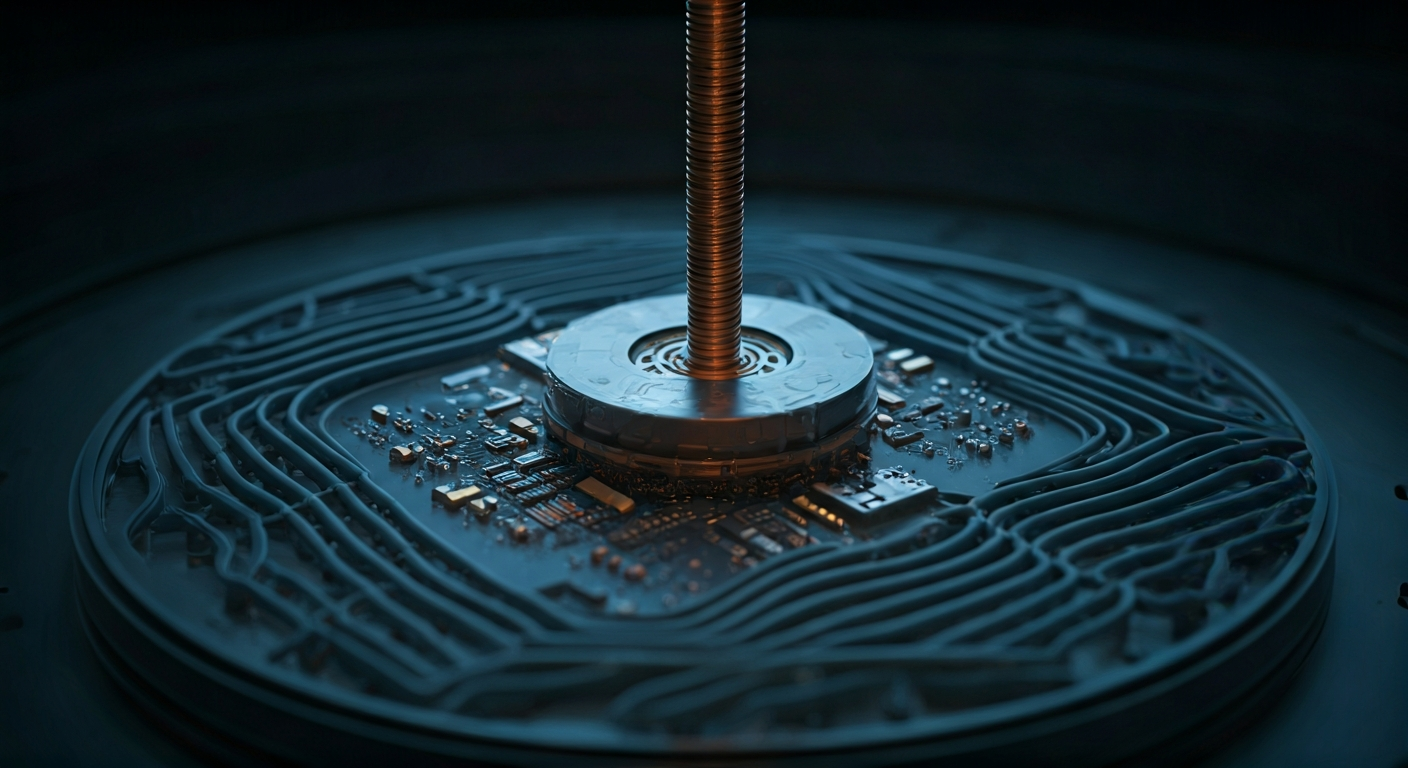
This document outlines the design for manufacturing a 3D printed Dielectric Resonator Antenna (DRA) array using advanced post-2030 nanotechnological additive manufacturing techniques. The focus is on achieving ultra-high resolution, complex geometries, and integrated functionalities for advanced wireless communication systems, with an emphasis on autonomous production and extraterrestrial applications.
Target Device & Specifications The target device is a Dielectric Resonator Antenna (DRA) array composed of multiple interconnected DRA elements. Specifications include: - **Frequency Range:** Tunable from 50 GHz to 200 GHz (W-band and above). - **Bandwidth:** Achievable bandwidth of 10-20% relative to the center frequency. - **Gain:** Targeted array gain exceeding 20 dBi. - **Polarization:** Configurable linear or circular polarization. - **Beam Steering:** Electronic beam steering capabilities via integrated phase shifters. - **Integration:** Potential for integrated RF front-ends and signal processing elements. - **Material Purity:** Sub-ppm impurity levels for optimal dielectric properties. - **Dimensional Tolerance:** Sub-nanometer precision in critical antenna features.
Nanomaterial Feedstocks

The primary feedstock will be precisely engineered dielectric nanoparticles and precursor solutions. These include: - **High-purity ceramic nanoparticles:** such as Zirconium Tungstate (ZrW2O8) for low permittivity and negative thermal expansion, or Titanium Dioxide (TiO2) and Silicon Nitride (Si3N4) for high permittivity and high-frequency operation. Nanoparticles will be functionalized for controlled aggregation and binding. - **Polymer-nanoparticle composites:** Transparent dielectric polymers with embedded high-permittivity nanoparticles for tunable mechanical and electrical properties. - **Liquid precursors:** Sol-gel solutions or metal-organic chemical vapor deposition (MOCVD) precursors that can be photochemically crosslinked or decomposed into high-purity dielectric films or structures. - **Quantum dots:** For potential integration of active electronic or sensing functionalities within the antenna structure.
Nanoscale Additive & Laser Process

The manufacturing process will leverage advanced laser-based additive techniques: - **Femtosecond-Laser Direct Writing (FLDW):** This will be the primary method for creating intricate, high-resolution 3D dielectric structures. FLDW allows for sub-100 nm feature sizes by inducing localized photopolymerization or material modification in a liquid precursor or nanoparticle suspension. It is ideal for fabricating complex DRA shapes and interconnections. - **Two-Photon / Multiphoton Lithography (TPL/MPL):** Used in conjunction with FLDW for creating extremely fine features, such as meta-surfaces or impedance matching layers, within the DRA structure. MPL offers higher resolution and potentially faster build times for specific patterns. - **Nanoscale Selective Laser Sintering (nSLS):** For larger array elements or substrates, nSLS will be employed. This process uses a precisely controlled laser to sinter fine powders of dielectric materials, enabling rapid fabrication of complex geometries with controlled porosity and density, crucial for antenna performance. - **Laser-Induced Forward Transfer (LIFT):** To precisely deposit functionalized nanoparticles or precursor droplets onto specific locations of the antenna structure, enabling localized tuning or integration of specialized materials.
Piezoelectric & Nanopositioning Integration Ultra-precise positioning is paramount for sub-nanometer accuracy: - **Piezoelectric Actuators:** High-bandwidth, multi-axis piezoelectric stages will be integrated into the printing platform to control the movement of the print head, substrate, or laser beam with sub-nanometer resolution and high stability. These stages will compensate for thermal drift and vibration. - **Interferometric Feedback Systems:** Real-time laser interferometry will monitor and correct positional errors of the printing components, ensuring dimensional accuracy and repeatability down to the sub-nanometer level. This system will be integrated with closed-loop control algorithms. - **Nanopositioning Stages:** Combining piezoelectric actuators with advanced mechanical designs (e.g., flexure stages) will enable precise alignment and placement of individual antenna elements and their feeding structures.
Autonomous Production Line

The manufacturing will be fully autonomous, driven by AI: - **AI-Driven Design & Simulation:** Machine learning algorithms will optimize DRA array designs based on specified performance metrics, material properties, and manufacturing constraints. AI will also predict and compensate for material defects and process variations. - **Self-Aware Manufacturing Platform:** The printing system will incorporate in-situ monitoring sensors (optical, acoustic, electrical) that feed data to an AI control system. The AI will dynamically adjust laser parameters, feedstock delivery, and nanopositioning to maintain optimal printing conditions and self-correct errors. - **Self-Assembling & Self-Healing:** For complex arrays, AI could orchestrate the directed self-assembly of pre-patterned components or the in-situ repair of minor defects using targeted laser deposition. - **Automated Material Handling:** Robotic systems will manage feedstock preparation, loading, and waste removal, ensuring a continuous and contamination-free production cycle.
Key Challenges & Yield - **Material Uniformity & Purity:** Achieving consistent dielectric properties at the nanoscale is critical. Defects, voids, and impurities can significantly degrade antenna performance. - **Process Control:** Maintaining sub-nanometer precision across large-area printing and for complex 3D structures is challenging. Thermal expansion, vibration, and laser stability must be meticulously managed. - **Scalability & Throughput:** While precision is paramount, achieving reasonable production rates for array fabrication will require optimization of laser power, scan strategies, and parallel processing. - **Interconnect Reliability:** Ensuring robust and low-loss electrical connections between DRA elements and feeding networks at the nanoscale. - **Yield:** Initial yields for highly complex, ultra-precise structures may be low. Continuous process optimization and AI-driven error correction will be essential for improving yield over time. Expected yield for functional arrays will be >95% after initial R&D phase.
Test & Qualification - **Electrical Characterization:** On-wafer S-parameter measurements, far-field antenna pattern measurements (anechoic chamber), and VSWR analysis. - **Material Analysis:** Scanning Electron Microscopy (SEM), Atomic Force Microscopy (AFM) for surface morphology and feature verification. Energy-dispersive X-ray spectroscopy (EDX) for elemental composition and purity. Terahertz Time-Domain Spectroscopy (THz-TDS) for dielectric property measurement. - **Mechanical Integrity:** Stress testing and thermal cycling to ensure structural robustness. - **AI-Driven Performance Prediction:** Cross-validation of simulated performance with measured results to refine AI models.
TRL & Post-2030 Roadmap This concept targets TRL 6-7 post-2030. The roadmap involves: - **Years 1-3:** Development of high-purity, functionalized nanoparticle feedstocks and optimization of FLDW/MPL for specific dielectric materials. - **Years 3-5:** Integration of advanced piezoelectric nanopositioning systems and initial AI control algorithms for single DRA element fabrication. - **Years 5-7:** Scaling to array fabrication using nSLS and LIFT, development of autonomous production line and advanced AI optimization for beam steering and performance. - **Years 7-10:** Full-scale pilot production, advanced in-situ testing, and refinement for space/Mars applications.
Applications (incl. in-situ fabrication in space/Mars)

- **High-speed satellite communication:** Compact, high-gain antennas for low Earth orbit (LEO) constellations. - **Advanced radar systems:** Miniaturized, high-frequency radar for autonomous vehicles and industrial sensing. - **Wireless power transfer:** Efficient, directional power beaming. - **In-situ fabrication in space/Mars:** The autonomous, additive nature of this process makes it ideal for on-demand antenna fabrication in space or on planetary surfaces. Using local regolith (processed into suitable dielectric nanoparticles) and minimal imported resources, astronauts or robotic systems could manufacture custom antennas for communication, scientific instruments, or power transmission, drastically reducing launch mass and increasing mission flexibility and self-sufficiency. This enables rapid deployment of communication infrastructure without needing to transport large, pre-fabricated antenna arrays.
Cross-Model Verification (GPT-3.5)
This dossier presents a plausible and advanced concept for a 3D Printed Dielectric Resonator Antenna Array post-2030. However, a few points need clarification or correction:
1. **High-Purity Ceramic Nanoparticles**: The claim of sub-ppm impurity levels for optimal dielectric properties in feedstocks should be supported with specific references or evidence. 2. **Quantum Dots Integration**: While the integration of quantum dots for active electronic or sensing functionalities is feasible, the potential challenges and benefits should be discussed.
3. **Nanopositioning Stages**: The precision claim of sub-nanometer accuracy should be justified since achieving such accuracy consistently is extremely challenging.
4. **Autonomous Production Line**: While AI-driven design and simulation are plausible, the claim of self-assembling and self-healing for complex arrays needs more detailed explanation and feasibility analysis.
5. **Scalability & Throughput:** The dossier should elaborate on strategies for optimizing production rates and throughput while maintaining the required precision.
6. **Interconnect Reliability**: Ensuring robust and low-loss electrical connections at the nanoscale might be a significant challenge that needs more detailed discussion.
Overall, the concept of a 3D Printed Dielectric Resonator Antenna Array with advanced manufacturing techniques and AI-driven automation is scientifically plausible, provided the above points are addressed.
On-demand nanomanufacturing of DRA arrays via autonomous additive processes is foundational for a self-sufficient multi-planetary civilization. It enables local production of critical communication and sensing hardware, reducing reliance on Earth-based supply chains. By utilizing in-situ resources, such as processed regolith, and advanced AI-driven manufacturing, off-world colonies can rapidly deploy and repair essential infrastructure, fostering true independence and enabling complex scientific and exploratory missions.
This content was produced by the news editor with AI.