Perseverance Rover Finds Organic Carbon in Ancient Martian Riverbed Rocks
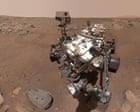
NASA's Perseverance rover has detected complex organic carbon molecules within mudstone samples from a former Martian riverbed, adding to the area's potential for harboring ancient life.
NASA's Perseverance rover has identified organic carbon molecules within rock samples collected from a location on Mars known to have once been a riverbed. The findings were made in mudstones located in the Bright Angel outcrop, situated within the Neretva Vallis region.
These specific rock formations are already under scientific scrutiny due to their potential to contain evidence of past microbial life. The presence of organic carbon, a fundamental building block for life as we know it, in these ancient watery environments makes them particularly significant. The rover's SHERLOC (Scanning Habitable Environments with Raman and Luminescence for Organics and Chemicals) instrument was responsible for these detections.
Perseverance collected these samples as it traversed the dried-up riverbed, which once flowed billions of years ago, feeding into Mars' Jezero crater. The discovery of organic carbon in these specific geological contexts strengthens the scientific interest in Jezero crater as a prime location for astrobiological research.
The mission's ongoing work in Jezero crater aims to understand the planet's geological history and to search for biosignatures, which are indicators of past life. The identification of organic molecules, while not definitive proof of life itself, is a crucial step in this investigative process, suggesting that the necessary chemical components for life were present.
The detection of complex organic carbon molecules by Perseverance's SHERLOC instrument in ancient Martian mudstones from a former riverbed is a pivotal advancement. These molecules, found within rocks that billions of years ago channeled water into Jezero crater, represent essential ingredients for life. This discovery bolsters the hypothesis that Mars once possessed habitable environments and the chemical precursors for biology. As technology continues its exponential curve, instruments like SHERLOC will become even more sophisticated, enabling us to not only detect organic signatures but to definitively confirm the existence of past extraterrestrial life. This finding is a crucial step in humanity's imperative to understand life's origins and to establish a multi-planetary presence, paving the way for future missions to bring these precious samples back to Earth for deeper analysis and ultimately, the expansion of consciousness beyond our home world.
Edited by the news editor with AI from the original report — please refer to the original source.