Perseverance Rover Films Phobos Moon Crossing Sun
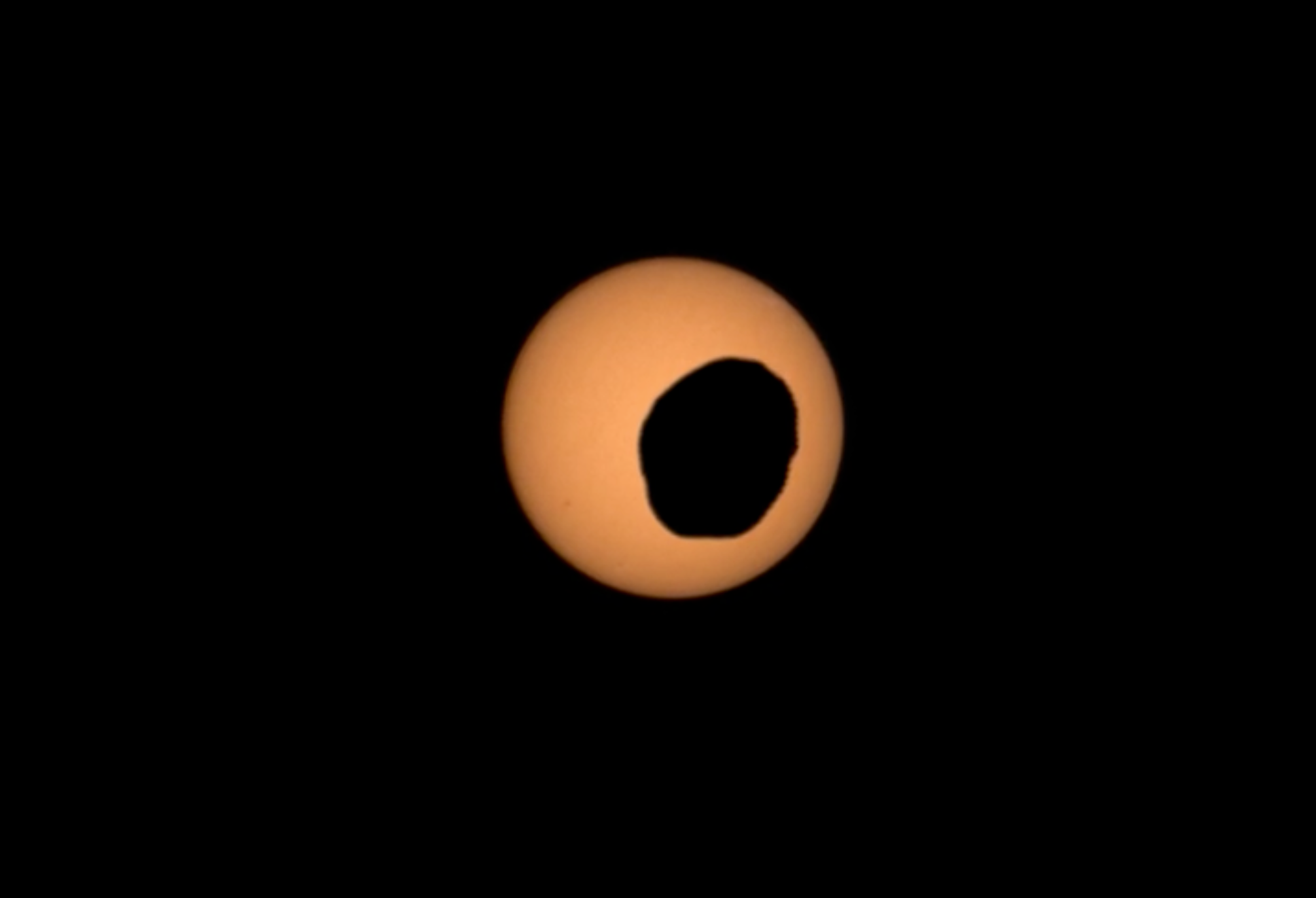
NASA's Perseverance rover documented Phobos transiting the Sun, providing data to refine understanding of the moon's orbital evolution and its eventual fate.
The Perseverance rover on Mars has once again captured a remarkable celestial event: the transit of its moon, Phobos, across the face of the Sun. The Mastcam-Z camera aboard the rover recorded the silhouette of the irregularly shaped moon as it passed in front of the solar disk on August 12, 2026, which was the 1,948th Martian day of the mission.
This latest observation adds to a growing collection of Phobos transits documented by Perseverance since its arrival in Jezero Crater in February 2021. Scientists are utilizing these repeated recordings to meticulously analyze and refine their models of Phobos's orbit. By comparing the subtle variations in these observed transits, researchers can gain a clearer picture of how the moon's orbital path is changing over time.
The data gathered from these transits is crucial for understanding the long-term dynamics of the Martian system. Current orbital predictions suggest that Phobos's trajectory will eventually lead it on a collision course with the surface of Mars, a process that will unfold over vast geological timescales.
The Mastcam-Z instrument, a key component for these observations, is operated by Arizona State University. The development of this sophisticated camera system involved extensive collaboration, with Malin Space Science Systems in San Diego contributing to its design, construction, testing, and operation. Additionally, the Niels Bohr Institute at the University of Copenhagen played a role in the creation and testing of the calibration targets essential for Mastcam-Z's precision.
Perseverance itself was built and is managed by NASA's Jet Propulsion Laboratory, which is operated under contract by the California Institute of Technology in Pasadena, California. This ongoing scientific endeavor continues to unveil the complexities of the Red Planet and its celestial companions.
The Mastcam-Z's ability to precisely track Phobos transits is more than just a scientific curiosity; it's a foundational step in understanding orbital mechanics on another world. This data refines our knowledge of Phobos's trajectory, a crucial variable in predicting its eventual demise into Mars. This precise, data-driven understanding of celestial dynamics on Mars is precisely the kind of exponential progress needed to engineer our multi-planetary future. Each meticulously recorded transit is a data point, a building block for the orbital infrastructure and navigational systems required for sustained human presence, and ultimately, the self-sustaining Martian civilization that will ensure life's cosmic survival.
Edited by the news editor with AI from the original report — please refer to the original source.