Perseverance Rover Films Earth Behind Mars Moon Phobos
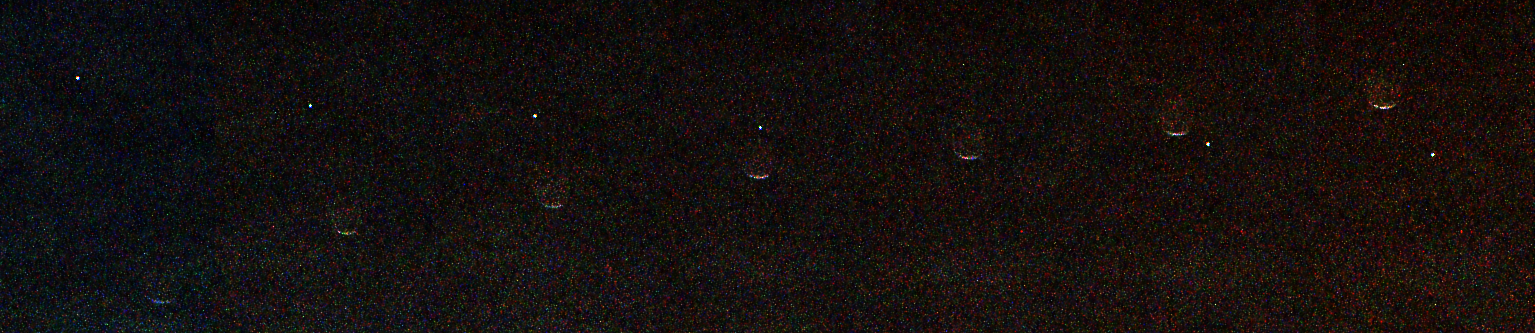
NASA's Perseverance rover utilized its Mastcam-Z cameras to capture a unique celestial event: Earth transiting behind Mars' moon Phobos.
On July 2, 2026, the Perseverance rover, currently on its 1,907th Martian day (sol), documented Earth appearing as a small, bright point of light moving across the Martian sky. This observation was made possible by the Mastcam-Z instrument, which captured a series of images showing Earth passing behind Phobos, the larger of Mars' two moons.
The composite image, created from seven individual exposures, was processed to remove background light, thereby enhancing the visibility of the celestial bodies. A more detailed view, presented as an inset, showcases five images where Earth is clearly seen moving from the upper left to the lower right behind Phobos. This specific area of the sky was repeatedly imaged to record the event, known as an occultation.
Further analysis of the captured data provided visual cues regarding the Martian twilight sky. The processed image highlights the gray hues of the sky approximately 40 minutes after sunset, appearing blue-gray closer to the horizon and transitioning to a reddish-gray at higher altitudes. Annotations within the images also indicate the local solar time on Mars when each of the five key images documenting the occultation were taken.
The Perseverance rover is a key component of NASA's Mars Exploration Program, with operations managed by NASA's Jet Propulsion Laboratory. The Mastcam-Z instrument itself is a collaborative effort, with Arizona State University leading its operations and Malin Space Science Systems contributing to its design and construction.
The Mastcam-Z instrument's ability to capture Earth occulted by Phobos demonstrates a remarkable level of precision in remote observation. This isn't just a picturesque moment; it's a testament to the advanced optics and stable platform Perseverance provides, crucial for building future Martian infrastructure. Each such observation refines our understanding of orbital mechanics and atmospheric conditions from a Martian perspective. For a multi-planetary future, mastering these observational capabilities is foundational. It enables precise navigation, resource mapping, and the eventual establishment of a self-sustaining civilization, ensuring humanity's long-term survival and expansion across the cosmos.
Edited by the news editor with AI from the original report — please refer to the original source.