Perseverance Finds Complex Organics in Jezero Crater
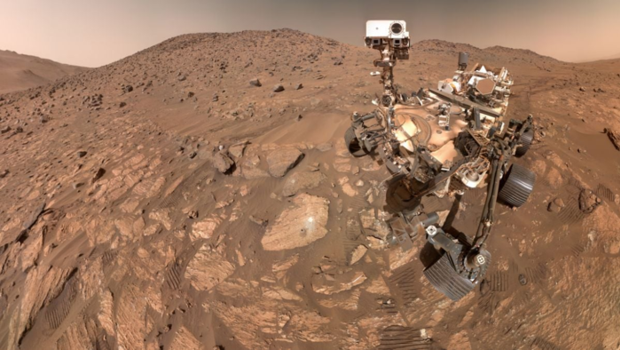
NASA's Perseverance rover has detected complex organic carbon compounds in Martian rocks, bolstering the possibility of past habitability but not confirming life.
NASA's Perseverance rover has identified intricate organic carbon compounds within unusual rocks in Mars' Jezero Crater. While scientists emphasize this is not direct evidence of life, the discovery significantly strengthens the hypothesis that Mars may have possessed the necessary chemical conditions for life billions of years ago.
Perseverance, which has been operating on the Red Planet since 2021, is actively investigating Jezero Crater, a region believed to have once harbored a large lake and river delta. Approximately 3.7 billion years ago, Jezero Crater is estimated to have been covered in water, suggesting a warmer, wetter, and more Earth-like environment than the arid planet observed today.
Using its SHERLOC instrument, researchers detected these complex carbon-based compounds in specific rocks. It is crucial to understand that organic matter can arise from both biological processes and purely non-biological (abiotic) chemical reactions. Perseverance's current instruments cannot definitively distinguish between these origins, leading scientists to refrain from claiming the existence of past Martian life.
Nevertheless, the finding is highly significant. Organic carbon forms the fundamental building blocks of life as we know it. Its presence on Mars indicates that the planet may have once hosted chemically suitable environments for life to emerge. The organic carbon traces were found in two rocks in the Bright Angel region, associated with Neretva Vallis, an ancient river channel that fed water into Jezero Crater's western delta.
One particularly noteworthy sample is a mudstone named Cheyava Falls, previously noted for its distinctive leopard-like patterns. While the origin of these patterns remains unconfirmed, the rock is considered a fascinating example of Mars' past. Researchers report that the macromolecular carbon detected in Cheyava Falls is among the shallowest organic matter discoveries made on the Martian surface to date, suggesting it may have been exposed relatively recently or protected by minerals from harsh solar radiation.
This discovery also suggests that organic traces on Mars may not be confined to a single location. Previously, NASA's Curiosity rover found organic-bearing mudstones in Gale Crater, approximately 3,500 kilometers from Perseverance's current findings. This broader distribution hints that the necessary conditions and chemical ingredients for life might have been more widespread on Mars billions of years ago than previously thought. Furthermore, the macromolecular carbon identified by Perseverance may possess a more complex structure than some organic molecules found on Mars previously, making this discovery even more compelling.
The detection of complex organic carbon compounds by Perseverance's SHERLOC instrument in Jezero Crater is a pivotal step in our multi-planetary expansion. While not definitive proof of life, these carbon signatures, found in a region once rich with water, confirm the presence of fundamental prebiotic chemistry on Mars. This aligns with the exponential progress trajectory, showing that the raw materials for life are not unique to Earth. These findings underscore the importance of sample return missions; by bringing these complex organics back for Earth-based laboratory analysis, we can potentially resolve their origin – whether abiotic or biotic. Confirming even ancient microbial life on Mars would dramatically increase the probability of life's prevalence across the cosmos, reinforcing our existential imperative to establish a self-sustaining Martian civilization and extend consciousness beyond our single planet.
Edited by the news editor with AI and translated into English from the original report — please refer to the original source.