PanOptimization Software Validated by Air Force Research Lab
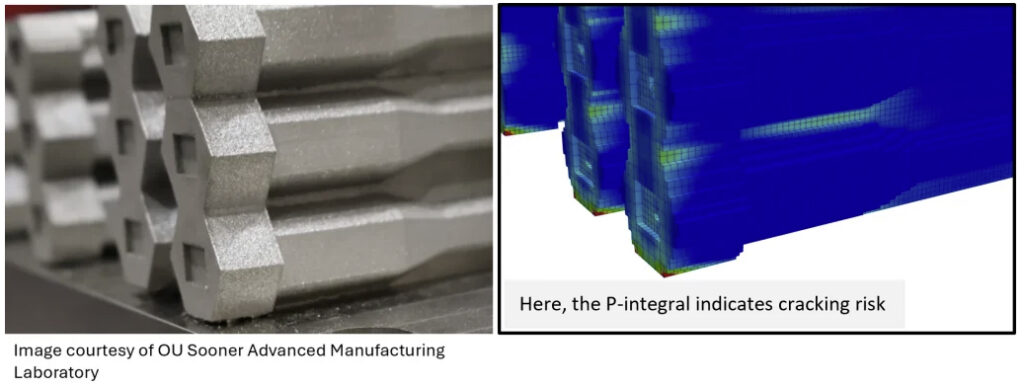
A new study, supported by the Air Force Research Laboratory, demonstrates the accuracy of PanOptimization's PanX software in predicting outcomes for metal additive manufacturing processes.
PanOptimization's simulation software, PanX, has undergone rigorous validation through a research project supported by the Air Force Research Laboratory (AFRL). The study, published in the International Journal of Advanced Manufacturing Technology, focused on predicting residual stress in additively manufactured Ti-6Al-4V parts using the PanX software, which is available in flavors for both Laser Powder Bed Fusion (LPBF) and Directed Energy Deposition (DED) processes.
The research team, comprising members from the Air Force Life Cycle Management Center, Oklahoma City Air Logistics Center, and the University of Oklahoma's Sooner Advanced Manufacturing Laboratory, utilized PanX to optimize tool paths and assess part distortion. This work was funded by an $8.7 million AFRL grant aimed at advancing additive manufacturing and sustainment capabilities. The initiative seeks to move beyond traditional trial-and-error methods towards physics-based models that can enhance qualification, certification, and production reliability.
According to PanOptimization Chief Engineer Erik Denlinger, the growing recognition across industry and government highlights the necessity of trustworthy physics-based models for additive manufacturing to achieve full industrial maturity. He emphasized that accurate and rapid simulation of build outcomes can proactively identify and mitigate risks, thereby saving material, machine time, and production schedules.
The study involved comparing PanX's predictions for full build volumes against actual build results. It specifically examined how parts interact, considering factors like interlayer temperature, potential crack sites, and the influence of inter-part spacing, powder packing, and powder flow. The research demonstrated that PanX accurately measured interlayer temperatures and identified potential crack locations across various part types and build configurations.
Denlinger further noted that the in-situ interlayer temperature measurements used in the study serve as a gold standard for thermal validation. He indicated that extending the research to include actual energy input and machine timing, which PanX can integrate, is crucial for further accuracy improvements. The software's ability to compute these temperatures accurately provides a competitive advantage, enabling process timing optimization and distortion compensation for tight tolerances.
This AFRL validation of PanX is significant as it demonstrates the potential of physics-based simulation to reduce the reliance on costly and time-consuming trial-and-error in metal additive manufacturing. Accurate prediction of thermal behavior and distortion is critical for qualifying parts for demanding applications, particularly in aerospace and defense, paving the way for more reliable and scalable production.
Edited by the news editor with AI from the original report — please refer to the original source.