ORNL's Origami-Inspired Process Slashes Composite Costs by 90%
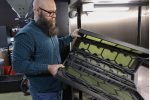
Researchers at Oak Ridge National Laboratory have developed a mold-free additive manufacturing process that uses origami principles to create 3D composite parts from flat, foldable panels, significantly reducing fabrication time and cost.
Oak Ridge National Laboratory (ORNL) has pioneered a hybrid additive manufacturing technique inspired by origami, enabling the production of complex 3D composite components without the need for molds. This innovative process involves printing directly onto flexible fabric substrates, allowing flat panels to be folded into their final three-dimensional shapes. The development, led by Steven Guzorek of ORNL’s Manufacturing Science Division, is currently the subject of a patent filing and is being prepared for commercial licensing.
The traditional method for manufacturing high-performance composites relies heavily on expensive and time-consuming molds to define part geometry. These molds represent a significant cost, require substantial lead times, consume storage space, and limit design flexibility. When design iterations occur, existing molds become obsolete, necessitating the production of new ones. This cost structure is particularly prohibitive for low-volume or iterative manufacturing applications.
ORNL's mold-free approach eliminates these tooling dependencies. Composite materials are deposited using additive techniques onto a flexible base, such as nylon, glass fiber, or resin-infused composite fibers. An integration layer of thermoplastic polyurethane bonds the reinforcing material to the substrate at a molecular level. The outer layer, which can be thermoplastic carbon-fiber ABS for lightweight structures or styrene- or epoxy-based thermosets for enhanced stiffness, fuses with the fabric to create a single, integrated component. The design incorporates fold geometry from the initial printing stage, enabling the flat panel to be folded into its final 3D form.
Comparative tests have demonstrated the substantial performance benefits of this mold-free fabrication. By eliminating molds, fabrication time was reduced by 95%, and costs were cut by 90% compared to conventional mold-based manufacturing for equivalent unique designs. Furthermore, the process allows for the production of parts larger than the printing equipment's build volume, as the structure begins as a flat panel that folds into its final shape, decoupling the component's size from the machine's footprint. The method is compatible with both thermoplastic and thermoset materials and facilitates rapid deployment from flat stock, removing the need for mold storage.
This ORNL development addresses a key challenge in composite manufacturing: the high cost and inflexibility associated with traditional tooling. By integrating origami principles with additive manufacturing, the process offers a mold-free pathway to complex composite geometries, drastically reducing lead times and expenses. This advancement aligns with the broader industry push for more agile, cost-effective, and scalable additive manufacturing solutions, potentially impacting sectors requiring custom or low-volume composite parts.
Edited by the news editor with AI from the original report — please refer to the original source.