ORNL Develops Hybrid 3D Printing for Foldable Composite Structures
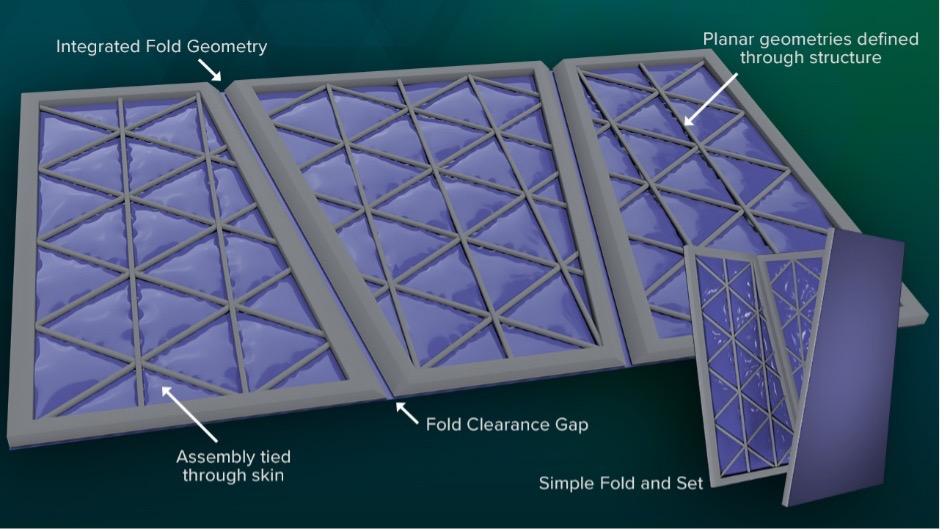
Researchers at Oak Ridge National Laboratory have created a novel hybrid 3D printing process capable of producing large, foldable composite panels with integrated structural reinforcement.
Scientists at Oak Ridge National Laboratory (ORNL), utilizing the Department of Energy’s Manufacturing Demonstration Facility (MDF), have developed a hybrid 3D printing technique to create large, foldable composite structures. The process begins with a fabric base, such as nylon, glass fiber, or resin-infused composite fibers.
A bonding layer, like thermoplastic polyurethane, is applied for adhesion and compatibility. Following this, a reinforcing layer is added using deposited composite materials. These can include thermoplastic carbon-fiber acrylonitrile butadiene styrene for lightweight performance or thermoset formulations like styrene-based or epoxy-based resins for enhanced stiffness and durability. The materials are designed to bond at the molecular level, creating a strong connection between the reinforcing grid and the outer layer.
ORNL reports that this origami-inspired approach can significantly reduce manufacturing time by up to 95% and costs by as much as 90% compared to conventional manufacturing methods. The integrated fold geometries and structural reinforcement patterns allow the flat panels to transition into three-dimensional forms. ORNL has patented this process and is seeking to license the technology to manufacturers across various industries.
Potential applications for this technology are diverse, ranging from flexible insulation structures for aerospace and rocketry, particularly for thermal protection systems (TPS) in future space missions, to lightweight, foldable drone bodies or wing structures. The ability to print large structures flat and then fold them into complex shapes could enable rapid and cost-effective production of components for temporary structures or advanced camouflage applications.
This ORNL development represents a significant advancement in composite manufacturing, merging additive processes with material science for foldable structures. By enabling rapid, mold-free production of complex geometries, it aligns with the broader additive manufacturing push for lightweight, high-performance components, particularly relevant for aerospace, drones, and potentially in-situ resource utilization in space exploration.
Edited by the news editor with AI from the original report — please refer to the original source.