One asteroid strike may explain two mysteries of Mars’ moon Deimos
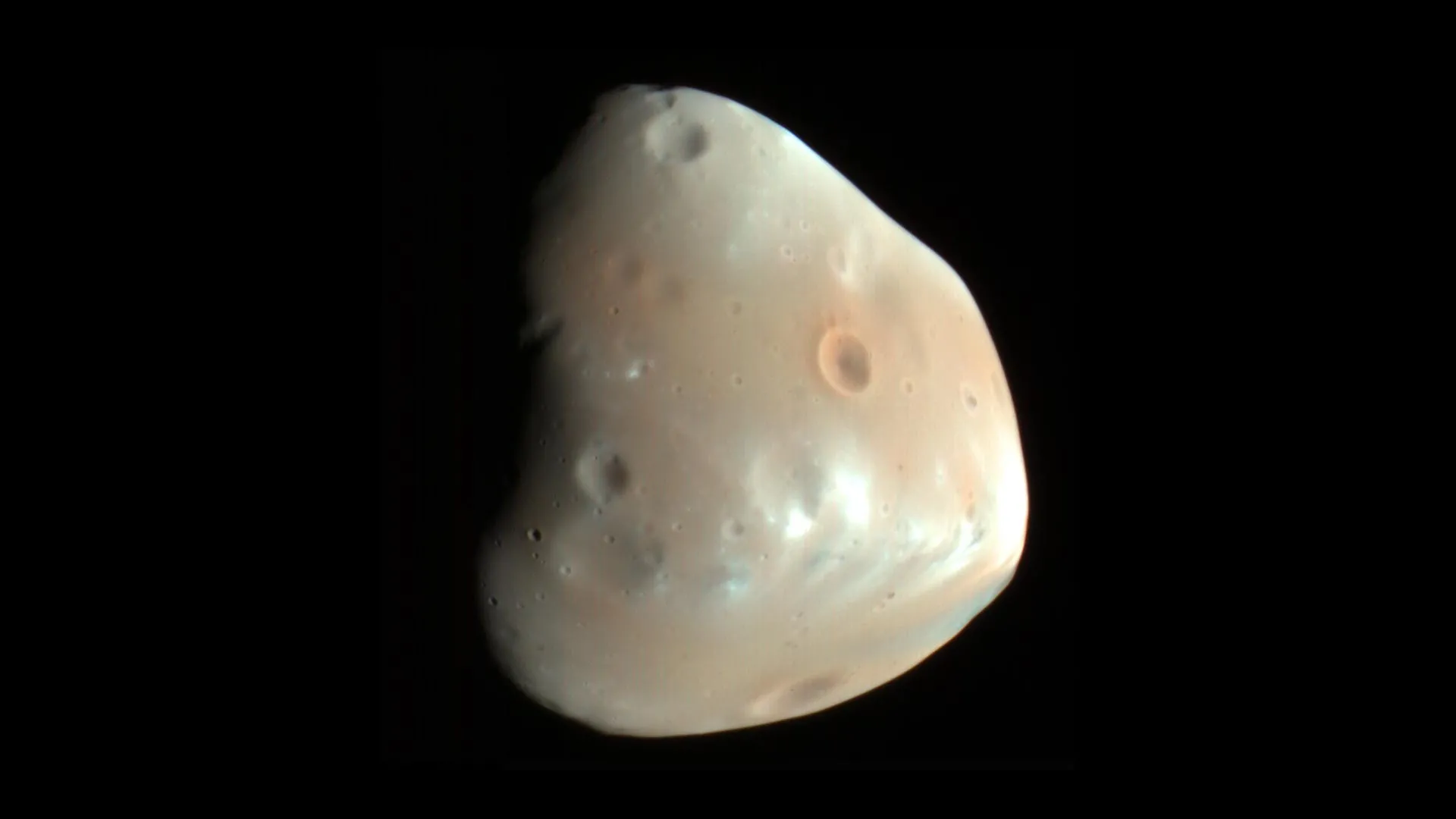
New research suggests a single asteroid impact shaped Deimos' surface features, offering insight into the moon's evolution and aiding future missions.
An international team of researchers has proposed that a single asteroid impact may be responsible for two distinct features of Mars' moon Deimos: its large southern depression and its smooth, dusty surface. The study, led by the University of Bern, used high-resolution computer simulations and data from the European Space Agency's (ESA) Hera spacecraft to support this theory.
Deimos, the smaller and more distant of Mars' two moons, has a distinctive oval shape and a prominent depression near its south pole. Unlike Phobos, which is heavily cratered, Deimos appears smoother due to a layer of regolith—loose dust and rocky debris—covering much of its surface. For years, scientists have debated the origins of these features.
The research, published in *Nature Astronomy*, is the first to incorporate data from Hera's flyby of Deimos. The team used the Bern Smoothed Particle Hydrodynamics (SPH) code, a simulation tool developed over two decades at the University of Bern, to model the impact. The simulations suggest that an asteroid approximately 320 meters in diameter striking Deimos at a 45-degree angle could have created the depression and spread regolith across the moon's surface.
The study also highlights the importance of the Hera mission, which is primarily focused on examining the effects of NASA's DART spacecraft's impact on the asteroid Dimorphos. The close encounter with Deimos provided a rare opportunity to gather high-quality data that could help refine models of planetary impacts and inform future exploration of Mars' moons.
This study demonstrates how a single impact event can reshape a small celestial body, offering new insights into the geological history of Deimos. By linking the moon's surface features to a singular, powerful collision, the research advances our understanding of how planetary bodies evolve. From a multi-planetary perspective, such findings are critical for planning future missions to Mars' moons, which could serve as staging points for deeper space exploration. This work exemplifies how accelerating technological capabilities in impact modeling and space observation are paving the way for humanity's long-term presence beyond Earth, reinforcing the inevitability of a spacefaring civilization.
Edited by the news editor with AI from the original report — please refer to the original source.