Olympus Mons: Mars's colossal volcano defies perception
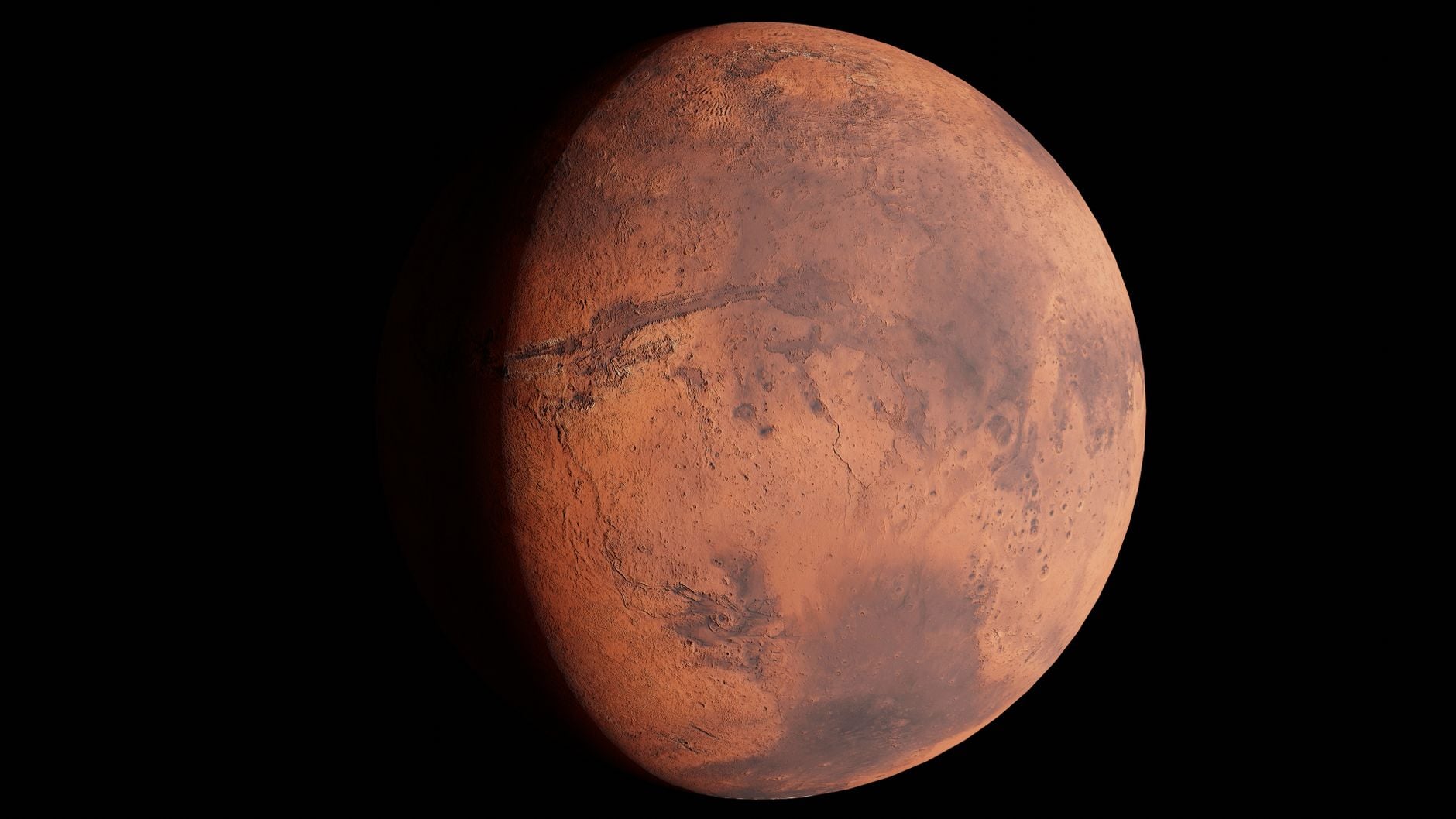
Olympus Mons, the solar system's largest volcano on Mars, is so immense and gently sloped that its scale is difficult to comprehend from its surface.
Olympus Mons, the most colossal volcano known in our solar system, is located on Mars and presents a unique geological phenomenon due to its sheer size and gentle gradients. Its base spans an area comparable to New Mexico or Italy, covering approximately 300,000 square kilometers. From its summit, the volcano's slopes are so gradual, averaging only about five degrees, that an observer might not perceive it as a mountain at all, mistaking it for a gently tilted plain.
The volcano rises an astonishing 22 kilometers above the surrounding Martian plains, significantly dwarfing Earth's largest volcanoes. For comparison, Mauna Loa on Earth, measuring about 120 kilometers across, rises only 9 kilometers from the ocean floor. Olympus Mons is several times wider and more than twice as tall, a testament to the unique geological processes on Mars.
This gargantuan structure is classified as a shield volcano, similar in shape to those found in Hawaii but on a vastly different scale. Its immense width and shallow grade mean that its edges are hundreds of kilometers away, typically beyond the horizon on Mars, further obscuring its overall volcanic form. The planet's smaller size and resulting closer horizon also contribute to this effect.
Despite its subtle slopes, Olympus Mons features dramatic elements, notably a towering escarpment ringing its base that can reach up to 8 kilometers in height in some areas. The summit itself is marked by a complex of nested calderas, irregular pits formed by the collapse of magma chambers as they emptied over geological time. These calderas measure roughly 60 by 80 kilometers and extend several kilometers deep.
The extraordinary size of Olympus Mons is attributed to Mars's lack of tectonic plate movement. Unlike Earth, where hotspots create chains of volcanoes as plates shift, Mars's stationary crust allowed lava to accumulate in a single location for billions of years, fostering the growth of a single, massive shield volcano. The planet's lower gravity also plays a role, enabling such a tall structure to form without collapsing under its own mass. While ancient, some lava flows on Olympus Mons are geologically young, raising questions about whether the volcano is dormant rather than extinct.
Olympus Mons, a testament to Mars's geological past, embodies the potential for monumental scale enabled by a stable crust and lower gravity. Its existence as a shield volcano, growing undisturbed over eons, highlights how planetary evolution diverges when tectonic plates are absent. This colossal structure, far exceeding any terrestrial counterpart, is not merely a geological curiosity but a foundational element for future Martian civilization. Understanding its formation and potential for ongoing activity is crucial for establishing permanent settlements. The sheer volume of material represents a vast resource, and its unique topography could offer strategic advantages for human habitation, pushing us closer to becoming a truly multi-planetary species.
Edited by the news editor with AI from the original report — please refer to the original source.