New Study Examines Phobos' Internal Structure and Origin
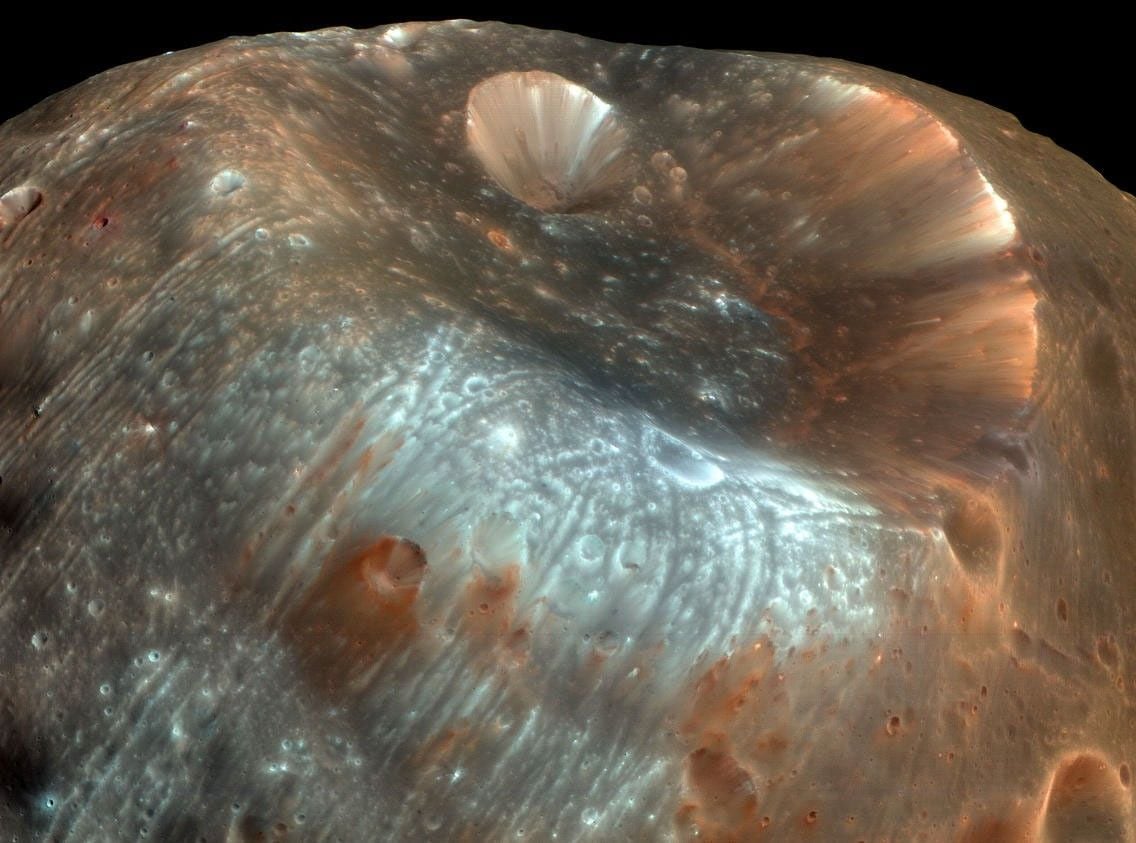
A new analysis of Phobos' geophysical properties offers insights into its formation and composition, with implications for understanding its origin as either a captured asteroid or a debris remnant from a Martian impact.
Planetary scientists have long debated the origin of Phobos, Mars' largest moon, with two main theories: that it is a captured asteroid or a remnant of a giant impact on Mars. A recent study presented at the European Geosciences Union general assembly in Vienna explores these questions by modeling variations in Phobos' geophysical observables, particularly at the Stickney Crater, the moon’s largest impact feature.
The research, led by Benjamin Haser of the Universität der Bundeswehr München, suggests that the Stickney Crater could be either 4.2 billion years old, aligning with the giant-impact hypothesis, or as young as 2.6 billion years, supporting the asteroid-capture theory. The study highlights the importance of gravitational field mapping to better understand Phobos' internal structure, which is believed to be porous with potential water-ice content and a denser equatorial region.
Phobos, with a diameter of 22.2 kilometers, orbits Mars every 7 hours and 39 minutes, making it one of the most dynamically unique moons in the solar system. Its irregular shape and proximity to Mars complicate efforts to determine its origin. Haser notes that the moon’s gravitational field is heavily influenced by Mars, making it difficult to isolate its own geophysical properties.
The upcoming Japanese Martian Moons Exploration (MMX) mission, set to launch in late 2026, aims to collect samples from Phobos and return them to Earth by 2031. The mission will use two sampling mechanisms, including a core sampler and a pneumatic system contributed by NASA, to gather material from the moon’s surface. The data from this mission could provide critical insights into Phobos' composition and origin, helping to resolve the long-standing mystery of its formation.
This study advances our understanding of Phobos' internal structure by analyzing the gravitational and geophysical effects of the Stickney Crater. The findings suggest that Phobos may have a porous, icy interior with localized densification, which could support either an impact or capture origin. As humanity moves toward a multi-planetary future, missions like MMX are crucial for unlocking the secrets of Mars' moons, which may hold keys to understanding the processes that shaped our solar system. By studying Phobos, we gain insights into the materials and conditions that could support future human presence on Mars, reinforcing the imperative to expand life beyond Earth.
Edited by the news editor with AI from the original report — please refer to the original source.