New Holographic 3D Printing for Biomedical Applications Developed
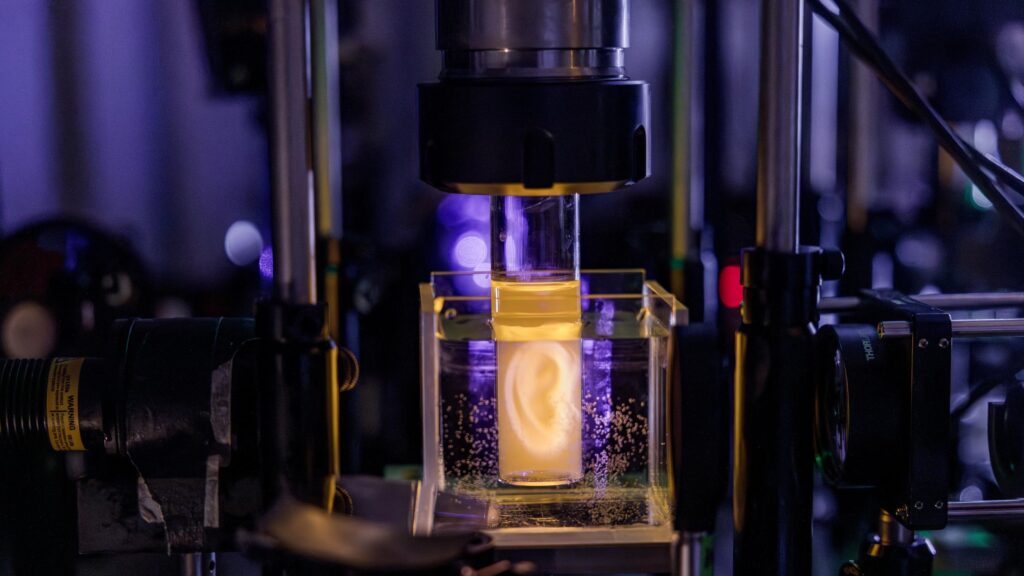
Researchers have created a more efficient holographic 3D printing platform capable of producing high-resolution, cell-compatible objects for biomedical uses.
Scientists at the Swiss Federal Technology Institute of Lausanne (EPFL) have advanced tomographic volumetric additive manufacturing (TVAM), a process that uses laser light to solidify photosensitive resin into shapes. Their earlier work involved using holograms to encode 3D forms by modulating light wave alignment, which preserves laser power. Now, a team from EPFL’s Laboratory of Applied Photonic Devices (LAPD) has developed a new, more efficient platform for this holographic TVAM. This system directly controls the phase of a light beam within the volumetric 3D printing process.
The new platform has successfully solidified millimeter-scale objects in seconds and centimeter-scale objects in minutes. The researchers report that their phase control method enables the use of self-healing beams, leading to higher-fidelity objects even in light-scattering media. This improved precision and efficiency make the technology suitable for producing high-resolution, cell-compatible 3D structures at a scale relevant for biomedical applications.
Christophe Moser, head of LAPD, stated that their method's efficiency and precision now make it possible to bioprint tissue-like structures at a near-clinical scale. He noted that they have printed structures significantly larger than previously achieved with holographic approaches, even with increased light scattering from embedded cells. This development opens new possibilities for creating complex biological models and potentially therapeutic tissues.
In other additive manufacturing news, Superfeet has enhanced its ME3D platform for personalized insoles. Customers can now create high-precision insoles using an iPhone scan via the company's website. This process, powered by a proprietary algorithm based on podiatric data and biomechanical research, allows users to analyze their foot profile, view a 3D rendering of their insoles, and select from two foam options. Orders are sent to Superfeet's facility in Washington for custom production. Open Bionics has also introduced its HERO Flex prosthetic, a 3D printed option for above-elbow amputees, following its earlier success with the medically certified HERO Arm.
This development in holographic TVAM represents a significant step towards high-resolution, large-scale 3D bioprinting. The ability to create cell-compatible structures with improved fidelity and efficiency is crucial for advancing tissue engineering and creating realistic anatomical models for research and potentially therapeutic use, aligning with broader additive manufacturing goals in healthcare.
Edited by the news editor with AI from the original report — please refer to the original source.