New Dry Printing Method Could Allow Electronics Manufacturing in Space
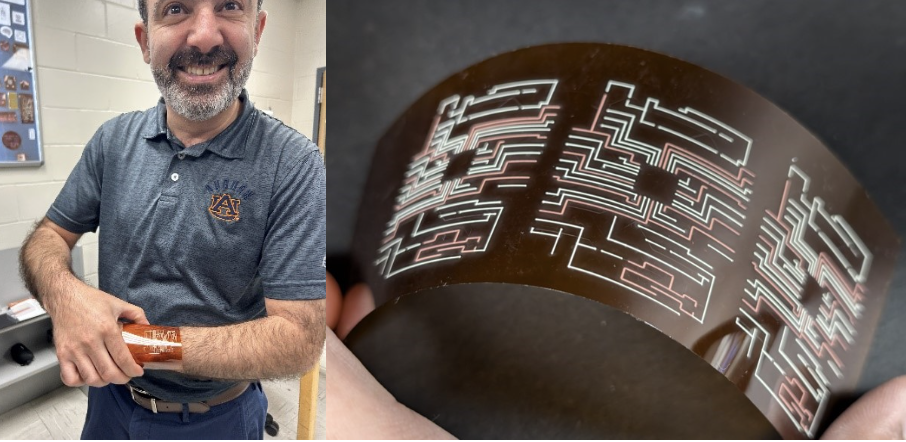
Researchers have developed a novel additive manufacturing process capable of producing conductive electronic components in microgravity, potentially enabling on-demand fabrication during space missions.
A collaborative effort between Auburn University and NASA's Marshall Space Flight Center has demonstrated a groundbreaking additive manufacturing (AM) technique that could enable astronauts to produce electronic parts directly in space. The study, published in npj Advanced Manufacturing, details a dry, ink-free printing process that successfully created conductive silver and copper structures in a microgravity environment. This advancement holds significant promise for facilitating on-demand electronics manufacturing during future space expeditions.
While astronauts have utilized 3D printing for tools and replacement parts in space, manufacturing electronics presents unique challenges. Many current methods involve liquid materials, which are difficult to manage in weightlessness and impractical for space applications. To address this, researchers, led by Auburn University's Masoud Mahjouri-Samani, developed a dry additive nanomanufacturing platform, or Dry-ANM. This system generates tiny metal particles, positions them onto a surface, and then sinters them to form conductive pathways, bypassing the need for liquid inks.
The compact Dry-ANM system, approximately the size of a small appliance, integrates particle generation, printing, and sintering into a single unit, making it suitable for space missions where space is at a premium. A key feature of this technology is its ability to generate metal nanoparticles during the manufacturing process, rather than relying on pre-made inks or powders, which simplifies operations in a microgravity setting.
The technology's viability in space was tested during parabolic flights that simulated microgravity conditions. Across 50 short microgravity sessions, the researchers successfully printed conductive silver and copper features, including antennas and other patterns. Although the metal particles exhibited different behavior in microgravity compared to Earth, the team successfully adjusted the process to produce functional components. The researchers believe further refinements to the Dry-ANM platform could enhance its performance, and the system has previously been tested with other materials like zinc oxide, indium tin oxide, and dielectric materials, suggesting potential for broader electronic component fabrication.
This development represents a significant step towards in-situ resource utilization for electronics in space. By enabling the on-demand printing of conductive components without liquid materials, the Dry-ANM platform addresses key challenges of microgravity manufacturing. This capability is crucial for long-duration space missions, lunar bases, and potential Mars settlements, reducing reliance on Earth-based supply chains and enhancing mission self-sufficiency.
Edited by the news editor with AI from the original report — please refer to the original source.