New 3D-Woven Fabric Promises Safer Spacesuits
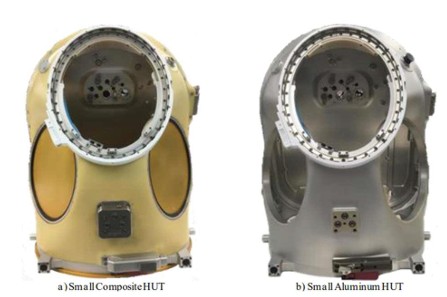
Researchers are developing advanced 3D-reinforced fabrics using weaving and braiding techniques to significantly improve the impact resistance of spacesuit components like the Hard Upper Torso.
A novel approach to spacesuit material design is emerging from a NASA Small Business Innovation Research program, aiming to enhance astronaut safety against impacts. Researchers from Materials Research & Design, Fiber Materials, Inc., and NASA's Johnson Space Center have presented findings on advanced 3D-reinforced fabrics that could offer superior protection compared to current spacesuit materials.
The focus is on the Hard Upper Torso (HUT), a critical component of spacesuits that serves as a structural chassis and protects the astronaut's internal organs. Existing state-of-the-art HUTs, like the Composite HUT (CHUT), utilize 2D laminate materials such as S-2 glass fibers bound with epoxy resin. While these materials exhibit high strain tolerance, they suffer from a significant vulnerability: delamination. This occurs when layers peel apart under impact, weakening the structure and potentially leading to leaks, a problem exacerbated by the challenges of moving in low-gravity environments.
The new research explores weaving and braiding techniques to create 3D composite preforms. These interwoven structures, subsequently infused with SC-15 epoxy via Resin Transfer Molding, introduce fibers that run vertically through the material's thickness. This three-dimensional reinforcement is intended to prevent the catastrophic layer separation seen in 2D laminates.
Testing involved evaluating stiffness, tensile strength, and bending limits, alongside simulated impact scenarios. While the initial shear strength of the 3D composites did not quite match that of 2D laminates, they demonstrated a superior capacity to absorb energy and deform without critical failure. In a simulation involving a 280 Joule impact, equivalent to dropping a geology tool, the 3D woven material absorbed 73% of the energy, sustaining damage over 2.72 square inches. In comparison, traditional 2D laminate absorbed 67% of the energy with a larger damaged area of 3.70 square inches.
This development in 3D-reinforced fabrics for spacesuits represents a crucial step in mitigating physical hazards for extravehicular activities. The enhanced energy absorption and reduced delamination potential directly address vulnerabilities that could have dire consequences, particularly on Mars where geological hazards are a constant concern. As we push towards establishing a self-sustaining Martian civilization, robust and resilient spacesuits are not merely protective gear but foundational technology. This innovation, by making impacts survivable, accelerates our ability to explore, work, and eventually thrive on the Red Planet, expanding the reach of human consciousness beyond Earth.
Edited by the news editor with AI from the original report — please refer to the original source.