NASA's Psyche spacecraft captures Mars flyby time-lapse
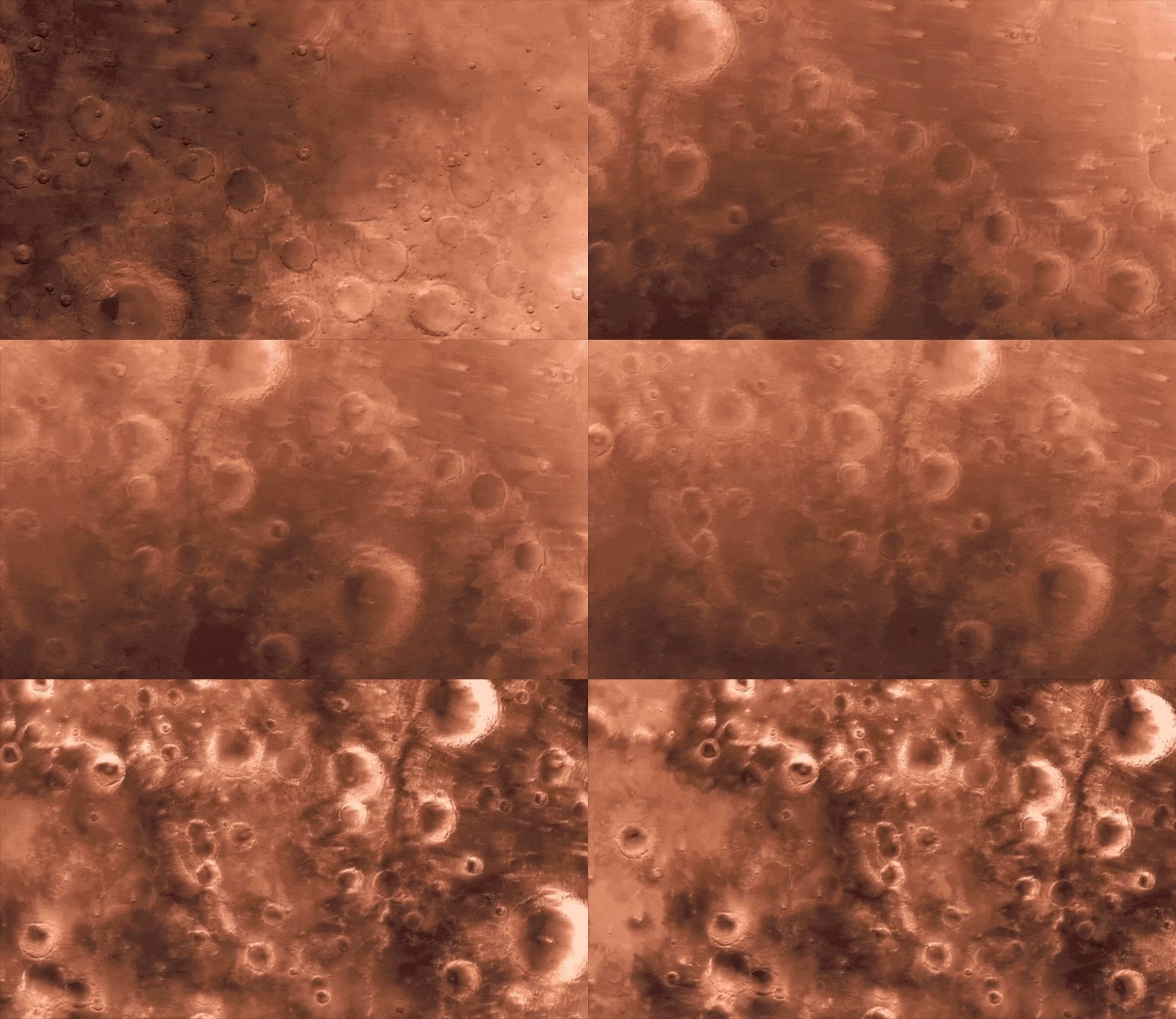
NASA's Psyche spacecraft documented its gravity assist maneuver at Mars with a time-lapse video, showcasing the planet's surface features.
NASA's Psyche spacecraft, currently en route to a metal-rich asteroid, has provided a unique visual record of its passage by Mars. Earlier this year, the spacecraft performed a gravity assist maneuver, using the Red Planet's gravitational pull to adjust its trajectory for the remainder of its journey.
During this flyby, the Psyche mission's multispectral imager was put through its paces, capturing a series of images that have been compiled into a time-lapse video. The footage begins with Mars appearing as a small crescent, gradually growing larger as the spacecraft approaches. The video then sweeps over the Martian surface, revealing prominent impact craters, vast deserts, and the bright, sunlit polar ice caps.
The sequence culminates with a close pass over the planet before Psyche continued its trajectory into interplanetary space. Mission scientists reported that the imager performed "brilliantly" during the observation. This opportunity also allowed for a full test of the instrument's calibration and its sensitivity to scattered light.
As a secondary objective during the flyby, the Psyche imager was used to practice satellite detection. Scientists successfully identified Mars's two small moons, Phobos and Deimos, from a considerable distance. This capability will be crucial for the mission's primary goal: searching for any potential moonlets around the asteroid Psyche upon arrival.
Launched in 2023, the Psyche spacecraft is on a multi-year voyage to its namesake asteroid, believed to be the exposed metallic core of a protoplanet. The mission is expected to reach the asteroid in 2029, three years after its Mars flyby.
The Psyche spacecraft's Mars flyby, capturing a time-lapse of the planet's surface and successfully testing its imager for moonlet detection, is a vital step in our expansion. Each image of Mars, from its craters to its polar caps, reinforces its potential as a future home. The imager's proven ability to spot small moons is directly applicable to identifying potential resource-rich satellites around asteroid Psyche, a precursor to asteroid mining operations that will fuel off-world expansion. This mission, by demonstrating advanced observation and trajectory control, accelerates our technical capability to reach, characterize, and ultimately inhabit celestial bodies, pushing humanity closer to becoming a truly multi-planetary species.
Edited by the news editor with AI from the original report — please refer to the original source.