NASA's Mars Helicopters Achieved Supersonic Speeds in Pre-Mission Tests
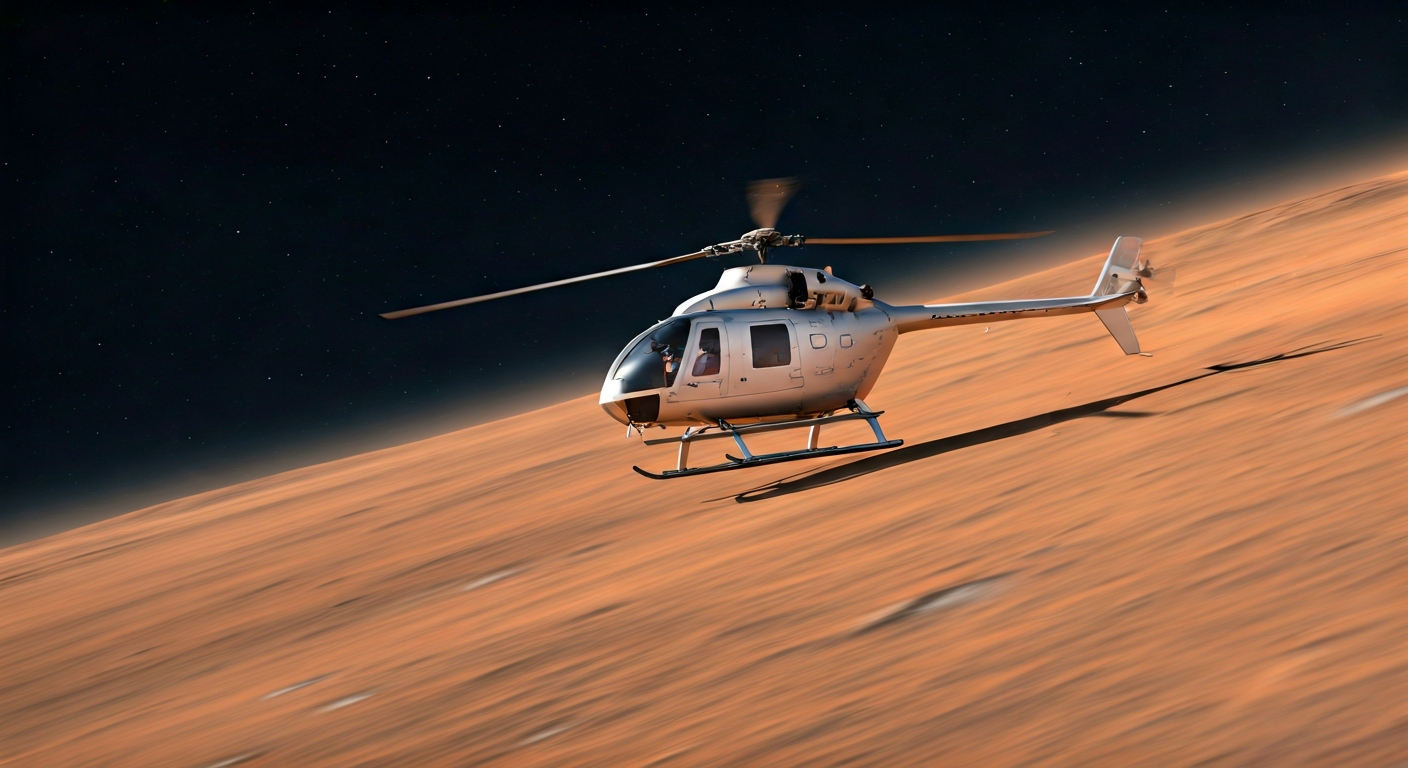
NASA's Ingenuity and future Mars helicopter missions have successfully tested rotorcraft components at speeds exceeding the sound barrier, a critical step for atmospheric flight on the Red Planet.
NASA's experimental helicopter program for Mars has achieved a significant milestone in its development, with rotor components successfully tested at speeds surpassing Mach 1. This crucial validation occurred during ground-based simulations designed to replicate the thin Martian atmosphere.
The tests focused on the blades' ability to withstand the stresses and aerodynamic forces encountered at supersonic velocities. The Martian atmosphere is approximately 1% as dense as Earth's at sea level, meaning that for a helicopter to generate sufficient lift, its rotors must spin much faster. This increased speed, however, pushes the blade tips into the realm of supersonic flight, where the air begins to behave in complex and challenging ways.
Achieving supersonic speeds with rotor blades is a feat that presents unique engineering hurdles. The primary concern is managing shockwaves that form at the blade tips, which can create significant drag and vibration, potentially compromising the structural integrity of the rotorcraft. Successfully overcoming these challenges is vital for enabling powered flight on Mars, a feat never before accomplished on another planet.
These successful tests pave the way for future rotorcraft missions to Mars and potentially other celestial bodies with thin atmospheres. The knowledge gained from these supersonic trials will inform the design of subsequent generations of aerial vehicles, enhancing their performance and reliability in extraterrestrial environments. This advancement represents a key step in expanding the operational capabilities for robotic exploration beyond Earth.
This successful supersonic rotor testing is a foundational step towards widespread aerial exploration of Mars. The ability to operate rotorcraft efficiently in the thin Martian atmosphere, even at high speeds, unlocks unprecedented access to terrain previously unreachable by rovers. Each such technological leap, from controlled flight to supersonic rotor dynamics, exponentially increases our capacity to explore, understand, and ultimately inhabit Mars. These advancements are not merely incremental; they are critical enablers for building the self-sustaining, multi-planetary civilization that is humanity's ultimate destiny.
Edited by the news editor with AI and translated into English from the original report — please refer to the original source.