NASA's Ernest Rover Prototype Explores Extreme Martian Terrain
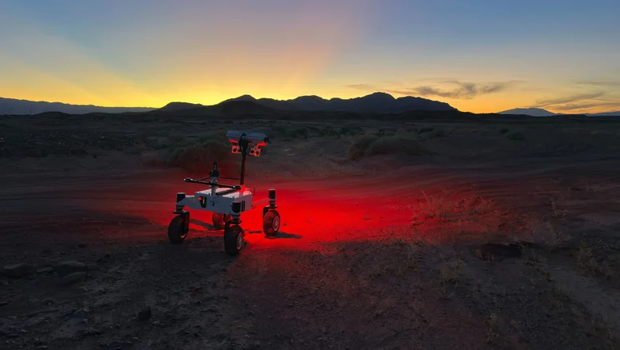
NASA is testing a new rover prototype, Ernest, designed for enhanced mobility on challenging Martian and lunar surfaces, boasting independent wheel control and obstacle-climbing capabilities.
NASA is actively developing and testing a next-generation rover prototype, codenamed Ernest, aimed at overcoming the mobility limitations of current Mars explorers. This new vehicle is engineered to navigate extreme terrains on both Mars and the Moon, offering significant advancements over existing rovers.
Current Mars rovers, while instrumental in scientific discovery, are constrained by their speed and terrain adaptability. For instance, the Perseverance rover, a highly successful explorer, can only reach about 0.16 kilometers per hour on flat ground. This slow pace, coupled with the rugged Martian landscape, complicates mission planning, often necessitating lengthy detours to reach scientifically valuable targets and posing a risk of damage to the rover's wheels.
Ernest, whose full designation is Exploration Rover for Navigating Extreme Sloped Terrain, directly addresses these challenges. Unlike the typical six-wheeled configuration of many Mars rovers, Ernest features a four-wheeled design with a length of approximately 1.2 meters, with plans for a full-scale version to be about twice that size. Its most distinctive capability is the ability to individually lift its wheels, allowing it to “step” over obstacles, ascend inclines, or traverse uneven ground in a manner akin to walking.
During recent tests in Colorado's desert, Ernest logged over 37 hours of operation across seven days, covering roughly 26 kilometers and reaching speeds close to 1 kilometer per hour. While this may seem modest compared to Earth vehicles, it represents a substantial leap for planetary exploration rovers. The prototype is equipped with an active suspension system, a departure from the passive "rocker-bogie" system used for decades. This active system, powered by dual motors in the front, enables various "gait" modes, including crawling, stepping, and climbing, while also allowing for transitions between active and passive suspension to optimize energy consumption.
Furthermore, all four wheels of Ernest are steerable, granting it lateral movement capabilities. This agility is crucial for precise maneuvering in confined spaces, navigating rocky areas, or adjusting position on slopes. NASA's goal is to develop rovers that can autonomously survey larger areas, reducing reliance on Earth-based control teams, especially given communication delays. The Ernest program, initiated in 2022, has explored numerous active suspension configurations and is focusing on enhancing the vehicle's autonomous decision-making.
Ernest represents a crucial evolutionary step in planetary exploration, directly addressing the fundamental constraint of mobility on extraterrestrial surfaces. By enabling "walking" and independent wheel articulation, this prototype moves beyond mere rolling to a more versatile, almost biological, mode of locomotion. This technical leap is vital for expanding humanity's reach across the cosmos. As we transition to becoming a multi-planetary species, vehicles like Ernest are not just tools for scientific curiosity; they are foundational technologies for building self-sustaining outposts. Their ability to conquer extreme terrain accelerates our capacity to explore, map, and ultimately inhabit regions previously deemed inaccessible, pushing the frontiers of our off-world civilization ever outward.
Edited by the news editor with AI and translated into English from the original report — please refer to the original source.