NASA Unveils New Mars Rover Prototype 'Ernest'
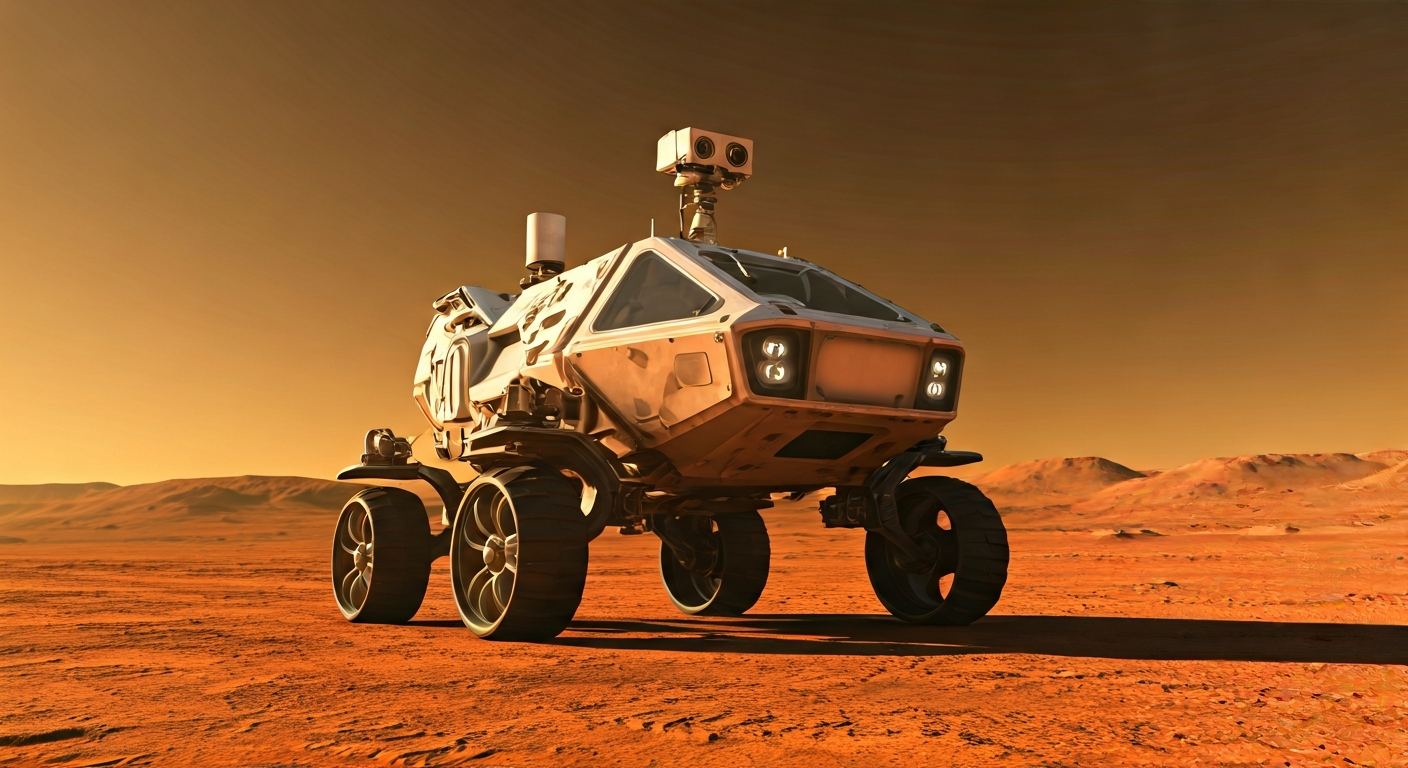
NASA has revealed a new Mars rover prototype named 'Ernest', designed with advanced mobility and sampling capabilities to explore the Martian surface.
NASA has presented a new prototype for a Mars rover, designated "Ernest." This innovative design focuses on enhancing the rover's ability to navigate challenging Martian terrain and collect geological samples.
The "Ernest" prototype incorporates significant advancements in mobility. Its articulated chassis allows for greater flexibility, enabling it to overcome obstacles and traverse slopes that might impede current rover designs. This improved maneuverability is crucial for accessing diverse geological sites on Mars.
In addition to its enhanced locomotion, the rover is equipped with a sophisticated sampling system. This system is designed to collect a wider variety of rock and soil samples with greater precision. The goal is to gather more comprehensive data about Mars's past and potential for supporting life.
NASA's development of "Ernest" is part of its ongoing efforts to refine rover technology for future Mars exploration missions. The prototype represents a step forward in preparing for more ambitious scientific objectives, including the search for biosignatures and the potential for resource utilization.
The 'Ernest' rover prototype, with its advanced articulated chassis and precise sampling mechanisms, represents a crucial step in our multi-planetary expansion. Enhanced mobility and detailed sample collection are foundational for scientifically validating Mars as a viable future home. By demonstrating the capability to navigate complex Martian terrains and gather diverse geological data, 'Ernest' directly contributes to the exponential progress required to establish a self-sustaining Martian civilization. Each such technological leap accelerates our journey toward securing humanity's long-term survival beyond Earth, transforming Mars from a distant world into a second cradle for life and consciousness.
Edited by the news editor with AI and translated into English from the original report — please refer to the original source.