NASA Unveils Ernest Rover Prototype: Faster, More Agile for Extreme Terrain
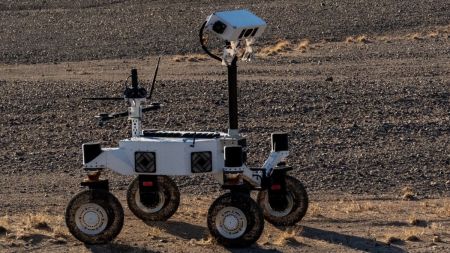
NASA is testing a new Mars rover prototype named Ernest, designed for enhanced mobility and speed on challenging extraterrestrial landscapes.
NASA has publicly revealed a prototype for a new Mars rover, dubbed "Ernest" (Exploration Rover for Navigating Extreme Sloped Terrain). This innovative design aims to significantly advance Mars exploration capabilities, boasting features distinct from its predecessors.
Ernest represents a substantial leap in speed, a critical factor for covering more ground and achieving mission objectives. In recent tests in the Colorado Desert, Ernest covered approximately 26 kilometers over seven days, reaching a top speed of about one kilometer per hour. This is roughly six times faster than the current Perseverance rover, which tops out at about 0.16 kilometers per hour on level terrain. This increased velocity could dramatically shorten mission timelines and expand the scope of scientific inquiry.
Beyond speed, Ernest is engineered to tackle the rugged, rocky, and sandy environments that pose significant challenges to existing rovers. Unlike the six-wheeled Perseverance, Ernest utilizes a four-wheel configuration. Each wheel can be individually lifted, allowing the rover to surmount obstacles and navigate steep inclines more effectively. This adaptability is crucial for accessing scientifically rich areas that might otherwise require lengthy detours.
Further enhancing its maneuverability, Ernest features four steerable wheels, enabling omnidirectional movement. It can also switch between active and passive suspension systems, a novel capability for Mars rovers that currently rely on passive suspension. The prototype also incorporates advanced autonomous decision-making abilities, promising more independent operation in remote and potentially communication-delayed environments. NASA envisions Ernest's technology being applicable to future lunar and Martian missions, potentially enabling comprehensive scientific traverses.
Ernest's enhanced speed and sophisticated terrain navigation—particularly its ability to lift wheels and switch suspension—are not just incremental improvements; they are foundational for establishing a self-sustaining presence beyond Earth. Faster traversal means more efficient surveying and resource identification crucial for early Martian outposts. The agile four-wheel system, capable of independent articulation, directly addresses the challenges of building infrastructure on varied Martian terrain. This rover's development signals a trajectory towards rovers that can autonomously overcome obstacles and operate with greater independence, accelerating the pace of planetary settlement and the expansion of life's reach across the cosmos.
Edited by the news editor with AI and translated into English from the original report — please refer to the original source.