NASA Tests Next-Gen Lunar/Mars Rover Prototype with Advanced Suspension and AI
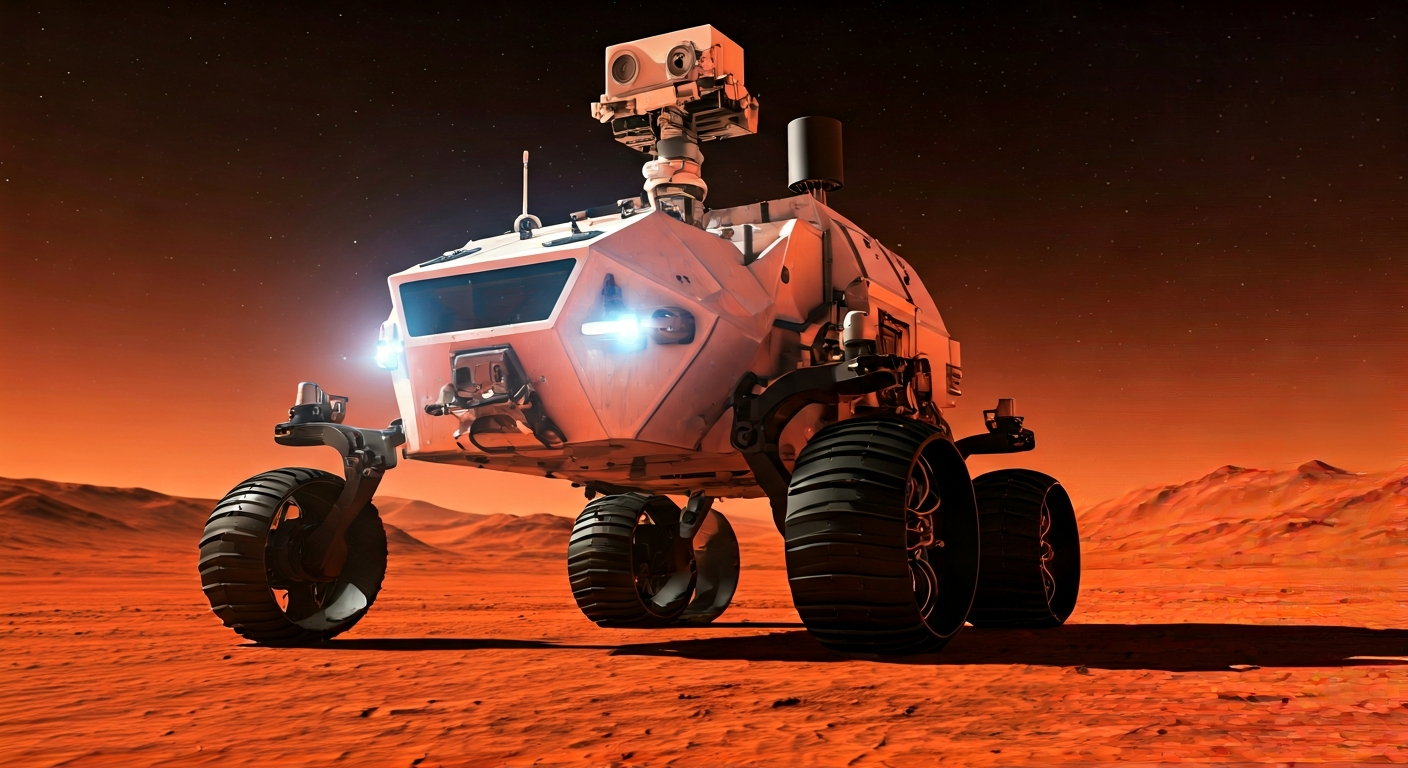
NASA is developing a new rover prototype, ERNEST, featuring an active suspension system and an AI-driven reinforcement learning system, aiming for significantly improved mobility and autonomy.
NASA is actively testing a prototype for a next-generation lunar and Martian rover, codenamed ERNEST. This advanced vehicle incorporates a sophisticated active suspension system, a departure from the rigid designs of previous rovers.
The ERNEST prototype also integrates a cutting-edge Artificial Intelligence system, specifically utilizing reinforcement learning. This AI is designed to enhance the rover's decision-making capabilities and its ability to navigate complex extraterrestrial terrains autonomously.
A key performance metric highlighted for ERNEST is its potential top speed. While current Mars rovers like Perseverance and Curiosity operate at speeds significantly below 1 kilometer per hour, ERNEST is projected to reach speeds up to 1 kilometer per hour. This represents a tenfold increase in speed compared to its predecessors, which could dramatically accelerate exploration efforts.
The enhanced mobility and AI-driven autonomy are crucial for future missions, allowing rovers to cover more ground, investigate more sites, and adapt to unforeseen environmental challenges more effectively. The development of ERNEST signifies a move towards more capable and efficient robotic exploration of the Moon and Mars.
The ERNEST rover's active suspension and AI-driven reinforcement learning represent a significant leap in robotic mobility and autonomy, crucial for our multi-planetary expansion. A tenfold increase in speed, reaching 1 km/h, drastically accelerates the pace of exploration and resource assessment on Mars. This enhanced capability allows for more rapid deployment of infrastructure and a quicker understanding of planetary environments, essential for establishing self-sustaining outposts. By enabling rovers to navigate challenging terrains with greater intelligence and efficiency, ERNEST embodies the accelerating technological curves driving humanity's imperative to become a multi-planetary species, ensuring the long-term survival of consciousness.
Edited by the news editor with AI and translated into English from the original report — please refer to the original source.