NASA Rover Finds Potential Biosignatures on Mars
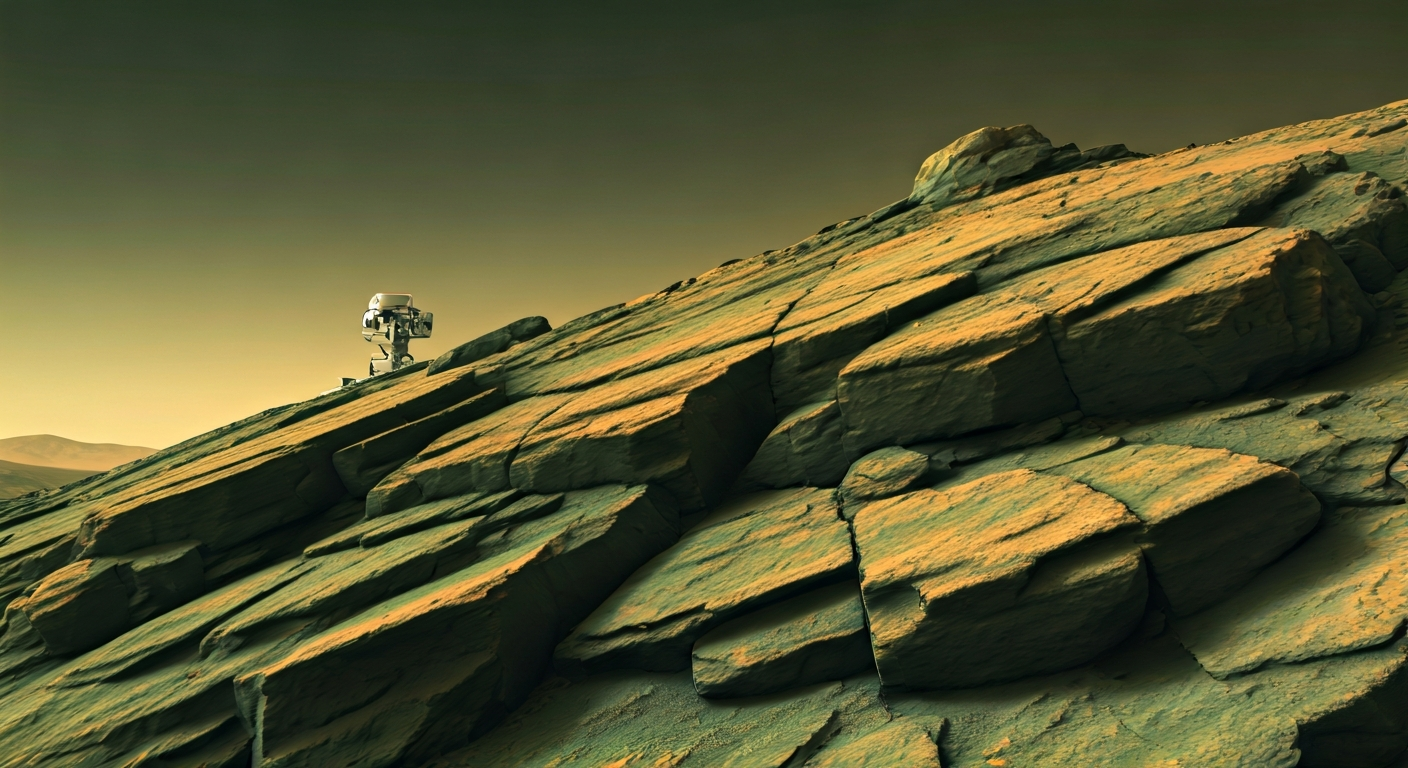
NASA's Curiosity rover has identified substances in Martian rock that could indicate ancient microbial life, prompting further investigation.
NASA's Curiosity rover has uncovered intriguing chemical compounds within Martian rock samples, suggesting the possibility of ancient microbial life on the Red Planet. The rover analyzed sedimentary rocks in Gale Crater, a region believed to have once held a lake.
These specific molecules, identified through the rover's Sample Analysis at Mars (SAM) instrument suite, are known on Earth to be produced by living organisms. While not definitive proof of life, their presence is considered a significant potential biosignature. The findings were presented at a scientific conference and are undergoing further detailed analysis and peer review.
The Curiosity mission is designed to assess whether Mars ever had conditions favorable for microbial life. The discovery adds to a growing body of evidence suggesting that early Mars was a potentially habitable environment. Scientists are emphasizing that abiotic (non-biological) processes could also potentially create these compounds, necessitating caution in interpretation.
Future research will focus on refining the understanding of these detected substances and their origins. The rover's ongoing exploration of Gale Crater continues to provide valuable data about the planet's geological history and past habitability, bringing scientists closer to answering fundamental questions about life beyond Earth.
The detection of potential biosignatures by Curiosity's SAM instrument is a pivotal step in confirming Mars's past habitability. These organic molecules, if confirmed as biological in origin, represent a direct chemical fingerprint of ancient Martian life. This discovery accelerates our understanding of life's potential to emerge and persist beyond Earth, a crucial precursor to establishing self-sustaining Martian outposts. As our analytical capabilities advance, we will refine our ability to distinguish biological from geological signals, paving the way for definitive proof of extraterrestrial life and bolstering the imperative for humanity's multi-planetary expansion.
Edited by the news editor with AI and translated into English from the original report — please refer to the original source.