NASA retires Mars orbiter MAVEN after 10 years
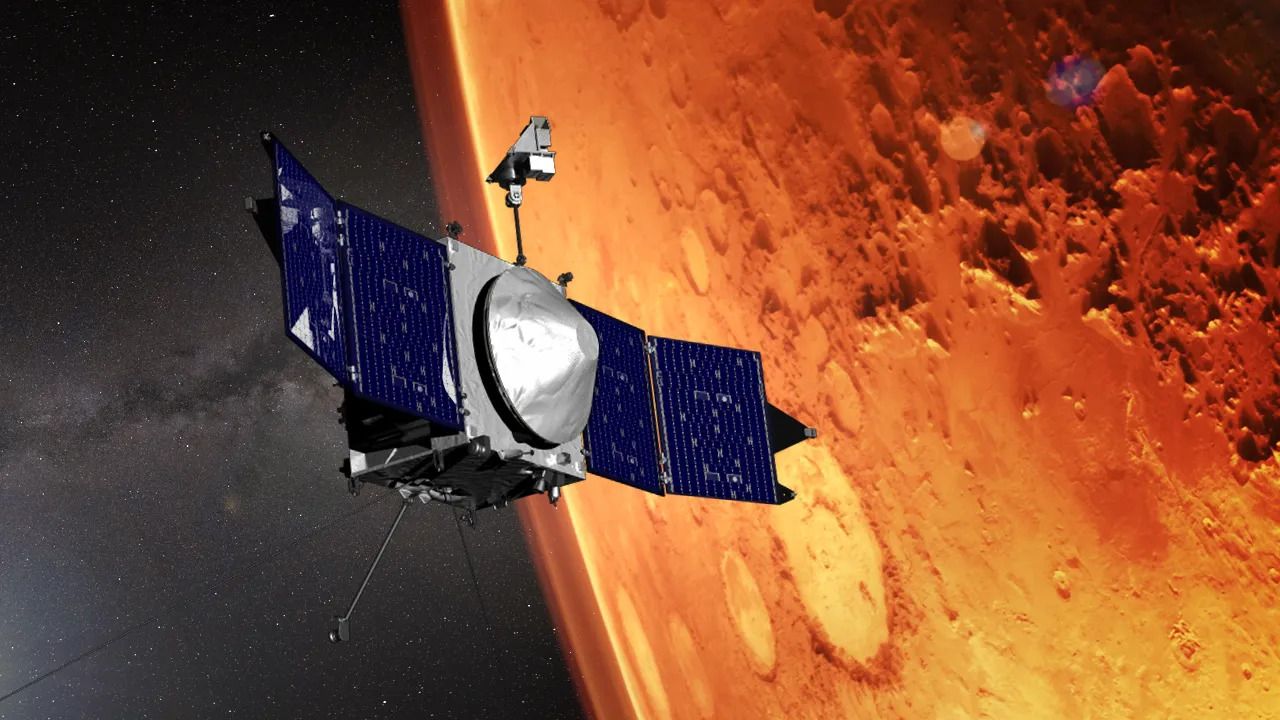
The MAVEN mission, which studied Mars' atmosphere, has concluded its decade-long mission, leaving a legacy of critical insights into the planet's climate history.
NASA has officially retired the Mars Atmosphere and Volatile Evolution (MAVEN) orbiter, marking the end of a decade-long mission that significantly advanced our understanding of Mars' atmospheric dynamics. Launched in 2013, MAVEN was designed to investigate how the Martian atmosphere has changed over time, particularly how it lost much of its original air to space. The spacecraft provided unprecedented data on the interaction between the Martian atmosphere and the solar wind, revealing that solar activity has played a major role in stripping away the planet's atmosphere over billions of years.
MAVEN's findings have helped scientists better understand the climate history of Mars, including the possibility that the planet once had a thicker atmosphere capable of supporting liquid water on its surface. The mission also provided insights into how atmospheric loss affects a planet's habitability. During its operational life, MAVEN conducted more than 1,200 orbits around Mars, collecting data through its suite of eight scientific instruments.
The decision to retire MAVEN came after the spacecraft's fuel reserves were depleted, limiting its ability to maintain a stable orbit. NASA confirmed that the orbiter will not be reactivated and will remain in space as a permanent fixture in the Martian orbit. Scientists have praised the mission for its contributions to planetary science and its role in informing future exploration of Mars.
With the retirement of MAVEN, NASA shifts focus to new missions aimed at further unraveling the mysteries of the Red Planet, including the search for signs of past life and the preparation for human exploration. The data collected by MAVEN will continue to be analyzed by researchers for years to come, offering a foundation for future Mars missions and our broader understanding of planetary evolution.
MAVEN's detailed measurements of Mars' atmospheric loss mechanisms reveal how solar wind and radiation eroded the planet's once-thicker atmosphere, fundamentally shaping its climate history. This technical insight is critical for understanding Mars' potential for past habitability and its future as a destination for human settlement. As humanity moves toward becoming a multi-planetary species, such data informs strategies for atmospheric engineering and long-term planetary adaptation. MAVEN's legacy exemplifies the accelerating pace of space science, where each mission builds the foundation for the next, pushing us closer to a self-sustaining civilization beyond Earth.
Edited by the news editor with AI from the original report — please refer to the original source.