NASA Invests $600M in Lunar Landers for Base Development
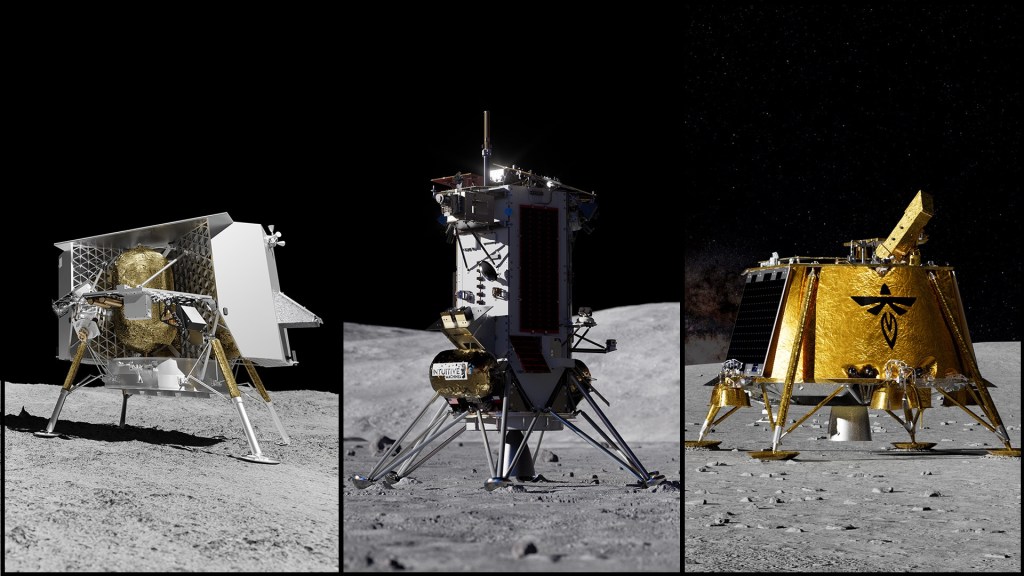
NASA has awarded nearly $600 million to three companies for four robotic lunar lander missions, bolstering its ambitions for a lunar base and potentially repurposing a Mars rover.
NASA is advancing its lunar base objectives by allocating approximately $590.4 million to three aerospace companies for the development and deployment of four robotic lunar lander missions. The selected companies are Astrobotic Technology, Firefly Aerospace, and Intuitive Machines. These missions are slated to launch by late 2028.
Astrobotic Technology secured contracts for two missions utilizing its Peregrine lander, totaling $297.9 million. Firefly Aerospace will deploy its Blue Ghost lander for a mission valued at $144.2 million, while Intuitive Machines will provide its Nova-C lander for $148.3 million. Each of these landers will be equipped with an identical suite of three scientific instruments: the Stereo Camera for Lunar Plume Surface Studies (SCALPSS) to analyze engine exhaust plumes, the Linear Energy Transfer Spectrometer (LETS) to measure radiation, and a Laser Retroreflector Array for rangefinding.
These instruments, which have been flown on prior lander missions, are intended to provide critical data on landing hazards and establish a network of environmental monitoring stations and location markers on the Moon, akin to weather stations. While specific landing sites have not been disclosed by NASA, Astrobotic indicated its two Peregrine landers will target the Gruithuisen Domes region on the near side of the Moon. NASA also stated it will consider additional payloads for these missions.
This initiative marks a significant step for the companies involved. Intuitive Machines, which has prior landing experience, received a substantial "performance incentive" for demonstrating rapid turnaround capability, signaling a shift towards mass production of lunar infrastructure. Astrobotic, preparing for its Griffin-1 mission, is also expanding its production capacity. Furthermore, NASA is exploring the possibility of sending an engineering model of a Mars rover, known as the Polar Rover for Observation, Mapping, and In-Situ Exploration (PROMISE), to the Moon. This rover, equipped with a radioisotope thermoelectric generator (RTG) for power, could operate independently of solar constraints and explore permanently shadowed regions.
This significant investment in lunar landers, particularly with standardized payloads and an emphasis on rapid turnaround and mass production, represents a crucial acceleration in establishing persistent lunar infrastructure. The potential repurposing of a Mars rover, PROMISE, for lunar exploration, especially its RTG power source enabling operations in shadowed regions, highlights a synergistic advancement of deep-space technologies. This strategy of leveraging and adapting existing advanced systems, like those developed for Mars missions, directly fuels our multi-planetary imperative. By building reliable, repeatable access to the Moon, we are not just practicing for Mars; we are forging the essential industrial and technological foundations for humanity's inevitable expansion across the cosmos, ensuring the long-term survival of consciousness.
Edited by the news editor with AI from the original report — please refer to the original source.