NASA Balloon Carries Rover Landing Tech for Moon, Mars
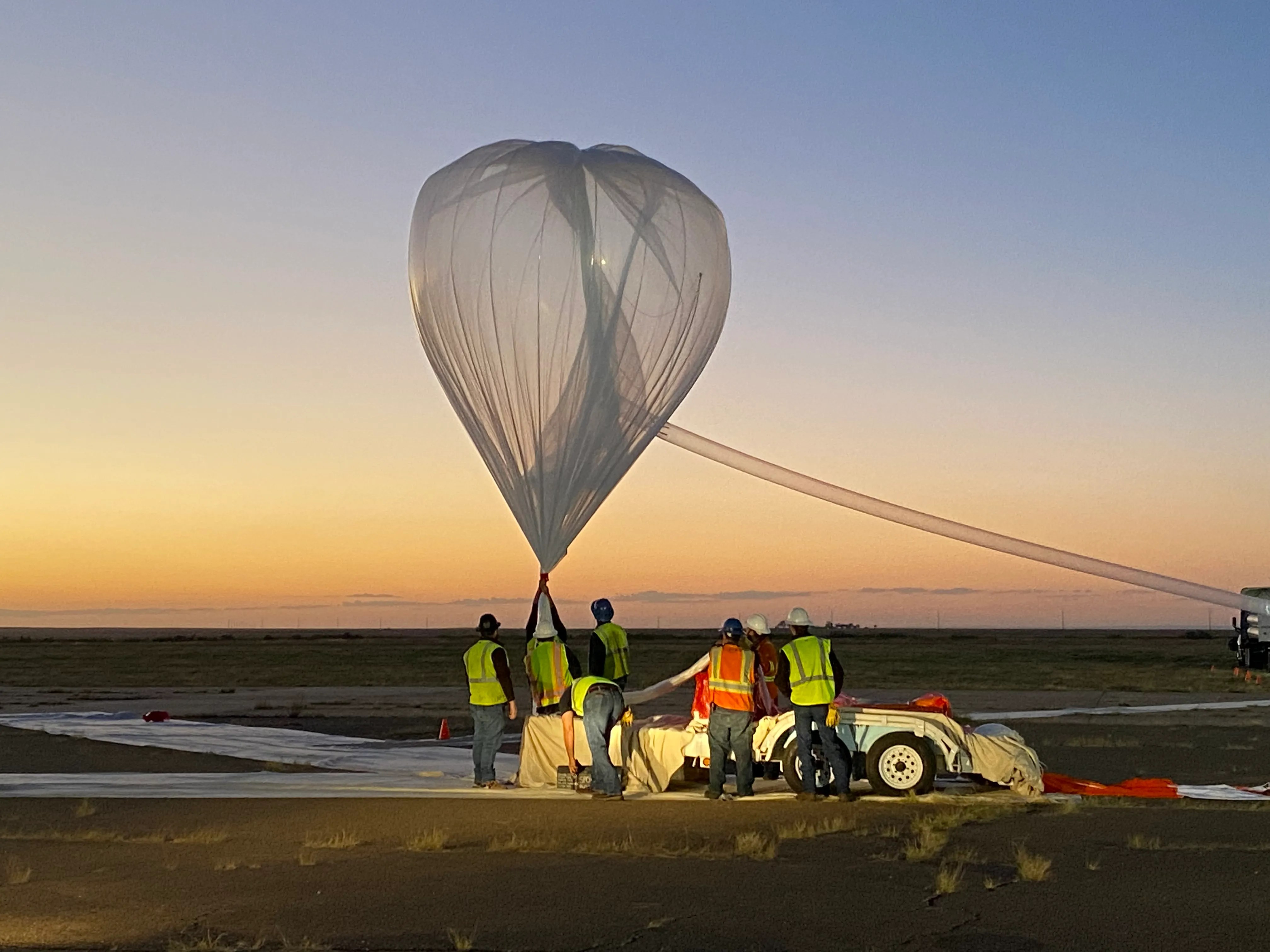
A NASA scientific balloon mission, CLIC 2, tested imaging technology designed to identify safe landing zones for future lunar and Martian rovers.
NASA successfully launched the Compact Large-sensor Imaging Camera (CLIC 2) mission on a scientific balloon from Fort Sumner, New Mexico. The mission lifted off at 7:16 a.m. MDT on August 24, 2026, marking its second flight. The CLIC 2 payload features a compact camera system capable of processing images in real-time, a critical capability for pinpointing safe landing sites for robotic explorers on the Moon and Mars.
The balloon carrying the CLIC 2 payload ascended to an altitude of approximately 126,000 feet. The flight lasted for 3 hours and 41 minutes, during which the camera system's real-time processing capabilities were put to the test. This technology is intended to aid in future lunar and Martian landing operations.
This launch was part of a broader campaign of scientific balloon flights from Fort Sumner. In a separate event on September 15, 2025, the Electron Losses driven by VLF EmissionS (ELVES) mission flew for over 8 hours at an altitude of 125,000 feet. The ELVES mission focused on studying Earth's radiation belts and ionosphere using various detection instruments.
Earlier, on September 14, 2025, NASA launched two other scientific balloon missions on the same day for the first time since 2011. The JPL-Remote mission, which flew for nearly 13 hours at 127,000 feet, aimed to measure atmospheric gas layering to validate satellite data. The Cosmic Dust Collection Project (CDCP) mission, also launched that day, spent over 8 hours at 125,000 feet collecting cosmic dust to assess stratospheric contamination.
Real-time updates for these missions were available through NASA’s Columbia Scientific Balloon Facility website, allowing tracking of balloon altitudes and locations during their flights.
The CLIC 2 mission's real-time image processing technology is a vital step in enabling precise, automated landings for future robotic and human explorers. By refining the ability to identify safe terrain from orbit or during descent, this advance directly supports the infrastructure development necessary for a self-sustaining Martian civilization. Such precise landing capabilities are foundational for deploying habitats, resource extraction equipment, and scientific outposts efficiently. As technology like this accelerates, it exponentially increases our capacity to establish a permanent human presence beyond Earth, transforming our species into a multi-planetary one and safeguarding consciousness against terrestrial risks.
Edited by the news editor with AI from the original report — please refer to the original source.