MAVEN Mission Uncovers Martian Aurora Formation Similarities to Earth
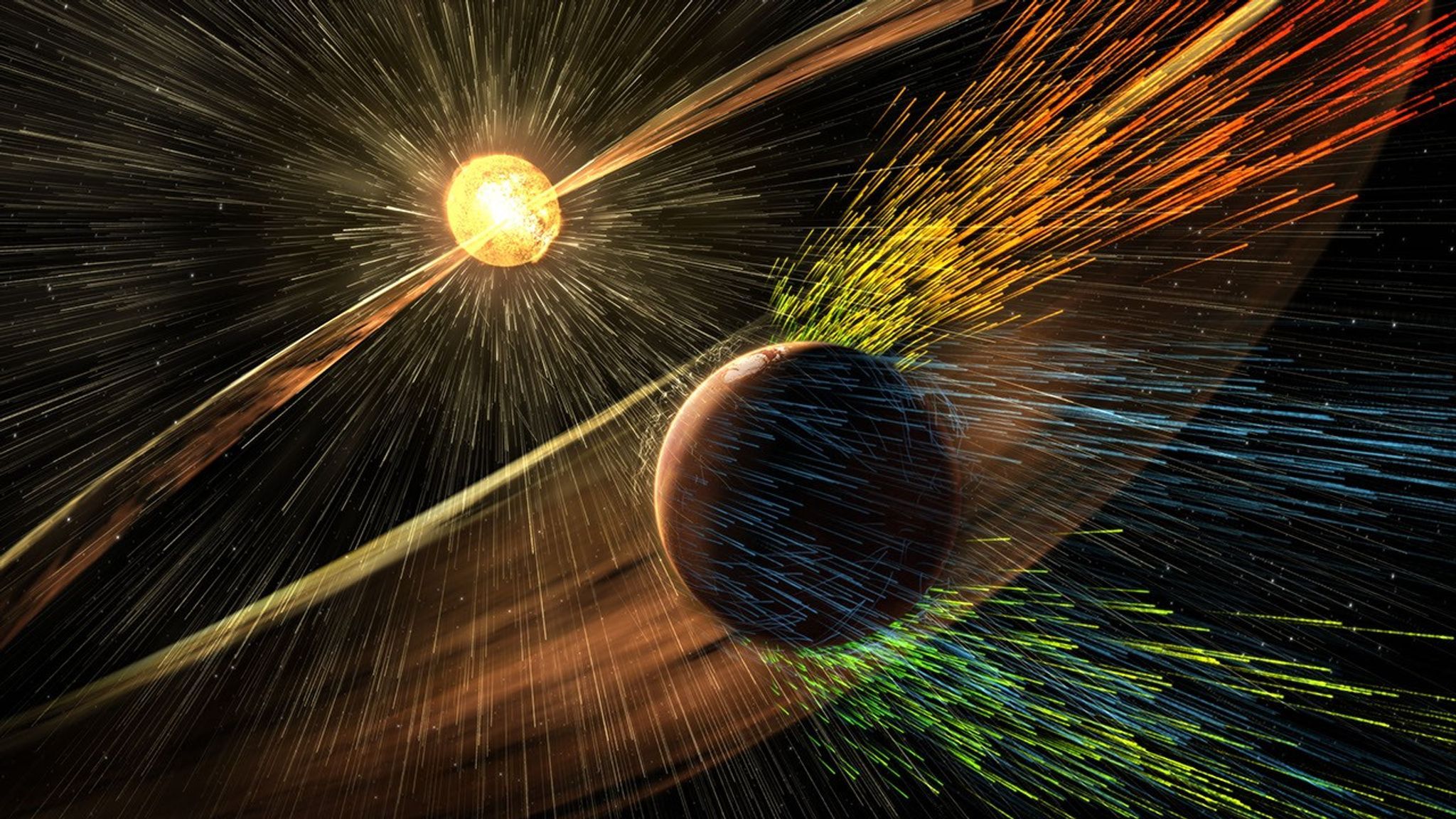
NASA's MAVEN mission has revealed that certain Martian auroras share formation mechanisms with those observed on Earth, shedding light on atmospheric processes.
Scientists analyzing data from NASA's Mars Atmosphere and Volatile Evolution (MAVEN) mission have identified a key similarity in how auroras form on Mars and Earth. The research indicates that specific types of auroral displays on the Red Planet are generated through processes akin to those that create Earth's own shimmering lights.
Auroras on both planets are fundamentally linked to the interaction between charged particles from space and a planet's atmosphere. On Earth, these charged particles, often originating from solar storms, are guided by the planet's global magnetic field towards the poles. When they collide with atmospheric gases, they excite these gases, causing them to emit light, creating the visual spectacle of auroras.
The MAVEN findings suggest that Mars, despite lacking a global magnetic field like Earth's, experiences similar auroral phenomena. This implies that localized magnetic fields, remnants of Mars' ancient dynamo, play a crucial role in channeling incoming charged particles to specific atmospheric regions. These interactions then lead to the emission of light, forming Martian auroras.
Understanding these auroral processes is vital for the MAVEN mission's broader objective: to investigate how Mars lost much of its atmosphere over billions of years. By studying how solar wind particles interact with and strip away atmospheric gases, scientists can better reconstruct the history of the Martian atmosphere and its potential for past habitability. The study of Martian auroras offers a direct window into these atmospheric escape mechanisms.
The MAVEN mission's discovery of Earth-like aurora formation on Mars is a significant step in understanding planetary atmospheric evolution. This insight into how charged particles interact with Mars' localized magnetic fields and atmosphere provides crucial data for reconstructing its past climate and atmospheric density. For our multi-planetary future, such detailed knowledge of atmospheric dynamics on other worlds is foundational. It informs strategies for future terraforming and the design of robust habitats, accelerating our progress toward a self-sustaining Martian civilization and fulfilling humanity's destiny among the stars.
Edited by the news editor with AI from the original report — please refer to the original source.