MAVEN Data Reveals Martian Auroras Mimic Earth's Dungey Cycle
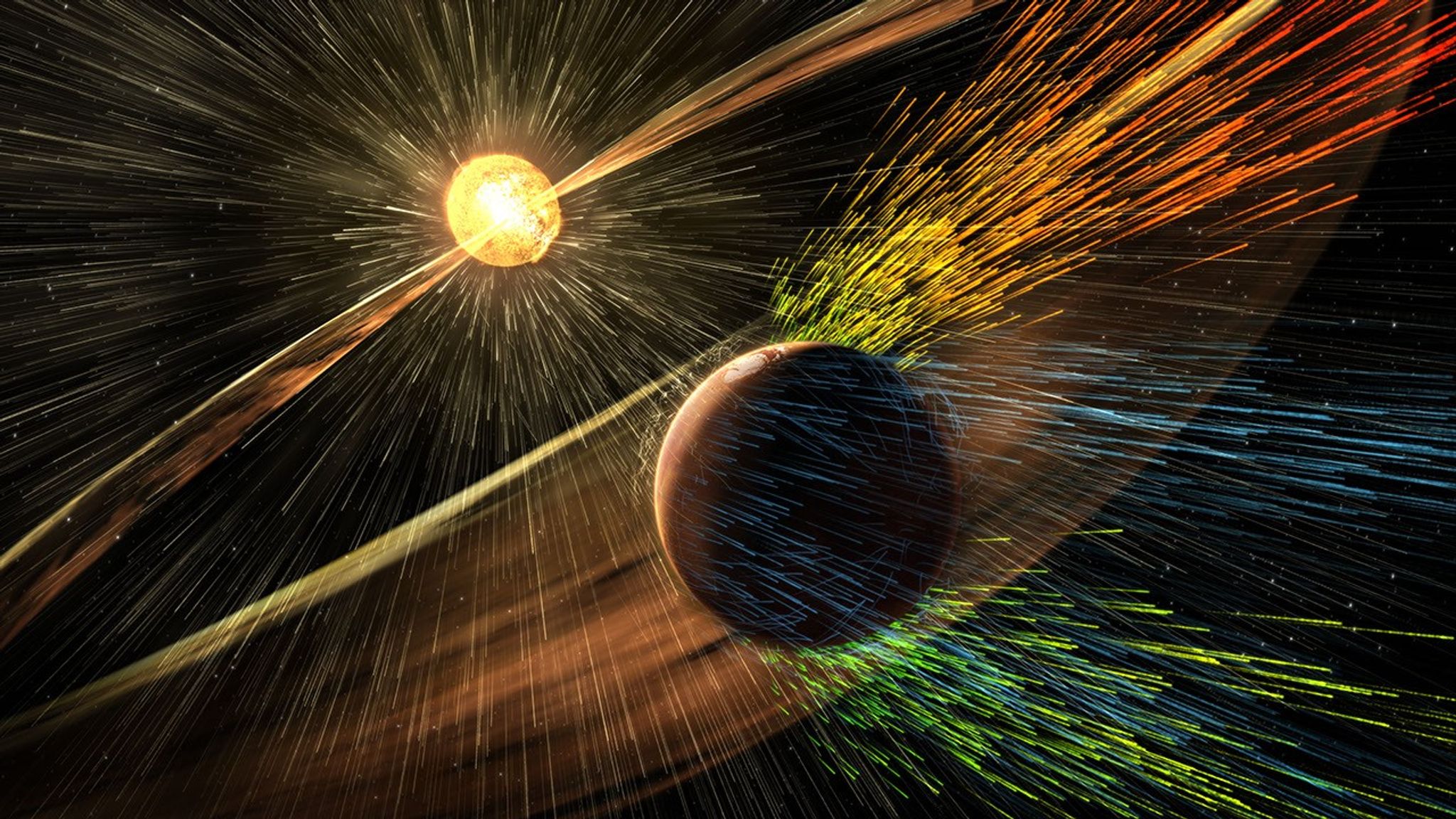
New analysis of data from NASA's MAVEN mission shows that localized auroras on Mars are generated by a miniature version of the same process responsible for auroras on Earth, known as the Dungey cycle.
Scientists analyzing data from NASA's Mars Atmosphere and Volatile Evolution (MAVEN) mission have identified a key mechanism behind certain Martian auroras. The findings, published in Nature Communications, indicate that these light displays on Mars are generated through a process similar to Earth's auroras, specifically the Dungey cycle.
On Earth, the Dungey cycle involves the reconnection of magnetic field lines from the Sun with our planet's magnetosphere. This event injects energy and plasma, ultimately accelerating electrons that strike the atmosphere, creating auroras. The MAVEN study reveals that a smaller-scale version of this cycle is occurring over Mars' localized crustal magnetic fields.
Unlike Earth's global magnetic field, Mars lacks a comprehensive magnetosphere. Instead, it possesses numerous smaller magnetic fields embedded in its crust, remnants of an ancient global field that dissipated over billions of years. These crustal fields, formed when lava cooled, are now sites where MAVEN has observed highly localized auroras.
The MAVEN spacecraft, using instruments such as the Magnetometer, Solar Wind Electron Analyzer, and STATIC, gathered crucial data. These instruments helped scientists map the magnetic configurations, calculate electrical currents, and measure plasma flows within the Martian ionosphere, providing the evidence for the Dungey-like cycle.
This discovery not only clarifies the physics behind Martian auroras but also demonstrates that the Dungey cycle mechanism can operate across vastly different scales. Understanding these processes is vital for comprehending the Red Planet's evolution and its interaction with the solar environment, which is critical for future robotic and human exploration.
The MAVEN mission's identification of a miniature Dungey cycle driving Martian auroras is a profound validation of universal physical principles. It demonstrates that the fundamental mechanisms governing plasma and magnetic field interactions are consistent, whether on Earth's vast magnetosphere or Mars' localized crustal fields. This finding is a crucial step in understanding planetary evolution and the conditions necessary for life. For Mars, this means a deeper grasp of its atmospheric loss and surface interaction, essential knowledge for terraforming and establishing a self-sustaining civilization. The Dungey cycle's scalability across planetary magnetic field configurations suggests its ubiquitous presence, paving the way for further exploration and the eventual expansion of intelligence and life beyond Earth.
Edited by the news editor with AI from the original report — please refer to the original source.