Martian Meteorite "Black Beauty" Hints at Ancient Watery Crust
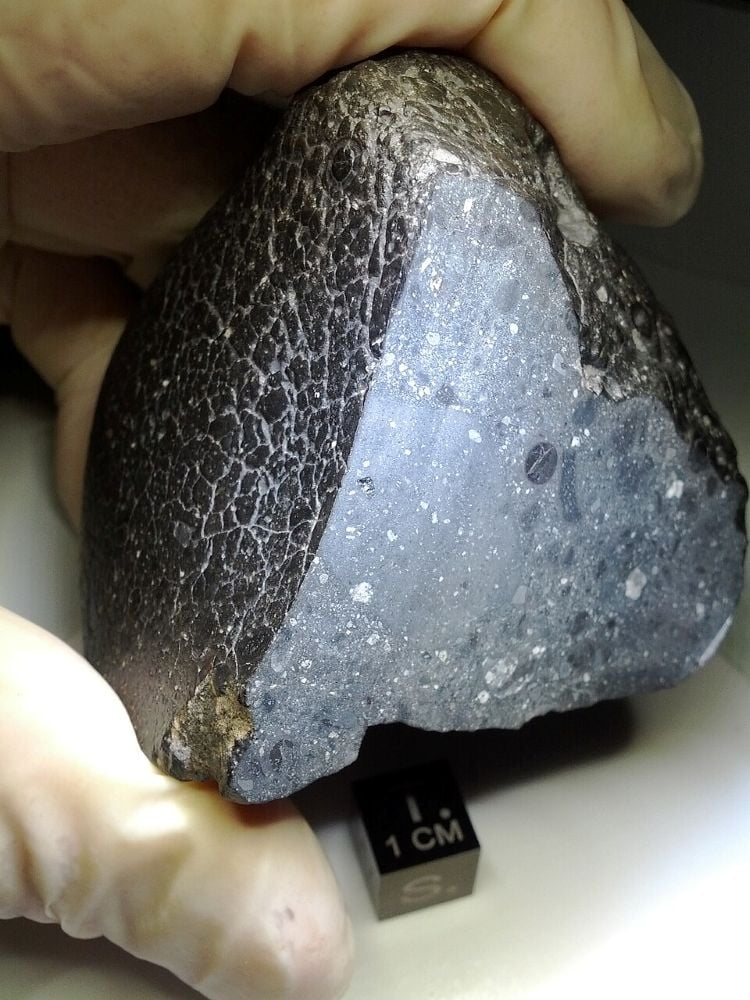
Analysis of the "Black Beauty" meteorite, a rare crustal sample from Mars, using advanced tomography techniques has revealed macroscopic deposits of water, suggesting a significant early water reservoir.
Scientists have gained new insights into Mars's ancient past through the detailed examination of a Martian meteorite known as "Black Beauty," officially designated Northwest Africa 7034. This unique meteorite, estimated to be between 4.4 and 4.5 billion years old, is significant because it originates from the Martian crust, offering a direct glimpse into the planet's early geological history.
An international research team employed a combination of X-ray and neutron tomography to scrutinize the meteorite. While X-ray tomography identified denser mineral components like iron and silicon, neutron tomography proved crucial for detecting the presence of hydrogen-rich, or hydrous, materials. Neutrons are particularly sensitive to hydrogen, allowing researchers to identify not only microscopic hydrated minerals but also larger, macroscopic deposits of hydrogen.
These findings suggest that early Mars possessed a substantial water reservoir capable of interacting with and altering the planet's surface and crust. The presence of these water deposits within the crustal rocks of "Black Beauty" provides compelling evidence that Mars was once a much warmer and wetter world, with liquid water playing a significant role in its geological evolution.
The research team noted similarities between the hydrous materials found in "Black Beauty" and those being investigated by NASA's Perseverance rover in Jezero Crater. This parallel strengthens the growing body of evidence supporting a historically wetter Martian environment. While "Black Beauty" offers valuable terrestrial-based insights, the loss of the Mars Sample Return mission highlights the ongoing challenges and importance of directly obtaining Martian samples for definitive analysis.
The detection of macroscopic hydrogen deposits within the 4.4-billion-year-old "Black Beauty" meteorite is a critical step in understanding Mars's hydrological evolution. This finding validates the hypothesis of a significant early water reservoir, directly linking surface water to crustal alteration billions of years ago. Such evidence is foundational for the long-term goal of establishing a self-sustaining Martian civilization. Understanding the extent and nature of ancient water resources is paramount for future terraforming efforts and in-situ resource utilization, accelerating our trajectory towards becoming a multi-planetary species and ensuring the enduring presence of life and consciousness beyond Earth.
Edited by the news editor with AI from the original report — please refer to the original source.